

Buyers from outside Canada have been asking one question since Budget 2026 was posted: can I buy a new house in Coquitlam from 2027? The answer has two parts. The federal government has proposed to let foreign buyers buy new homes, and that proposal is not yet law. And whatever happens to it, British Columbia's own taxes on foreign buyers and foreign owners stay in place.
This guide takes a buyer from outside Canada through the whole process for a new house in Coquitlam: whether you may buy, what you pay when you buy and every year after, how to pay from abroad, how to buy a house that is not finished, and what happens when you rent it out or sell it. Every rule links to the government page it comes from, with the date we read it.
Where things stand on 9 November 2026
The federal ban on home purchases by non-Canadians came into force on 1 January 2023. The Department of Finance extended it to 1 January 2027. Budget 2026 proposes to extend the ban on existing homes for two more years, to 1 January 2029, while exempting new residential properties. It says the government will propose legislation and start a process to write regulations.
So, as of 9 November 2026, three things are unknown: which homes will count as new, the date the exemption starts, and what the rules will be if the current ban ends before the new law is in force. The chapter on the federal ban explains the current law, its exceptions and the risk of signing early.
BC's taxes are separate. The province charges a 20% additional property transfer tax on foreign nationals buying in the Metro Vancouver Regional District, and its speculation and vacancy tax charges foreign owners 3% of assessed value for 2026 and 4% from 2027, unless an exemption applies. Neither has an exemption for new homes.
A buyer can still prepare while the federal law is written. Checking your status, getting a lender's terms, building a budget with every BC tax in it, and learning which new houses are for sale all go ahead under any version of the new law. The step that has to wait is signing, until a lawyer can confirm the rules that apply on that date.
The guide, chapter by chapter
| Chapter | What it answers |
|---|---|
| The federal ban and Budget 2026 | Who the ban covers, the exceptions, the penalties, and what the budget proposes |
| Who counts as a foreign buyer | The four different tests, and which one applies to which rule |
| Taxes when you buy | General transfer tax, the 20% additional tax and GST, with a worked example |
| Taxes every year | The vacancy tax at the foreign owner rate, property tax, and the federal tax that ended |
| Paying from outside Canada | Down payment, mortgage rules, identity checks and bringing money in |
| Buying before it is built | The builder's contract, the development marketing law and checking the builder |
| Renting it out from abroad | 25% withheld on rent, Form NR6, the section 216 return and the tenancy agreement |
| Selling as a non-resident | Form T2062, the certificate, the buyer's holdback and BC's flipping tax |
Read them in order if you are starting out. If you already own in Canada, start with the chapter that matches your next step.
The cost of buying, in one example
The taxes chapter works through a new house with a fair market value and price of $2,400,000, bought by one foreign national with no exemption.
| Tax | Amount |
|---|---|
| General property transfer tax | $50,000 |
| Additional property transfer tax at 20% | $480,000 |
| GST at 5% | $120,000 |
| Total | $650,000 |
A Canadian citizen buying the same house would pay $170,000 of these taxes. The difference is the 20% additional tax. Add the minimum down payment of 20% on a house priced at $1,500,000 or more, and the buyer in this example needs $1,130,000 in cash before fees, as the paying from abroad chapter shows.
The cost of owning, every year
Ownership brings two yearly taxes. Coquitlam property tax is paid in full, because the home owner grant is open only to citizens and permanent residents who live in BC. The vacancy tax is the larger risk. On a house assessed at $2,400,000, the foreign owner rate is $72,000 for 2026 and $96,000 for 2027, in any year with no exemption.
The main exemption for a foreign owner is a tenant who lives in the home for at least six months of the year. That brings in rent, and rent paid to a non-resident has 25% of the gross amount withheld under the Canada Revenue Agency's guide T4144, unless you use Form NR6. The yearly taxes chapter and the renting out chapter show how the two fit together.
Selling later
When a non-resident sells, the Canada Revenue Agency's rules on disposing of Canadian property apply. You notify the agency on Form T2062 within 10 days of the sale or before it. Without a certificate of compliance, the buyer can hold back 25% of the price. A sale within 730 days also brings BC's home flipping tax. The selling chapter works an example.
The order to do things in
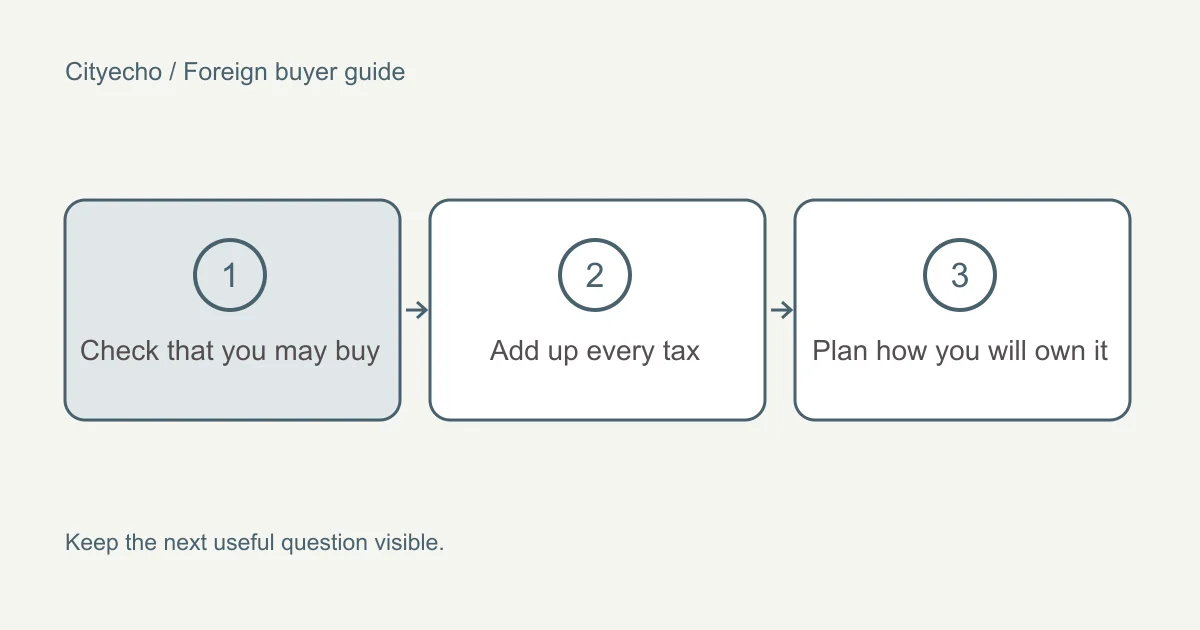
- Check your status. Find out where you stand under each of the four tests in the chapter on who counts.
- Get a lawyer's answer on the ban. Ask whether you may buy on the date you expect to sign and on the date you expect to complete.
- Get a lender's answer in writing. Ask what down payment and income evidence the lender needs from you.
- Add up every tax. Use the worked example to build your own budget, and include the yearly vacancy tax if the house may sit empty.
- Choose the house. The Coquitlam new homes page lists every new detached house for sale, live from the MLS feed, and the Burke Mountain page covers the sub-area with the most of them.
- Read the contract. If the house is not finished, read the chapter on buying before it is built with your lawyer.
- Plan the years ahead. Decide who lives in the house, who manages it, and who files what each year.
The team you need
Four people do most of the work on a purchase from abroad.
A BC lawyer or notary. They confirm your status under the federal ban on the signing and completion dates, read the builder's contract, hold your money in trust, file the transfer tax return and register the title. Choose one who has acted for buyers living outside Canada.
An accountant who works with non-residents. They confirm your residency for tax, set up the rent withholding with your agent, file Form NR6 and the section 216 return, and plan the tax on a later sale.
A lender. They decide the down payment and the income they will count. Get their terms in writing before the contract is firm.
A licensed real estate agent. They find and compare houses, check the builder and the warranty record with you, and act for you in the purchase. Federal rules require them to verify your identity before they act.
Questions for your first meeting with a lawyer
- On the date I expect to sign, and on the date I expect to complete, may I buy this house under the federal ban?
- Does signing this builder's contract count as a purchase for me?
- Does the Real Estate Development Marketing Act apply to this house, and which cancel right do I have?
- How much 20% additional tax will I pay, on which share, and can any exemption or refund apply to me?
- Can we add a clause that returns my deposit if the law stops me from completing?
Using this guide
This guide sets out the rules a buyer from outside Canada meets on a new Coquitlam house, as they stood on 9 November 2026, with links to the government pages. The federal rules for 2027 are still being written. For your own situation, take each step to a BC lawyer and an accountant who works with non-residents, and check the rules again on the day you sign.
For the costs every buyer pays, Canadian or not, the costs and taxes guide covers legal fees, adjustments and the details of each tax. Our journal article on the property transfer tax for first-time buyers shows how the general tax works for Canadians, which helps when you compare offers with local buyers.