

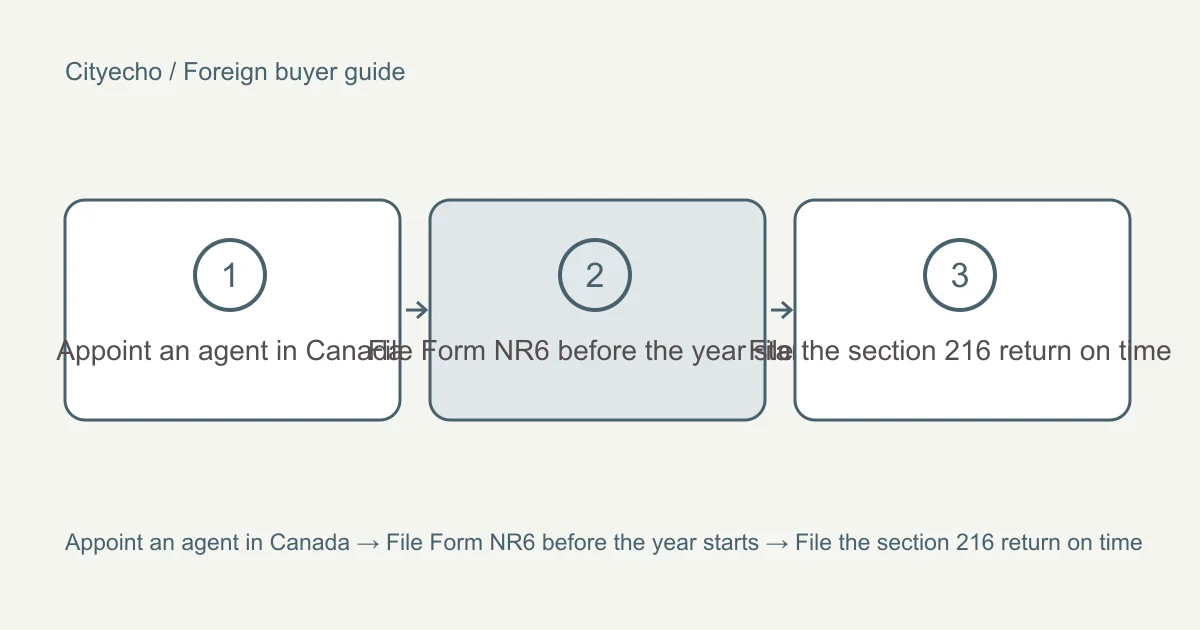
A house that sits empty costs a foreign owner the vacancy tax every year. A house rented to a qualifying tenant for at least six months of the year can avoid that tax, and brings Canadian income tax on the rent instead. Rent paid to an owner who lives outside Canada has its own withholding rules, a form that reduces the amount withheld, and a return with a fixed deadline. A BC tenancy agreement also has to name someone the tenant can reach. All of it is part of our foreign buyer guide.
The vacancy tax itself is covered in the yearly taxes chapter. Whether you count as a non-resident is covered in the chapter on who counts.
The 25% withheld on gross rent
The Canada Revenue Agency's guide T4144, revision 25, says the payer or agent, such as the property manager, must withhold non-resident tax of 25% on the gross rental income paid or credited to a non-resident. The agent must be a resident of Canada.
The agency's page on electing under section 216, modified on 20 January 2026, says the tax withheld is usually your final tax obligation to Canada on that rent. Filing a separate return is optional.
On gross rent the 25% is charged before any expenses. A house rented at $5,000 a month brings $60,000 a year, and $15,000 is withheld. Property tax, insurance, repairs and mortgage interest do not reduce that amount under the default rule.
Paying on net rent instead
There are two ways to pay tax on net rent. Both depend on paperwork done on time.
Form NR6. Guide T4144 says you and your agent complete Form NR6 and send it to the agency on or before 1 January of each year, or before the first rental payment is due. Once the agency approves it, the agent may withhold 25% on your net rental income. Until approval arrives in writing, the agent keeps withholding on gross rent.
The section 216 return. This is a separate Canadian return on which you report your rental income and expenses and pay tax on the net amount. If more tax was withheld than the return shows is owed, the agency refunds the difference. Without NR6, filing it is optional and is done after the year ends to recover some of the 25% withheld on gross rent.
| Default | With approved NR6 | |
|---|---|---|
| Withheld during the year | 25% of gross rent | 25% of estimated net rent |
| Section 216 return | Optional | Required |
| Deadline for the return | Within 2 years after the year ends | 30 June of the next year |
| If the return is late | The 25% on gross rent stays as the final tax | The election is invalid and tax applies to gross rent |
The deadlines
The agency's page on when to file sets the dates. Generally, the section 216 return is due within 2 years from the end of the year the rent was paid or credited, which for 2025 rent was 31 December 2027. If the agency approved your Form NR6 for the year, the return is due on or before 30 June of the next year, which for 2025 was 30 June 2026.
Missing the earlier date after using NR6 is costly. The agency says the election then becomes invalid and you are subject to non-resident tax on your gross rental income. If the right tax was not withheld at source, the agency issues the assessment to your agent. Your agent will want to see the return filed on time for that reason.
A worked example
Take a new house rented for $5,000 a month, or $60,000 a year, with $40,000 a year of expenses that an accountant agrees can be claimed. Net rent is $20,000.
| Default | With approved NR6 | |
|---|---|---|
| Gross rent | $60,000 | $60,000 |
| Base for withholding | $60,000 | $20,000 |
| Withheld at 25% | $15,000 | $5,000 |
Under the default, $15,000 is withheld and that may be the end of it. With NR6, $5,000 is withheld, and the section 216 return then works out the final tax on the net income. The figures here are an example only. An accountant who works with non-resident landlords sets the real numbers.
The dates follow from the same rules. Say you complete a purchase in spring 2027 and a tenant moves in on 1 June 2027. Form NR6 for 2027 must reach the agency before the first rent payment is due, so it has to be sent in May 2027, and your agent withholds on gross rent until the approval arrives in writing. Because you used NR6, the section 216 return for 2027 is due by 30 June 2028. For 2028, the next Form NR6 is due on or before 1 January 2028. Put each date in a calendar the day you sign the tenancy agreement.
The tenancy agreement
A tenancy of a house in BC is governed by the Residential Tenancy Act. Section 13 says a tenancy agreement must set out, among other things, the correct legal names of the landlord and tenant, and the address for service and telephone number of the landlord or the landlord's agent. Within 21 days after the agreement is made, the landlord must give the tenant a copy.
For an owner abroad, the agent's address and telephone number answer that requirement and give the tenant someone in BC to contact. Agree in writing with the agent who handles repairs, rent collection, notices and the tax withholding. Our journal article on buying a tenanted home explains the tenant's rights if you ever sell with a tenant in place.
Renting and the vacancy tax
The province's exemptions page for individuals lists an exemption where a tenant, including a non-arm's length tenant, occupies the owner's home for at least six months of the calendar year and the tenancy requirements are met. For a foreign owner the rate is 3% of assessed value for 2026 and 4% from 2027. On a house assessed at $2,400,000, the exemption is worth $96,000 for 2027, against the $15,000 withheld on gross rent in this chapter's example.
So renting does two jobs. It brings income, which is taxed under the rules above, and it can remove the vacancy tax for the year. Plan both together, and keep the tenancy agreement and rent records for every year you claim the exemption.
Short stays are limited in Coquitlam
Renting the house by the night or the week is a different business with its own rules. The province's principal residence requirement, updated on 21 September 2026, applies in Coquitlam. It limits short-term rentals to the host's principal residence, the usual place where they make their day-to-day home, plus one secondary suite or accessory dwelling unit on the same property. Provincial registration covers short-term rentals offered for fewer than 90 consecutive days.
An owner who lives outside Canada does not make their day-to-day home in the Coquitlam house. So plan on renting it to a tenant under the Residential Tenancy Act, with a tenancy of the length the vacancy tax exemption needs.
Choosing an agent
The agent you appoint collects the rent, withholds the tax and deals with the tenant. Ask each candidate these questions, and keep the answers:
- Do you live in Canada, and will you act as my agent for non-resident tax?
- How many non-resident owners do you act for, and how do you send and report the tax withheld?
- Will you help file Form NR6 before 1 January, and send me the figures for the section 216 return?
- Who handles repairs, and up to what amount without asking me?
- How do you hold the tenant's deposit and the rent before paying it to me?
- What do you charge, and is the fee a share of the rent or a fixed amount?
Get the agreement in writing, with a start date before the tenancy begins. The first rent payment starts the withholding.
Residency and the house
The Canada Revenue Agency decides residency by your ties to Canada. Its page on determining your residency status lists a home in Canada, a spouse or common-law partner in Canada, and dependants in Canada as significant ties. This chapter assumes you are a non-resident. If your ties make you a resident, the non-resident withholding rules do not fit your case, and an accountant should set up your tax affairs on that basis. When you later sell, the selling chapter covers the extra steps for a non-resident seller.