

Owning a Coquitlam house from outside Canada brings taxes every year, and the largest one depends on how the house is used. A foreign national pays BC's vacancy tax at the foreign owner rate in any year with no exemption, pays the full Coquitlam property tax with no home owner grant, and has fixed dates to declare and pay. This part of our foreign buyer guide sets out the rates, the exemptions and the calendar.
The one-time taxes when you buy are in the taxes when you buy chapter. Income tax on rent is in the renting out chapter.
The yearly bills
| Tax | Who sets it | What a foreign owner pays |
|---|---|---|
| Speculation and vacancy tax | Province of British Columbia | 3% of assessed value for 2026 and 4% from 2027, unless an exemption applies |
| Property tax | City of Coquitlam and other taxing bodies | The full bill, with no home owner grant |
| Underused Housing Tax | Government of Canada | Nothing for 2025 and later years |
The speculation and vacancy tax
Coquitlam is on the province's list of taxable areas, so every owner of residential property in the city must declare each year. The tax is charged on the assessed value of the home.
The province's rate page sets two rates. Canadian citizens and permanent residents who are not untaxed worldwide earners pay 1% for 2026 and 2027. Foreign owners and untaxed worldwide earners pay 3% for 2026 and 4% from 1 January 2027.
| Assessed value | Foreign owner, 2026 at 3% | Foreign owner, 2027 at 4% | Canadian owner at 1% |
|---|---|---|---|
| $1,800,000 | $54,000 | $72,000 | $18,000 |
| $2,400,000 | $72,000 | $96,000 | $24,000 |
| $3,000,000 | $90,000 | $120,000 | $30,000 |
These amounts apply only when no exemption covers the year. The province's declaration page, updated on 4 June 2026, says each person on title makes a separate declaration, even when the other owner is a spouse or relative.
The exemptions a foreign owner can use
The province's exemptions page for individuals, updated on 28 July 2026, lists the options. Three matter most to a foreign owner.
The year of purchase. A newly bought property is exempt for the year it was bought, if the owner paid property transfer tax or qualified for an exemption from it. A foreign buyer pays property transfer tax, so the first year is covered. The province's example makes clear that the next year needs a different exemption.
A tenant for six months. The home is exempt for a year in which a tenant, including a non-arm's length tenant such as a relative, occupies it for at least six months and the tenancy requirements are met. For a foreign owner who does not live in the house, this is the exemption that decides whether the tax is paid. The renting out chapter covers the income tax side of renting.
A home that cannot be lived in. The province lists an exemption where a residence becomes uninhabitable for 60 days in a row in the calendar year because of a disaster or a hazardous condition the owner did not cause.
The principal residence exemption, which covers a Canadian owner living in their own home, is closed to a foreign owner. The province requires a Canadian citizen or permanent resident, a BC resident for income tax purposes, and an owner who is not an untaxed worldwide earner. A foreign national who lives in the house full time still fails the first condition.
Declaring each year
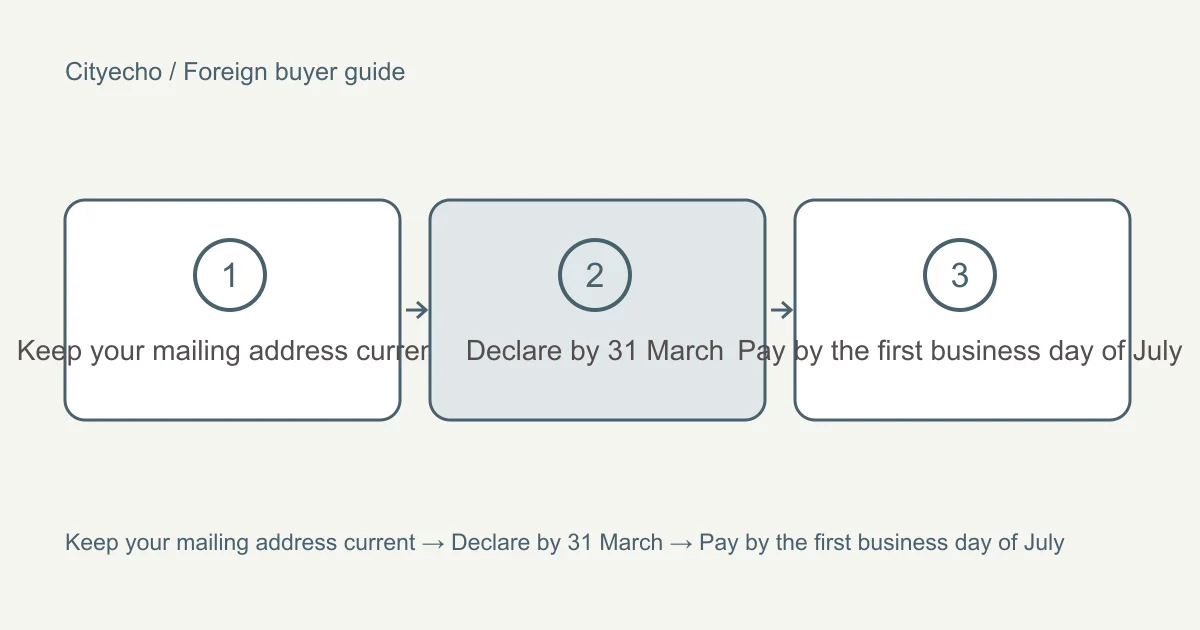
The province's page on how the tax works, updated on 31 December 2025, sets the timeline. Your declaration is due on 31 March each year, and if you owe tax you pay by the first business day in July.
A couple where one spouse is a citizen and the other is a foreign national therefore makes two declarations, and each one claims its own exemption. The declaration page also says you generally have up to 3 years to submit or correct a declaration for a tax year, and that the province may accept a late declaration up to 6 years later. Correct a mistake as soon as you find it. Our journal article on the speculation and vacancy tax works through examples.
The province mails the declaration letter to the address on file with BC Assessment. Its declaration page said the 2026 letters would be mailed in January and February 2026 and should all be delivered by late February. An owner abroad who never sees the letter can miss the deadline, so keep that address current.
Coquitlam property tax
The City of Coquitlam's property tax page set the 2026 due date as 2 July 2026. A 5% penalty applied to any unpaid balance of current taxes after that date, and a further 5% after 15 September 2026. The City lists payment online, at a bank, by cheque, by debit or by credit card.
The City says mailing address changes must be made through BC Assessment. It also offers eBilling through MyCoquitlam, which emails the tax notice when it is ready. For an owner abroad, eBilling plus a current mailing address with BC Assessment is the simplest way to see every notice.
Canadian owners who live in their home can reduce the bill with the provincial home owner grant. The province requires the registered owner to be a Canadian citizen or permanent resident, to live in BC, and to occupy the home as a principal residence. The 2026 threshold was an assessed value of $2,075,000. A foreign owner cannot claim the grant, so the full property tax is paid.
The federal tax that ended
The Canada Revenue Agency's Underused Housing Tax page describes it as an annual federal 1% tax on the ownership of vacant or underused housing in Canada, which took effect on 1 January 2022. The agency's Excise and GST/HST News No. 121 says no Underused Housing Tax is payable and no return is required for the 2025 calendar year and later years.
The change is in Bill C-15, the Budget 2025 Implementation Act, No. 1, which received royal assent on 26 March 2026. The agency says the filing and payment duties for 2022, 2023 and 2024 remain, with their penalties and interest. A buyer of a new house in 2026 or later has no Underused Housing Tax to file.
Planning the cost before you buy
The vacancy tax changes the cost of owning a house that sits empty. On a house assessed at $2,400,000, the 2027 rate of 4% is $96,000 a year, every year the house has no exemption. That is on top of property tax, insurance, utilities and upkeep. Over three empty years at that rate, the vacancy tax alone would come to $288,000.
So decide how the house will be used before you buy it. If family will live in it as tenants, read the tenancy requirements and set up a written tenancy agreement and a record of rent. If you will rent it to an unrelated tenant, plan for the income tax rules in the renting out chapter as well. If you plan to leave it empty for part of each year, work out the vacancy tax at the foreign owner rate and add it to your budget.
Assessed value and price are different numbers, and the vacancy tax uses the assessed value. Look up the BC Assessment figure for the house once it is assessed, and work out the tax on that. The annual property tax chapter explains how BC Assessment sets a value and how to dispute one.
A yearly calendar for an owner abroad
| When | What to do |
|---|---|
| January to February | Watch for the vacancy tax declaration letter at your BC Assessment mailing address; the 2026 letters were mailed in these months |
| By 31 March | Each owner declares for the year before, claiming an exemption or accepting the tax |
| By 1 June | If no Coquitlam property tax notice has arrived, contact the City's Revenue Services, as the City asked in 2026 |
| By 2 July in 2026 | Pay Coquitlam property tax; the City sets the date each year |
| First business day of July | Pay any vacancy tax owed |
| All year | Keep tenancy agreements and rent records if you claim the tenant exemption |
The vacancy tax chapter of the costs and taxes guide explains the declaration in more detail. Put each date in a calendar you check, and ask someone in Canada to collect your mail if you will be away for months at a time.