

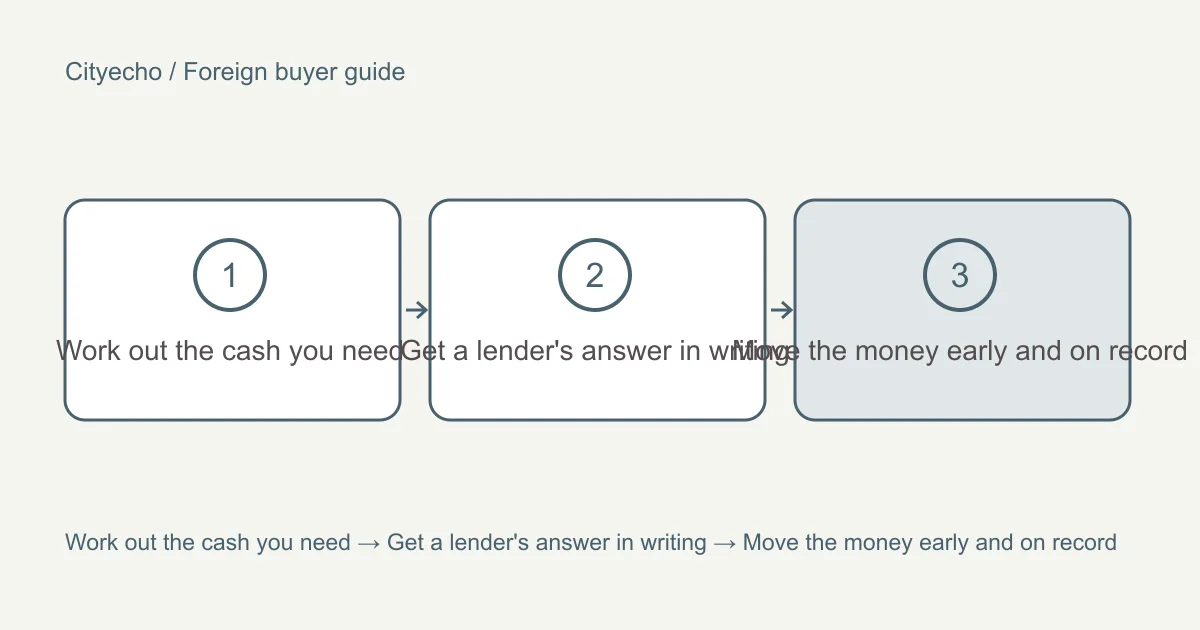
The money for a new Coquitlam house has to come together on one day: the down payment, the taxes and the rest of the price. A buyer from outside Canada faces more checks on that money than a local buyer, and fewer loan options. Four sets of rules apply to that money: the minimum down payment, the mortgage stress test, identity checks by agents and builders, and the border report for cash. Each is part of the purchase steps in our foreign buyer guide.
The taxes you pay on completion are worked out in the taxes when you buy chapter. Whether you may buy at all is covered in the chapter on the federal ban.
The down payment
The Financial Consumer Agency of Canada's down payment page sets the minimum by price.
| Purchase price | Minimum down payment |
|---|---|
| $500,000 or less | 5% of the price |
| $500,000 to $1,500,000 | 5% of the first $500,000 and 10% of the rest |
| $1,500,000 or more | 20% of the price |
New detached houses in Coquitlam sit in the last row. On 9 November 2026 every one for sale asked more than $1,500,000, as the Coquitlam new homes page showed. So plan for a down payment of at least 20%. A lender can ask for more. Plan to pay the taxes in cash as well, and read the costs and taxes guide on whether transfer tax can be added to a mortgage.
Insured and uninsured mortgages
Canada Mortgage and Housing Corporation insures some mortgages, which lets a buyer put down less than 20%. CMHC's page for newcomers sets the conditions for non-permanent residents. They must be legally authorized to work in Canada, for example with a work permit. The price must be below $1,500,000 for a homeowner loan. At least one unit must be owner-occupied. Only borrowers exempt from the federal ban on non-Canadians can be considered.
A buyer living abroad who does not work in Canada does not meet these conditions. A house priced at $1,500,000 or more fails CMHC's price test for any buyer. So for a new Coquitlam house at the prices shown on the new homes page, plan for an uninsured mortgage, set by the lender's own rules.
The stress test
The Office of the Superintendent of Financial Institutions sets a minimum qualifying rate for uninsured mortgages. Federally regulated lenders must test the borrower at the greater of the mortgage contract rate plus 2% or 5.25%. OSFI reviews the rate at least once a year.
| Rate the lender offers | Rate you must qualify at |
|---|---|
| 3.00% | 5.25% |
| 3.50% | 5.50% |
| 4.50% | 6.50% |
The test asks whether your income could carry the payments at the higher rate. For a buyer with income outside Canada, the lender also decides how much of that income it will count, how it checks it, and in which currency. Those are lender rules, and they differ. Ask two or three lenders for their requirements in writing before you sign a contract. The financing guide explains how lenders assess an application.
How much cash to plan for
Take the worked example from the taxes chapter: a new house at $2,400,000, bought by one foreign national with no exemption.
| Item | Amount |
|---|---|
| Down payment at 20% | $480,000 |
| General property transfer tax | $50,000 |
| Additional property transfer tax at 20% | $480,000 |
| GST at 5% | $120,000 |
| Cash needed before fees and adjustments | $1,130,000 |
| Mortgage at 80% of the price | $1,920,000 |
So in this example the buyer needs $1,130,000 in cash and a lender willing to lend $1,920,000. Legal fees, lender fees and the builder's adjustments come on top. If the lender asks for a larger down payment, the cash figure rises and the mortgage falls by the same amount.
The table below shows three cases. In the first two, one foreign national buys alone. In the third, a foreign national and a Canadian citizen each register 50% of the title. Every case uses the minimum 20% down payment and no exemption.
| Case | Price | Down payment | Three taxes | Cash before fees | Mortgage |
|---|---|---|---|---|---|
| Foreign buyer alone | $1,800,000 | $360,000 | $484,000 | $844,000 | $1,440,000 |
| Foreign buyer alone | $2,400,000 | $480,000 | $650,000 | $1,130,000 | $1,920,000 |
| Couple, 50% foreign share | $2,400,000 | $480,000 | $410,000 | $890,000 | $1,920,000 |
On the $1,800,000 house, the general transfer tax is $34,000, the 20% additional tax is $360,000 and the GST is $90,000. For the couple, the additional tax falls to $240,000 because it applies only to the foreign spouse's half, while the general tax and the GST stay at $50,000 and $120,000.
Questions to ask a lender
Put these to each lender and ask for the answers in writing:
- What down payment do you require from a borrower whose income is earned outside Canada?
- Which income do you count, how do you check it, and do you convert it at a set exchange rate?
- Do you lend on a house that is still being built, and when does your approval expire?
- Must the down payment be in a Canadian account, and for how long before completion?
- Which documents do you need, and must they be translated?
A written answer to each lets you compare lenders and stops a surprise near completion.
Identity checks
Canada's financial intelligence agency, FINTRAC, sets identity rules for the real estate sector. A real estate broker or sales representative must verify client identity when acting as an agent in a purchase or sale. A real estate developer must verify client identity when it sells a new house, a new condominium unit or certain new buildings to the public.
The rules also cover money. Agents and developers must verify the identity of any person they receive funds from, in any amount, and of anyone they receive $10,000 or more in cash from. So expect your agent and the builder's sales team to ask for your passport and other documents, and expect questions about where the money came from. Send clear copies early if you are abroad, and keep the originals ready for completion.
Bringing money into Canada
The Canada Border Services Agency's Memorandum D19-14-1, dated 3 September 2024, says that currency or monetary instruments of CAN$10,000 or more, or the equivalent in a foreign currency, must be reported when they are brought into or taken out of Canada. Monetary instruments are defined by their bearer form, such as bearer securities and negotiable instruments. Money that is not reported can be seized.
The memorandum deals with money carried, mailed or shipped across the border, and it does not mention wire transfers. A bank wire leaves a record of who sent the money and where it went. Carrying cash for a house purchase adds a border report, and then an agent or builder who receives $10,000 or more in cash has its own identity rules to follow.
Deposits on a new house
A builder's contract can ask for a deposit when it is signed. Where the Real Estate Development Marketing Act applies, section 18 says the developer must promptly place the deposit with a brokerage, lawyer, notary public or prescribed person, who holds it in a trust account at a savings institution in British Columbia. The Act applies when a developer markets a unit in a development property, which section 1 defines to include 5 or more subdivision lots and 5 or more strata lots.
Where the Act does not apply, the contract says who holds the deposit. Ask for it to be held in trust by a brokerage, lawyer or notary, and read the clause on when you get it back. The chapter on buying before it is built covers the rest of the builder's contract, and our journal article on presale deposit schedules explains staged deposits.
Timing the transfers
Plan the money in steps. Send the deposit only once the contract is signed and you know who holds it. Arrange the mortgage before the contract becomes firm, with written terms. Send the rest of the cash to your lawyer's trust account early enough to clear before completion, and allow for the exchange rate on the day you convert it. Keep the bank records of every step, because each person handling your money must check where it came from.