

Canada has a federal law that stops most people who are not Canadian citizens or permanent residents from buying a home. It came into force on 1 January 2023 and was due to end on 1 January 2027. Budget 2026, posted on 5 November 2026, proposes to keep the ban on existing homes to 2029 and exempt new homes, which would change who can buy a new house in Coquitlam.
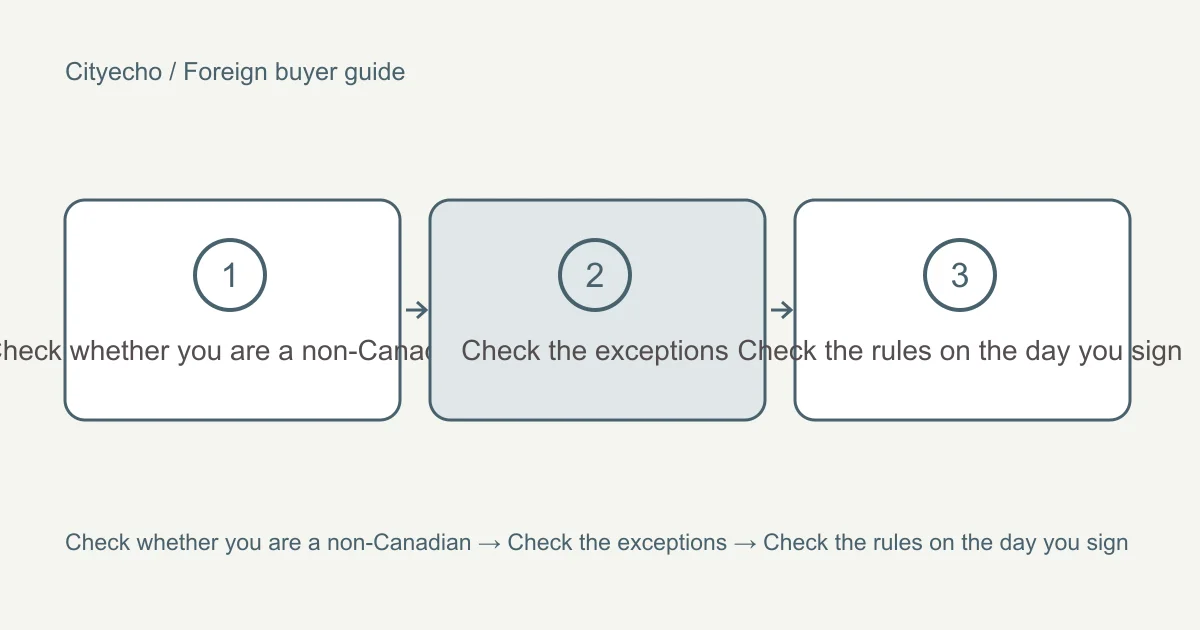
Three things decide whether a non-Canadian can buy a new Coquitlam house: what the ban covers today, who is exempt from it, and the date the contract is signed. Each is set out below as part of our foreign buyer guide. The taxes that apply whatever happens to the ban are in the taxes when you buy chapter.
What the law says
The law is the Prohibition on the Purchase of Residential Property by Non-Canadians Act. Section 4 makes it illegal for a non-Canadian to buy residential property in Canada, directly or indirectly. The Act gives the rule, and the regulations fill in the details: who counts as a non-Canadian entity, which places are left out, and which temporary residents are exempt.
Residential property in the Act means a detached house or similar building with no more than three dwelling units, plus the land it needs. It also means a semi-detached house, a rowhouse unit, a condominium unit or a similar unit that is, or will be, its own parcel of property. A new detached house in Coquitlam is residential property under this definition.
The regulations exclude property that is outside every census agglomeration and every census metropolitan area, as Statistics Canada draws them in its 2021 classification. Statistics Canada defines a census metropolitan area as one or more neighbouring municipalities around a core, with at least 100,000 people, and it counted 2,642,825 people in the Vancouver census metropolitan area in 2021. Coquitlam is a city next to Vancouver, so plan on the ban applying, and ask your lawyer to confirm the address in writing.
The regulations also say what a purchase is. Acquiring a legal or equitable interest in residential property, with or without conditions, counts as a purchase. Some events do not count: receiving property through death, divorce, separation or a gift, renting a home as a tenant, and a non-Canadian acquiring residential property for development.
Who is a non-Canadian
The Act lists four kinds of non-Canadian. An individual is a non-Canadian if they are not a Canadian citizen, not a permanent resident, and not registered under the Indian Act. A corporation formed outside Canada is a non-Canadian. A corporation formed in Canada can also be one, if a non-Canadian controls it and its shares are not listed on a Canadian stock exchange.
The regulations define control as owning 10% or more of the equity value or voting rights, directly or indirectly, or having control in fact through ownership, an agreement or another way. So buying through a Canadian company does not avoid the ban when a non-Canadian controls that company.
These definitions belong to this federal law only. BC's foreign buyer tax and its vacancy tax use their own definitions, and the Canada Revenue Agency uses a residency test for income tax. The chapter on who counts as a foreign buyer puts the four tests side by side.
The exceptions
The Act exempts some people from the ban. The regulations then set the conditions for each one.
| Who | Conditions in the regulations |
|---|---|
| Work permit holder | 183 days or more left on the work permit on the purchase date, and no more than one residential property bought |
| International student | All required Canadian tax returns filed for the five years before the purchase year, at least 244 days in Canada in each of those years, a price of $500,000 or less, and no more than one residential property bought |
| Protected person | Protected under subsection 95(2) of the Immigration and Refugee Protection Act |
| Buyer with a spouse or partner | Buying together with a spouse or common-law partner who is a citizen, registered Indian, permanent resident, or an exempt temporary resident or protected person |
| Some foreign nationals | Diplomatic and consular passport holders accepted by the Chief of Protocol, some people given safe haven under section 25.2, and refugee claimants whose claim was referred |
The work permit test is the one most buyers ask about. On the day you buy, your permit must have 183 days or more of validity remaining. You also must not have bought more than one residential property. A buyer whose permit is close to its end date should talk to a lawyer before signing, because the date of the purchase is the date that counts.
The student test is narrow. On 9 November 2026, no new detached house for sale in Coquitlam asked $500,000 or less. The Coquitlam new homes page shows the current asking prices.
Penalties and a forced sale
Section 6 of the Act sets a fine of up to $10,000 on summary conviction. It applies to the non-Canadian who buys, and to any person who knowingly helps them break the law.
Section 7 lets a provincial superior court order the home sold after a conviction, if the federal minister applies. The regulations set the order in which the sale money is paid out. Sale costs, the minister's costs and unpaid fines come first. Other people with a claim on the money come next. Then the non-Canadian gets back up to the price they paid, and anything above that price goes to the Receiver General for Canada.
So a buyer who breaks the ban can lose any rise in value, as well as paying the fine. The court must also be satisfied that the sale order is not out of proportion to the breach.
How long the ban lasts
The Act came into force on 1 January 2023. On 4 February 2024 the Department of Finance announced that the ban, then set to expire on 1 January 2025, would be extended to 1 January 2027.
Budget 2026, on the Department of Finance site with a modified date of 5 November 2026, proposes to extend the ban on foreign purchases of existing residential properties for two more years, to 1 January 2029, while exempting new residential properties. The budget gives its reason: it says this keeps most of the market available for Canadians while bringing in more investment in new housing.
The same section of the budget says the government will propose legislation and launch a regulatory process on the change. So the change needs two steps: Parliament has to pass a law, and the government has to write regulations.
What is still unknown
As of 9 November 2026, three questions are open.
First, the budget does not define a new residential property. A house finished last year, a house finished this year, a house still being built, and a house sold once and resold: each could be treated differently, and the budget does not say which of these count.
Second, the budget gives no start date for the exemption. It names 1 January 2029 as the new end date for the ban on existing homes, but it does not say from which day new homes are exempt.
Third, the timing of the law. The current ban runs to 1 January 2027. If the new law is not in force by then, the rules for the days in between depend on what Parliament passes. Nobody can tell you today what they will be.
Because of this, a buyer from outside Canada should wait for the law before signing a contract for a Coquitlam house, unless a current exception already covers them. Ask a lawyer which version of the law is in force on the day you sign, and on the day the purchase completes. The regulations treat acquiring an equitable interest, with or without conditions, as a purchase, so ask whether signing a contract counts as the purchase date in your case.
What stays the same either way
The federal ban decides whether you may buy. The province of British Columbia sets its own taxes on foreign buyers and foreign owners, and Budget 2026 leaves them as they are.
A foreign national buying in the Metro Vancouver Regional District, which includes Coquitlam, pays BC's 20% additional property transfer tax on top of the regular transfer tax. A foreign owner pays BC's speculation and vacancy tax each year at the foreign owner rate unless an exemption applies. The yearly taxes chapter covers the second one, and our journal article on the speculation and vacancy tax gives examples.
Ask a lawyer in British Columbia to check the federal ban for your situation before you sign anything. The rules are written in detail, the penalties are real, and the budget proposal is still a proposal.