

Buying a detached house in Coquitlam or Port Coquitlam means taking on the land, the building, and every right and duty attached to them. Much of it cannot be seen at a showing. It sits in a registry, a city file, a buried pipe, or the soil. This guide sets out the checks a buyer can make before committing, in the order a purchase needs them, with the person who performs each one.
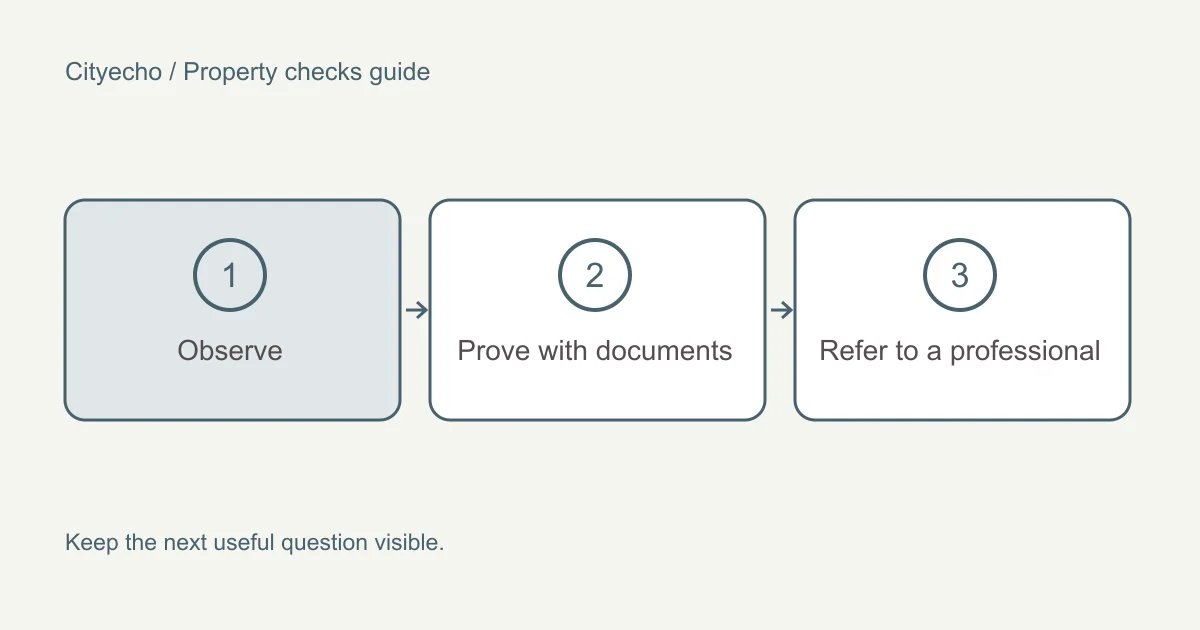
Every chapter uses the same three columns. What you can observe yourself. What a document proves. What needs a qualified professional. Keeping those apart stops an observation from turning into a conclusion, and stops a document from being read for more than it says. The checks tell you what is known, what is still open, and who can answer the rest. The decision to buy stays with you.
This guide assumes you already have a house in mind. For the search itself, from setting a brief to viewing homes, use the home buying guide. For the costs and taxes that come with a purchase, see the costs and taxes guide. If you are on the other side of a sale, the selling a home guide covers the seller's duties.
The chapters
- Home inspection: what a licensed inspection covers, what the contract excludes, and how to read the report.
- Title search and charges: what the title shows, and how easements, rights of way, covenants, building schemes and liens limit an owner.
- Survey and title insurance: where the buildings sit against the boundaries, and what a title insurance policy covers.
- Permits and unpermitted work: how to ask each city for the permit history, and what an open permit means.
- Buried oil tanks: records to ask for, how a search works, and what removal involves.
- Drainage and services: perimeter drains, sewer and water connections, and lots near creeks or on slopes.
- Secondary suites: what makes a suite lawful in each city, and what to ask a lender and an insurer.
- Buying a tenanted home: the tenancy rules when a house sells with a tenant in place.
- New home warranty: the 2-5-10 coverage, owner builder homes, and the New Homes Registry.
- Environmental and hazard checks: asbestos, radon, flood and wildfire maps, and the contaminated site registry.
Before the offer: checks that need no one's permission
Some checks need only an address or a parcel identifier. Do these first, because they tell you which questions the offer must leave room for.
Get a copy of the title. LTSA's page on finding information on a title says a title lists the owners, the legal description, the parcel identifier, and the charges and legal notations registered against it. You need the parcel identifier to search, because LTSA says a civic address cannot be used.
For a house built in recent years, search BC Housing's New Homes Registry. BC Housing says it shows whether a new home has a warranty policy, whether a licensed builder built it, or whether it was built under an owner builder authorization.
Look at the free maps: the city's flood and watercourse layers, the provincial floodplain maps, the wildfire threat maps, and the contaminated site layer in iMapBC. Then ask the seller, through your real estate professional, for the documents only the seller has: the disclosure statement, any tenancy agreement, past inspection or drain reports, oil tank removal records, radon results, and warranty papers.
The offer and the three day rescission period
For most resale purchases, the property checks happen inside subject clauses in the contract of purchase and sale. BCFSA's consumer guide to property inspections says a seller does not have to accept an offer with an inspection subject. If the seller removes it, BCFSA advises speaking with your real estate professional about the risks. The journal article on subject-free offers looks at that choice in more detail.
Separate from subjects, British Columbia has a Home Buyer Rescission Period. BCFSA says it applies to a detached house, among other property types, and lets a buyer rescind within three business days after the offer is accepted, excluding weekends and holidays. The buyer must give written notice before the period ends and pay a rescission fee of 0.25 percent of the offer price. The right cannot be waived. On an explicitly hypothetical $1,500,000 offer, that fee would be $3,750. Whether it applies to your contract, and how to use it, is a question for your real estate professional and lawyer.
During the subject period: checks with a deadline
Once the offer is accepted, the subject deadline sets the pace. Several checks need either access to the house or the purchase agreement itself. Coquitlam's building permits FAQ, for example, says realtors and prospective buyers must show a valid purchase agreement to obtain plans or a form survey. Book these on the day the offer is accepted.
The checks that fit inside the subject period are the home inspection, the city permit file, a survey, an oil tank search, a sewer and drain camera inspection, the suite's permit status, the lender's decision and the insurer's answer. Each one needs a date for the result that falls before the subject deadline, with time to act on what it finds. If a provider cannot deliver before the deadline, tell your real estate professional at once. The choices then include asking the seller for a longer subject period, agreed in writing, or narrowing the question to one that can be answered in time.
| Check | Who does it | What it produces |
|---|---|---|
| Home inspection | A licensed home inspector | A written opinion on condition, with exclusions and referrals |
| Title search and charge documents | You, then your lawyer or notary | The title and the registered documents behind each charge |
| Survey certificate | A BC land surveyor | A certified drawing of buildings against boundaries |
| Permit history | City building division staff | Permits, inspections and any open files |
| Oil tank search | A qualified contractor or environmental professional | A written search report for a stated area |
| Sewer and drain inspection | A plumber or drainage specialist | A camera report on the private pipes |
| Suite status | City building division staff | Permit records for the suite |
| Tenancy review | Your lawyer or notary | Advice on the tenancy terms and notice timing |
| Warranty check | You, using BC Housing's registry | Registry entry and policy details |
| Asbestos and radon | A licensed asbestos surveyor, a certified radon tester | A lab report, or a long term radon result |
After subjects are removed
Some steps can only start once the sale is firm. The clearest is a notice to a tenant for the buyer's own use. Section 49 (5) of the Residential Tenancy Act allows it only after all the conditions on which the sale depends have been satisfied and the purchaser has asked the seller in writing. The notice period, the form and the compensation are in the tenanted home chapter.
Before completion, your lawyer or notary does the legal work. BCFSA's guide to completing your purchase lists searching the title for other people's rights and for registered easements or restrictive covenants, making sure the seller's mortgage is discharged if required, and registering you as owner. It also notes that the completion date and the possession date are not necessarily the same.
Watch for late charges. Section 20 of the Builders Lien Act allows a claim of lien to be filed up to 45 days after work is completed or abandoned. If the seller renovated recently, ask your lawyer or notary how that window is handled.
After completion
A few checks run longer than any subject period. Health Canada says a radon test should run for at least 3 months, as its page on testing your home explains. If there is no past result, plan the test for your first fall or winter in the house. Keep every report from the purchase in one place. When you sell, the next buyer will ask many of the same questions, and your records will answer them.
Using this guide
Pick the chapters that match the house. An older house may raise asbestos, oil tank and drainage questions. A newer one raises warranty questions. A suite or a tenant raises permit and tenancy questions. A lot near a creek raises setback questions, which the land and zoning guide takes further. For each open question, write down who will answer it and by when, and make that date earlier than the subject deadline.
Keep one list for the whole purchase. Give each line the question, the source you used, the person responsible, the date you expect an answer, and the answer when it arrives. Mark a line closed only when a document or a qualified person has answered it. A line that stays open on the subject deadline is a decision you are making without that answer, so raise it with your real estate professional and your lawyer or notary before that day.