

Buying or selling a home in British Columbia moves more money than the price alone. A buyer pays taxes, fees and insurance around the purchase, and then a set of costs that recur every year. A seller pays commission, legal fees and sometimes tax on the profit. This guide sets out each cost, when it is paid, who sets it, and where to confirm the current figure.
Every rate and threshold in these chapters comes from the government or regulator page that sets it, and each one carries the date it was checked. Governments change these numbers, so open the linked source before you rely on one. For the wider buying process, such as viewings and comparing homes, see the home buying guide.
The costs at a glance
The table lists each cost category, when it is paid and whether it recurs. The chapter named in each row gives the rules and the sources.
| Cost | When it is paid | Once or yearly | Chapter |
|---|---|---|---|
| Deposit | With the offer or soon after acceptance | Once | Deposits and adjustments |
| Property transfer tax | On registration, normally the completion date | Once | Property transfer tax |
| GST on a new home | At completion, collected by the builder | Once | GST on new homes |
| Mortgage default insurance premium | At completion, or added to the loan | Once | Mortgage qualifying costs |
| Legal or notary fees and land title fees | Before or on completion day | Once | Legal and registration costs |
| Title insurance, if chosen | Before completion | Once | Legal and registration costs |
| Home insurance | In place by completion day, then renewed | Yearly | Home insurance before completion |
| Property tax and utility adjustments | On completion day | Once | Deposits and adjustments |
| Annual property tax | Due 2 July in 2026 in both cities | Yearly | Annual property tax |
| Water and sewer, plus garbage in Coquitlam | Due 31 March in 2026 in both cities | Yearly | Annual property tax |
| Speculation and vacancy tax declaration | By 31 March each year | Yearly | Speculation and vacancy tax |
| Home flipping tax or income tax on a sale | After a sale, through a tax return | Once, if it applies | Tax when you sell |
The Financial Consumer Agency of Canada's buying a home page tells buyers to be ready to spend between 1.5% and 4% of the purchase price on one-time closing costs, paid by the time the sale is completed. That range is a general national figure. In B.C., property transfer tax is part of it, and the chapters below show how to work out each piece for your own price.
A worked example of the one-time costs
The figures below use a hypothetical resale house at $1,500,000, bought by buyers who do not qualify for an exemption, with one new mortgage. Each figure links to the page that sets it, with the date it was checked.
- Down payment: at $1,500,000 or more, the Financial Consumer Agency of Canada's down payment page lists a minimum of 20%, which is $300,000, as it read on 30 September 2026.
- Property transfer tax: $28,000, from the provincial rates in effect on 30 September 2026, worked through in the transfer tax chapter.
- Land title fees: $83.82 for the transfer and $83.82 for the mortgage, a total of $167.64, from the Land Title and Survey Authority's fee list as at 1 April 2026.
- Legal or notary fees: set by the written quote you accept.
- Adjustments: set by the adjustment date and the year's tax and utility bills.
Home insurance is also arranged before completion, at the price the insurer quotes. Add each figure to your own list, and replace the example price with the price you plan to offer.
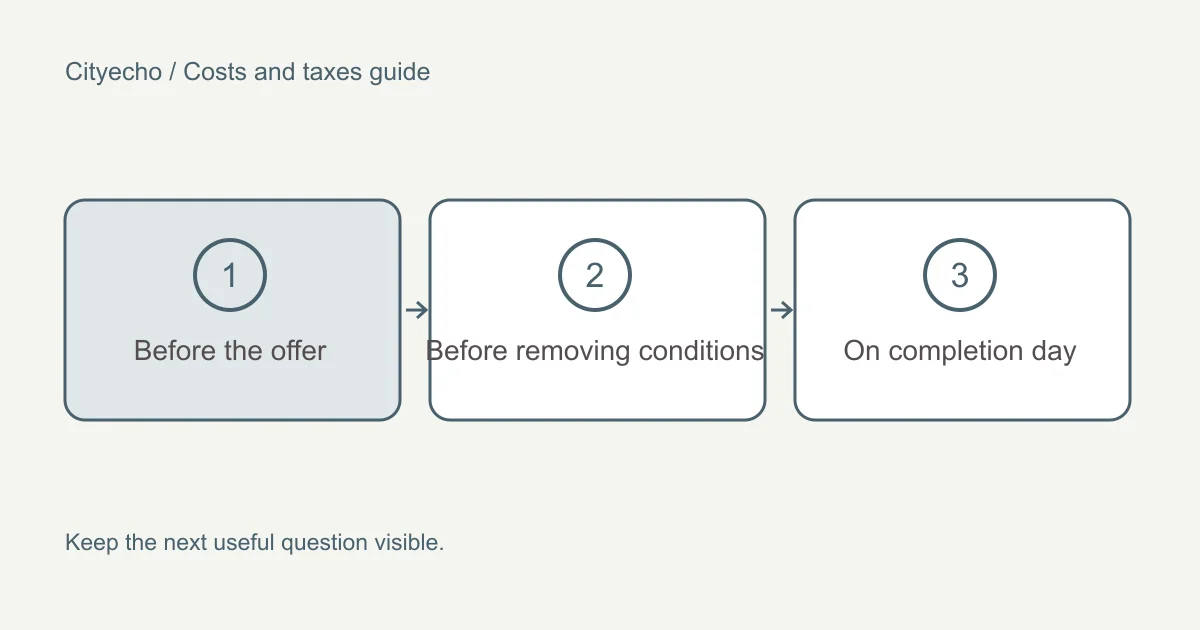
Before you make an offer
Start with the mortgage. A lender tests whether you can carry the loan at a rate above the one you are offered, and federal rules set the minimum down payment and the limits for insured loans. The mortgage qualifying chapter explains the stress test, down payment bands and default insurance premiums, with a worked example.
Next, work out the one-time taxes on the price you plan to offer. The property transfer tax chapter gives the rate bands and the additional tax for foreign buyers in Metro Vancouver. If you are a first-time buyer, or the home is newly built, the first-time and new home exemptions chapter shows when the tax is reduced or removed. For a newly built or substantially renovated home, the GST on new homes chapter covers federal sales tax and its rebates.
Ask for quotes early. A lawyer or notary can give you a written estimate of their fees before you write an offer. An insurance agent or broker can tell you what they need to quote on a house. Both answers shape the cash you need on completion day.
When the offer is accepted
The deposit is the first money to move. BCFSA explains that it is usually held in the brokerage's trust account as stakeholder, and released only by agreement, rescission or court order. The deposits and adjustments chapter covers the deposit, the three-business-day home buyer rescission period and its 0.25% fee, and presale deposits.
Use the period before you remove conditions to confirm each cost. Your lender will look at the specific home. CMHC's worksheet to estimate the total cost of a home purchase lists an appraisal fee, where applicable, property insurance and title insurance among the up-front costs. The home insurance chapter explains what an insurer weighs on an older detached house and what to do if cover is hard to find.
On completion day
Most of the purchase money moves on one day. BCFSA's page on completing your purchase says your lawyer or notary prepares the transfer documents and the property transfer tax return, registers your mortgage, prepares a statement of adjustments, delivers the final amount to the seller and registers you as owner.
The legal and registration costs chapter lists the Land Title and Survey Authority fees as at 1 April 2026 and explains title insurance as a separate, optional product. The province's property transfer tax page confirms that the tax is based on fair market value on the day of registration, so it is paid through your lawyer or notary on that day.
The statement of adjustments also splits the year's property tax and utility charges between you and the seller at the adjustment date. Read it line by line before you sign.
Costs that recur every year
After completion, a set of costs returns each year. Annual property tax is billed by the city, based on your BC Assessment value and the year's tax rates. Coquitlam's tax and utilities calendar shows the pattern: utility bills mailed at the end of February and due 31 March, and property tax bills mailed at the end of May and due 2 July. The annual property tax chapter covers both cities, the home owner grant and the deferment program.
Home insurance renews each year, at a price the insurer sets. Mortgage payments continue for the term of the loan. The speculation and vacancy tax chapter explains the yearly declaration that every owner in Coquitlam and Port Coquitlam must make by 31 March, and the separate federal vacant housing rules.
When you sell
A seller's costs are listed on BCFSA's page on what costs come with selling a home. They are the commission agreed with the brokerage, legal fees to discharge the mortgage, legal or notary fees for the transfer, GST on the commission and legal fees, any mortgage prepayment penalty, and the seller's share of property tax if the year's tax has not yet been paid.
Tax on the sale depends on how long you owned the home and how you used it. The tax when you sell chapter covers B.C.'s home flipping tax, the federal rule for homes held under a year, the principal residence exemption, and what changes when a home was rented. The selling a home guide covers the selling process itself.
Using this guide with your professionals
This guide organises questions. Advice on your own purchase or sale comes from the professionals who handle it. A lender decides whether you qualify. An insurer decides whether to offer cover and at what price. Your lawyer or notary calculates the tax and the adjustments. The province, the Canada Revenue Agency and your city answer questions about their own taxes.
Build one list of costs for the home you are considering. Next to each cost, write the amount, the source, the date you checked it and the person who confirmed it. Leave a line blank when a figure is not yet known, and give it an owner and a deadline. The due diligence guide and the land and zoning guide cover the questions about the property itself that can change these costs.