

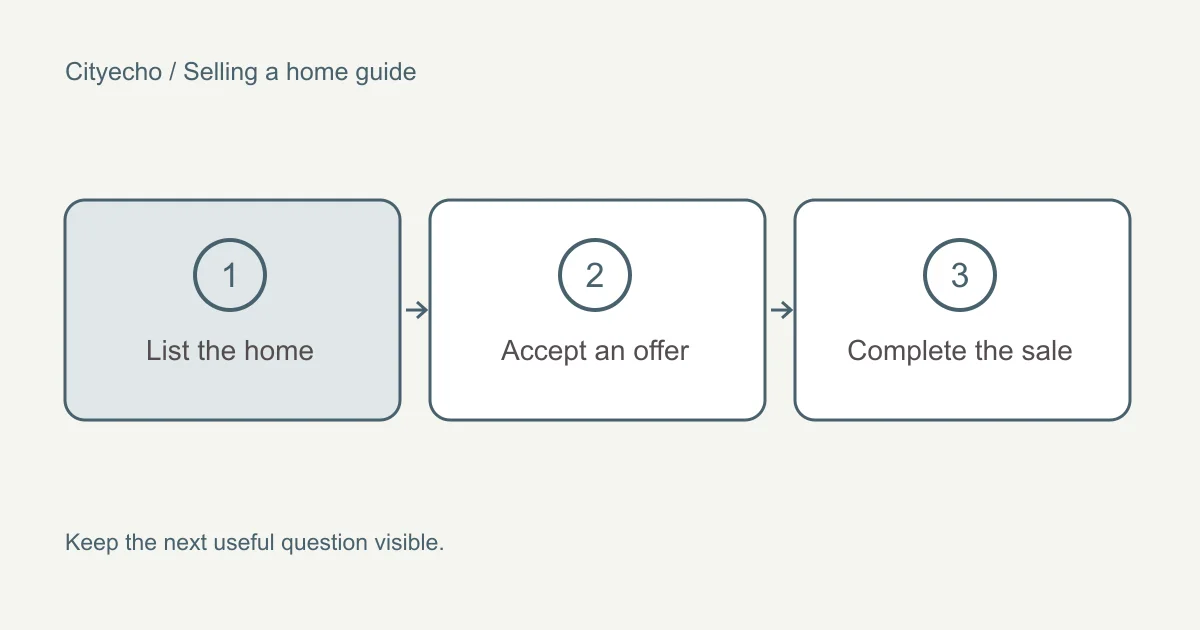
Selling a home in Coquitlam or Port Coquitlam follows the same order each time. You sign a listing agreement, you disclose what you know about the home, you set a price, the home is prepared and photographed, buyers visit, offers arrive, you accept one, the buyer's conditions are met or fail, and the sale completes. Each stage has its own documents and its own people. This guide sets out that order and sends you to the chapter that covers each stage in full.
The guide is written for owners of detached houses. Some chapters also apply to townhouses and strata homes, and where the rules differ for a strata lot, the chapter says so. Use it together with advice from your licensee, your lawyer or notary, your lender and your accountant. It gives you the questions to bring to them and the rules they work under.
The order of a sale
A home sale in British Columbia moves through a fixed set of stages, always in the same order. The time each stage takes depends on the market and on the dates you and the buyer agree. The table below lists the stages, who leads each one and what sets its length.
| Stage | Who leads it | What sets the time |
|---|---|---|
| Listing agreement | You and the brokerage | The start and expiry dates you sign |
| Disclosure and preparation | You, with your licensee | The repairs and records you choose to deal with |
| Pricing | You, with your licensee | The recent sales you compare |
| Media and showings | Your licensee | The marketing plan and access to the home |
| Offers | You, with your licensee | The offer deadline written in each offer |
| Rescission period | The buyer | Three business days after acceptance |
| Subject period | The buyer | The subject removal date in the contract |
| Completion and possession | Your lawyer or notary | The dates in the contract |
The provincial regulator, the BC Financial Services Authority, publishes a selling a home section for consumers. It covers agency, listing, disclosure, offers, deposits, costs and completion. The chapters in this guide use it, together with the legislation, as the starting point for each topic.
Stage one: the listing agreement
The listing agreement is the contract between you and a brokerage. It sets the fee, the term, the services and whether the listing is exclusive or goes on the Multiple Listing Service. The Real Estate Services Rules list what the agreement must contain, including the date it expires and the remuneration you will pay. The same rules set the duties the brokerage owes you as its client.
Read the agreement before the day you plan to list. Ask how the fee is calculated at different sale prices, what happens if you want to end the agreement early, and how any conflict of interest would be disclosed to you. The listing agreement chapter explains each term and the separate written form a conflict must be disclosed in.
Stage two: disclosure and preparation
A seller must disclose known latent defects. These are problems a buyer could not find in a reasonable inspection, such as a leak that appears only in heavy rain. Your licensee has a wider duty under the Rules, which includes a lack of proper permits. The seller disclosure chapter covers the Property Disclosure Statement, what you must disclose even when nobody asks, and what can happen after an inaccurate answer.
Preparation runs at the same time. You decide which repairs to make, how to clean and clear the rooms, and whether to stage. Past work done without a permit needs attention before you list, because it can affect both your disclosure and your buyer's lender. The preparing the home chapter sets out the questions to settle first.
Stage three: price, media and showings
The list price comes from recent completed sales of similar homes, adjusted for the differences between them and your home. Your assessed value is a separate number with a different purpose. The pricing chapter explains how a market evaluation is built, how it differs from an appraisal, and how a price reduction works.
Photographs, floor plans and a measured floor area follow. BCFSA's consumer guidance on listing your home says you are responsible for giving your licensee accurate information about the home. The listing media and measurements chapter covers what appears online and how to ask how the floor area was measured.
Buyers then visit. The showings and open houses chapter covers access, the security of your belongings and documents, and the written notice rules when a tenant lives in the home.
Stage four: offers and acceptance
Your licensee must present every offer to you. BCFSA's page on offers from buyers explains your choices: accept, reject, let the offer expire, or make a counter offer. Each offer has a price, a deposit, subject conditions and dates. The reviewing offers chapter explains how to compare two offers whose terms differ more than their prices.
When you accept, the Home Buyer Rescission Period begins. The buyer can rescind within three business days and must pay you 0.25% of the price. The subject period then runs until the date written in the contract. The chapter on the time after an offer is accepted covers what the buyer and the buyer's lender do in this window, and what you can and cannot do while conditions are open.
Stage five: completion day
On the completion date, legal ownership moves to the buyer in exchange for the price. BCFSA's page on completing your sale lists the work your lawyer or notary does, from searching title to preparing the statement of adjustments and paying you the final amount. The possession date, when the buyer can move in, may be a different day.
The money side of that day has several parts. BCFSA lists the costs that come with selling: the commission, GST on the commission and on legal fees, legal or notary fees, any mortgage prepayment penalty, and your share of property taxes. The completion day chapter goes through each one. For tax on the sale itself, read the tax when you sell chapter in the costs and taxes guide.
Planning your own dates
Some stages have a length that the law fixes. The rescission period is three business days after acceptance, and weekends and holidays are left out of the count. Other stages have a length that you agree to in writing. The listing agreement has an expiry date. Each offer has a deadline for your answer, a subject removal date, a completion date and a possession date. You and the buyer set those dates in the contract, so each one is a term you can negotiate.
Work backwards from the date you need to leave the home. If you are buying another home, your lender and your lawyer or notary need time to arrange both files, and the two completion dates must fit together. If you rent after the sale, check when your new lease starts. If a tenant lives in the home, the province explains that the tenancy continues after a sale unless a proper notice ends it, and a buyer who will live there may ask you in writing to serve one. The showings chapter covers the notice rules while the home is on the market.
Write each date on your list as soon as you sign. Then ask your licensee and your lawyer or notary what they need from you before each date arrives, and by when.
Selling a house for its land
Some houses in Coquitlam and Port Coquitlam sell for the value of the lot. Provincial legislation on small-scale multi-unit housing requires Coquitlam to allow up to four units on many residential lots, and a builder may make an offer that depends on rezoning, subdivision or an assembly of several lots. These offers carry longer subject periods and later completion dates. The selling to a builder chapter lists the questions to ask before you agree to a long condition. The land and zoning guide explains what a lot can become.
How to use this guide
Read the chapters in order if you are starting out. If you already have an offer in hand, go straight to the reviewing offers chapter and the chapter on the time after acceptance. The journal has narrower articles on single questions, such as what sellers should know about multiple offers and when to list in Metro Vancouver.
Keep one written list through the whole sale. Record each document you sign, each date you agree to and each question still open. Take that list to every meeting with your licensee and your lawyer or notary. A sale has many deadlines, and each one is easier to meet when you can see all of them in one place.
If you are also buying your next home, the home buying guide covers the other side of the process. The due diligence guide covers the checks a buyer is likely to make on your home, which helps you prepare the records they will ask for.