

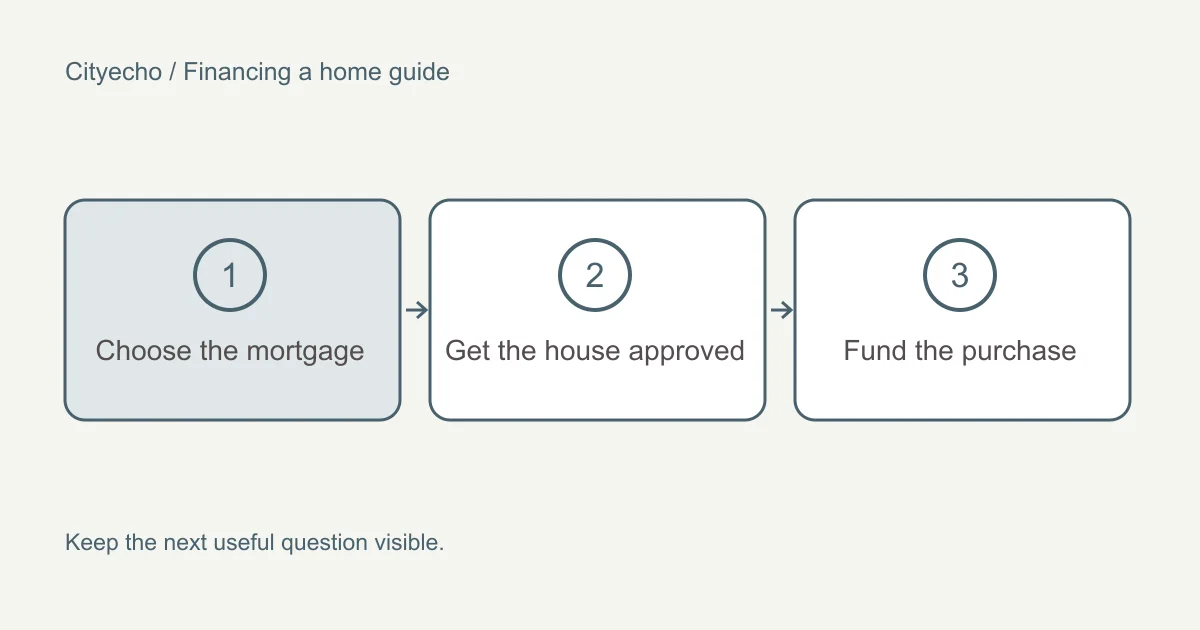
Financing a house in the Lower Mainland is a sequence of narrower decisions. You choose a mortgage product, test whether a lender will qualify you at today's rules, pick a lender or broker to work with, let that lender test the specific house, lock the rate for long enough to close, assemble the down payment and closing cash, then move into the payment schedule that follows funding. Each step has its own documents, its own deadlines and its own source of truth.
This guide covers each step in order. The chapters link to the Financial Consumer Agency of Canada, the Canada Revenue Agency, the Office of the Superintendent of Financial Institutions, Canada Mortgage and Housing Corporation and BC Financial Services Authority for every rule and figure, with the date each page was read. The costs and taxes guide covers the one-time charges on top of the mortgage. The home buying guide covers the search and the offer. This hub keeps the financing conversation in one place.
Keep these points beside your search
- Treat the preapproval as a working estimate, not a reservation of a house.
- Compare more than the interest rate: term, prepayment privileges and portability all matter at renewal.
- Ask who orders the appraisal, who pays for it and how a low appraisal is handled.
- Document the down payment source early, so the lender does not pause the file at the end.
- Keep the rate hold's expiry date in your calendar beside the condition removal date.
- Record the mortgage instructions your lawyer or notary receives and the day of funding separately.
Choose the mortgage before you choose the lender
The Financial Consumer Agency of Canada's choose a mortgage page, read on 5 October 2026, lays out the first set of choices. A fixed interest rate stays the same for the entire term and is usually higher than a variable rate for a similar term. A variable rate may rise or fall during the term and is typically lower than the fixed rate at the start. Closed mortgages have lower rates than open mortgages but limit how much extra you can pay each year without a penalty.
Term is the length of the contract and ranges from a few months to five years or longer, in the agency's words. Amortization is how long it takes to pay the full loan off. The agency's terms and amortization page, read on 5 October 2026, notes a maximum amortization of 30 years for first-time buyers or new builds with less than 20% down, and 25 years otherwise. A longer amortization lowers the monthly payment and increases the total interest paid.
Prepayment privileges, portability and the type of charge on title also matter. The mortgage choices chapter covers each option in turn, with the trade-offs and the questions to ask your lender or broker.
Pick the lender or the broker
A lender gives you one set of products. A mortgage broker shops the file to several lenders. Each path has duties and costs the buyer should know before signing. BC Financial Services Authority licenses mortgage brokers in British Columbia under the Mortgage Services Act, and the public register lists each licence. The lenders and brokers chapter explains how each is paid, the duties a broker owes you and the questions that compare offers meaningfully. Our mortgage preapproval article in the journal shows what a typical lender looks at before holding a rate.
Compare more than the rate. Prepayment privileges, portability, the type of charge used to register the loan and the renewal process all change what you pay over the life of the loan. Ask every lender or broker to describe their standard product in the same categories, so you are comparing like with like.
Pass the qualifying rate first
Federally regulated lenders apply a stress test to every mortgage. The Office of the Superintendent of Financial Institutions' minimum qualifying rate page, read on 5 October 2026, sets the qualifying rate for uninsured mortgages at the greater of the mortgage contract rate plus 2% or 5.25%. CMHC applies the same test to insured mortgages. A buyer offered 4.49% must therefore qualify at 6.49%, and a buyer offered 3.00% must qualify at 5.25%. The Financial Consumer Agency of Canada's preparing to get a mortgage page, read on 5 October 2026, sets the gross debt service ratio limit at 39% of gross household income and the total debt service ratio at 44%.
The mortgage qualifying chapter in the costs guide covers the stress test, down payment bands and default insurance premiums with worked numbers. The bridge financing article and the stress test article in the journal show what the test looks like in practice.
Get the house approved
A preapproval tests you. An approval tests you and the house. The Financial Consumer Agency of Canada's preapproval page, read on 5 October 2026, is explicit: the process does not guarantee your approval for a mortgage, and a lender could refuse you even after a preapproval. A lender can decline because the property does not meet certain standards or because your file has changed since the preapproval.
The lender's review of the house usually includes an appraisal. The lender orders it and reads the result. If the appraised value is lower than the price, the lender funds a loan based on the appraised value, not your offer. The application chapter and the appraisal chapter explain what the lender looks at, how to prepare, and what to do if the number comes in low.
Lock the rate and hold it
A rate hold is the lender's commitment to honour a quoted rate for a set period. The Financial Consumer Agency of Canada's preapproval page gives a range of 60 to 130 days depending on the lender. A rate hold shortens as time passes. Buyers who shop for several months need to know when it expires, since a new hold at a new rate changes the monthly payment and the qualifying result. The rate hold chapter covers converting a variable rate to a fixed rate inside the term, and the rules on early renewal of a closed mortgage.
Prepare the funds for closing
Your lender funds the mortgage on completion day, usually through your lawyer or notary. Your own money has to be in the lawyer's trust account by then. CMHC's general requirements for homeowner mortgage loan insurance page, read on 5 October 2026, lists savings, the sale of another property and gifts from an immediate family member as traditional sources, with borrowed funds as a non-traditional source. The Canada Revenue Agency's Home Buyers' Plan page, read on 5 October 2026, sets the withdrawal limit at $60,000 for a first-time buyer with a 15-year repayment schedule, with a deferred start for withdrawals made between 2026 and 2028. The agency's FHSA page, read on 5 October 2026, allows a qualifying withdrawal that is tax-free and does not need to be repaid.
The closing funds chapter covers each source, the documents a lender wants to see, and the way bridge financing fills a gap when a sale and a purchase do not close on the same day.
Fund, then run the loan
The lawyer or notary registers the mortgage against title on completion day. The first payment is set by the interest adjustment date your contract names, not by completion day itself. The after funding chapter covers the first payment, the use of prepayment privileges, the renewal letter at the end of the term and the choice between staying with your lender and switching.
Breaking a closed mortgage before the term ends triggers a prepayment penalty. The Financial Consumer Agency of Canada's prepayment penalties page, read on 5 October 2026, lists the two methods: three months of interest on the remaining balance, or the interest rate differential, with the lender charging the higher of the two. The agency's example on a $200,000 balance with 36 months remaining shows a penalty of $12,000 under the interest rate differential method against $3,000 under the three-month method, and recommends porting the mortgage to a new home as one way to reduce the penalty.
Use this guide with your professionals
| Who | What they decide | Chapter |
|---|---|---|
| Lender or broker | Whether to qualify you and at what rate | Mortgage brokers and lenders |
| Appraiser | The value the lender funds against | The appraisal process |
| Lender | Whether to approve the specific house | The mortgage application |
| Your lawyer or notary | Registration of the loan on title | Costs and taxes: legal and registration costs |
| You | Which trade-offs to accept and when | Every chapter |
This hub organises the questions and names the sources. A lender or broker licensed by BC Financial Services Authority discusses your own mortgage. A lawyer or notary registers it. The costs and taxes guide covers the one-time charges that sit alongside the mortgage on completion day.