

A Lower Mainland home search becomes easier to manage when you separate what you want from what you still need to establish. A bright living room may suit your routine. It does not tell you whether a building's documents support the renovation you have in mind. A station shown on a project map may influence your interest in an area. It does not describe the trip you can make today.
This home-buying guide gives you a way to keep those distinctions visible. Work through the chapters in the order that matches your search. Return to an earlier chapter when a property changes your priorities. The purpose is to arrive at useful questions, with a record of why each question matters, before the next decision becomes urgent.
Keep these points beside your shortlist
- Write essential requirements before rating attractive extras.
- Test travel from the address using current services.
- Keep observations separate from documents and professional conclusions.
- Give unresolved questions an owner and a deadline.
- Compare recurring obligations as well as the advertised price.
- Use a personal score to organise preferences, then review the evidence separately.
Set the search brief before booking viewings
Describe an ordinary week in the home. Consider where you work, who visits, what you carry, and how you travel when your usual arrangement is unavailable. Someone who cycles to work may need secure, usable bicycle storage more than an additional parking space. A household with changing work shifts may care about the return journey after a late finish rather than the shortest morning trip. These examples are prompts, not assumptions about your household.
Turn the routine into requirements you can test. “Good storage” is difficult to compare. A place for a bicycle, winter clothing, and a stroller gives you something to check. “Close to everything” becomes more useful when you name the destination, transport mode, and route. Keep nice-to-have features on a separate line so that an attractive extra does not quietly become more important than an essential need.
Use the search preparation chapter to make the brief and the neighbourhood chapter to test location. If the available homes repeatedly miss an essential requirement, revise the brief openly. Changing a priority is reasonable; forgetting that it changed makes later comparisons confusing. Record what changed and why before viewing the next property.
Decide who answers which question
A property search involves different kinds of expertise. Ask your real estate professional about representation and the services you are agreeing to before disclosing confidential negotiating information. BCFSA's agency guidance explains that the relationship carries duties and should be understood by the parties. An open-house conversation alone should not be your basis for assuming who represents your interests.
Create a question list with a recipient beside each item. A lender can explain the financing information they require. An insurer can address the coverage they may offer for the specific property. An inspector can describe the scope of a condition assessment. Your lawyer or notary can identify matters relevant to title and completion. Ask each professional where their work ends and whether another person needs to examine the issue.
This division also helps you write a useful enquiry. Instead of asking whether a home is “safe to buy,” explain the concern: an alteration without documents, an uncertain parking allocation, or an unanswered insurance question. The strata review chapter and house viewing chapter show how to turn those concerns into a record that someone can investigate.
Make a viewing record you can use afterwards
At the property, begin with the route through daily activities. Imagine arriving with groceries, storing a wet coat, working on a call, and having someone visit. Check the spaces relevant to your requirements with permission. Take notes that describe what you observed, rather than conclusions that require expertise. “A mark was visible below the window” is an observation. “The window leaks” is a diagnosis you may not be able to make.
Record the conditions of the visit. A quiet room during a brief afternoon appointment does not establish how it sounds at another time. A staged room does not prove that your own furniture will fit. If something could not be checked, say so. Treat an inaccessible area as unresolved rather than assuming it is satisfactory because the rest of the home looked well presented.
The viewing worksheet gives you space to keep those notes. BCFSA's property inspection guidance explains why an inspection deserves separate consideration. Discuss access, scope, and timing with the professionals involved. Do not turn a personal viewing checklist into a substitute for an agreed inspection or specialist assessment.
Read the property and the obligations together
Two homes with similar interiors can involve different responsibilities. For a strata property, British Columbia's buyer information identifies documents and shared ownership matters that need attention. A parking space visible during a tour is not, by itself, evidence of the rights attached to that space. Ask for the relevant records and have uncertainties explained.
Organise documents by the question they answer. A current fee figure helps with a recurring-cost discussion. Meeting records can point to matters needing follow-up. A report may describe assumptions and future work rather than a guarantee about what you will spend. Record the document's date, the page you are referring to, and the question it raises. This makes a conversation more useful than forwarding a large folder with “Is this okay?”
For a house, use the same discipline around alterations, boundaries, access, and intended uses. A listing description is a starting point for questions. Ask your professional how to establish the facts that matter to your plans. Keep your own willingness to do work separate from whether the work is permitted, insurable, financeable, and within a budget you have actually discussed.
Build a cost conversation around the actual home
Begin with the price, then create separate places for financing, transaction costs, recurring costs, and possible work. Leave an unknown entry blank and assign it a question. A number copied from another household can look precise while being irrelevant to your circumstances. Ask for property-specific information and clarify the assumptions behind any estimate before putting it into your comparison.
For a strata home, ask how the monthly fee fits alongside insurance, utilities, and other obligations that apply to you. For a house, consider the systems and outdoor work you would be responsible for investigating. The aim is a complete set of questions, not a generic allowance presented as a forecast. Keep quoted costs and your own discretionary plans in separate rows so that you can see what must be available and what could wait.
As checked on September 9, 2026, BCFSA describes the covered Home Buyer Rescission Period as three business days with a 0.25% fee when exercised. On an explicitly hypothetical $800,000 purchase, that percentage is $2,000. Those figures explain the scale of the fee; they do not establish that your transaction is eligible. Have your professional explain the applicable dates, notice requirements, and terms.
| Question | Evidence to request | Keep separate from |
|---|---|---|
| Does this fit my routine? | Your viewing and travel notes | A resale prediction |
| Can I finance it? | Property-specific lender guidance | A browsing budget |
| What condition needs attention? | Inspection and specialist findings | Presentation at a viewing |
| What obligations apply? | Title, contract, and relevant records | A listing summary |
| What happens at completion? | Instructions from your lawyer or notary | The moving-day plan |
Move through the decisions deliberately
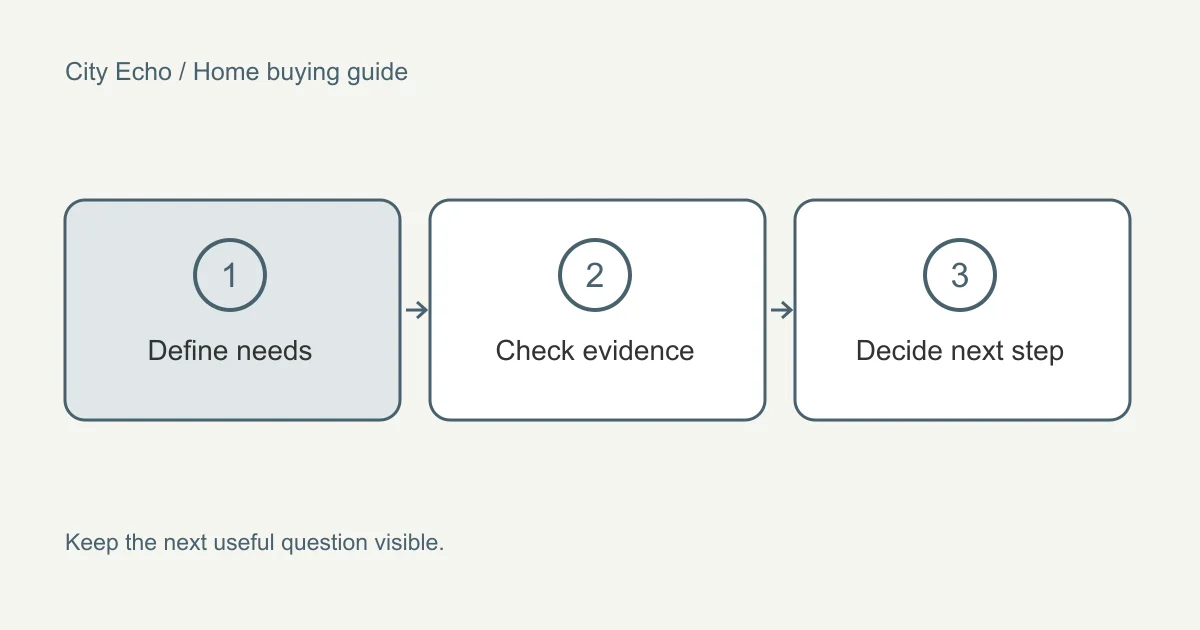
Start with a brief, shortlist properties, and investigate the ones that could meet it. After a viewing, consolidate your notes while the visit is fresh. Decide whether to stop, revisit, or ask for more information. When a professional is preparing an offer, bring the unresolved list into that conversation. Do not assume that a question will be dealt with later unless you understand how and when it will be addressed.
BCFSA's completion guide distinguishes the work needed to complete the purchase, including documents and funds. Put transaction dates in a separate calendar from practical tasks such as moving and setting up services. Ask the professional handling completion for their actual instructions. A date on a personal checklist does not alter a contractual deadline.
Keep a final decision note with the reasons you chose the property, the trade-offs you accepted, and the questions resolved along the way. This is useful even if you decide not to proceed. It can show that your search needs a different location or layout rather than another round of otherwise similar viewings. Use the comparison chapter and home comparison tool to make those preferences visible.
Avoid the mistakes a tidy checklist can hide
A completed-looking spreadsheet can conceal unanswered questions. Do not use zero to mean “not checked,” because it can be mistaken for no cost or no problem. Write “unconfirmed” and keep the source field empty until you have an answer. When two documents appear inconsistent, preserve both dates and ask which information governs the decision. Quietly choosing the more favourable figure makes the comparison less useful.
Be equally careful with attractive future possibilities. A proposed project, renovation idea, or potential use can be part of your interest in a home, but each requires its own investigation. Compare the property as it exists today before adding the version you hope it could become. If the purchase only works under that future scenario, identify that dependency directly in your discussion with your professional.
Finally, keep the guide proportional to the decision. You do not need to produce a perfect report on every listing you see. Use the brief to eliminate unsuitable options, then spend your attention on the evidence that could change your decision about a serious candidate. The next useful step is the one that resolves an important uncertainty, rather than simply adding more pages to your folder.