

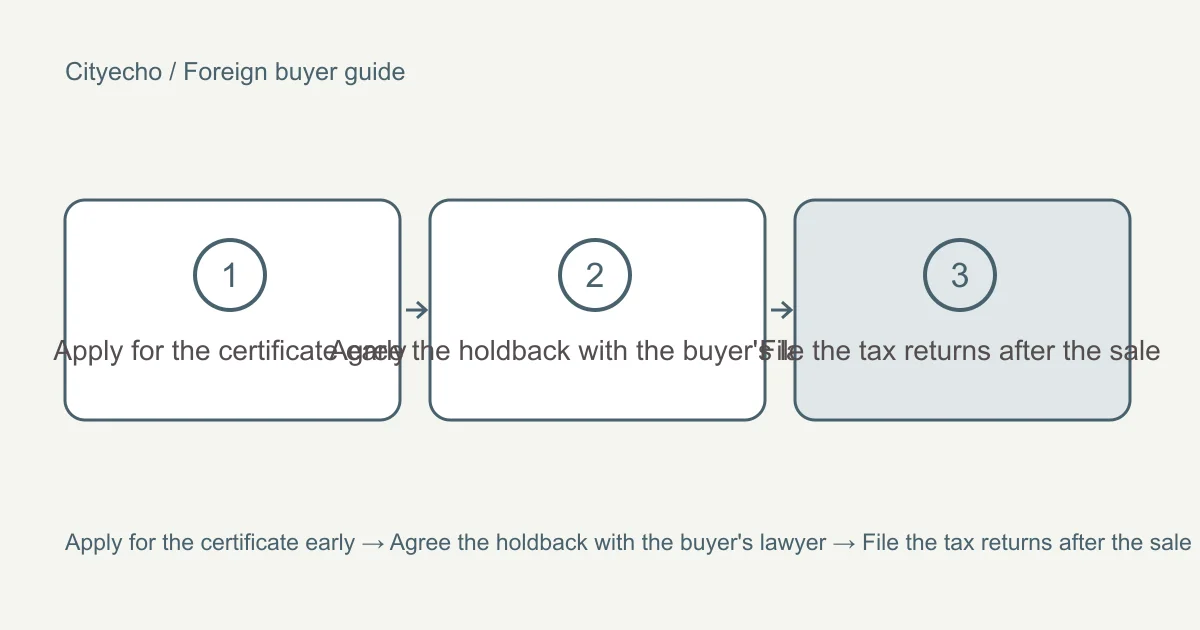
A Canadian resident who sells a house hands over the keys and receives the money. A non-resident seller has extra steps. Canada's income tax law puts part of the risk on the buyer, so the buyer's lawyer holds back money unless the seller brings a certificate from the Canada Revenue Agency. The certificate costs 25% of the gain, the holdback without it is 25% of the price, and a sale within 730 days adds BC's home flipping tax. The last chapter of our foreign buyer guide works through each step.
Whether you count as a non-resident is covered in the chapter on who counts. If the house was rented while you owned it, read the renting out chapter as well.
Notifying the Canada Revenue Agency
The agency's page on disposing of certain Canadian property sets out what a non-resident seller must do. You notify the agency on Form T2062 within 10 days of the date the property was disposed of. You can also notify before the sale, as a proposed disposition.
With the notice you send payment or acceptable security for the tax. The agency then issues a certificate of compliance: Form T2068 for a completed sale, or Form T2064 for a proposed one. The certificate sets a limit that reduces what the buyer may hold back.
What the certificate costs
The agency's circular IC72-17R6, on a page last updated on 2 April 2025, sets the payment for the certificate at a flat rate of 25% of the amount by which the proceeds of the sale exceed the adjusted cost base of the property.
| Item | Example |
|---|---|
| Price paid for the house | $2,400,000 |
| Sale price | $2,700,000 |
| Gain, with no other costs added | $300,000 |
| Payment for the certificate, 25% of the gain | $75,000 |
An accountant works out the real adjusted cost base for your house. The payment is credited against the final tax on your Canadian return for the year of the sale.
What the buyer can hold back
If you do not bring a certificate, the buyer carries the risk. The agency's page says the buyer is entitled to withhold 25% of the proceeds, or 50% on certain types of property, minus any certificate limit. The circular says the buyer must send that amount to the Receiver General for Canada within 30 days from the end of the month in which the property was acquired.
| Item | With no certificate |
|---|---|
| Sale price | $2,700,000 |
| Buyer's holdback at 25% | $675,000 |
| Compared with the certificate payment above | $75,000 |
The difference shows why sellers apply early. In this example, a seller with no certificate waits on $675,000 of the sale money, while a seller with a certificate has paid $75,000 for it. The buyer's lawyer, who carries the buyer's risk, will hold the money back until the certificate arrives or send it to the government.
The tax return for the year of sale
The circular says a non-resident seller must file a Canadian tax return for the year of the disposition, unless all four conditions it lists for skipping the return are met. The return reports the gain, works out the final tax, and credits the payment made for the certificate.
If the house was your home at some point, or was rented, the gain may be treated in more than one way. The tax when you sell chapter of the costs and taxes guide covers the principal residence rules and the federal treatment of homes held for a short time. Take those questions to an accountant who works with non-residents.
BC's home flipping tax
The province's home flipping tax, updated on 8 June 2026, applies to the profit from selling a property in British Columbia, including presale contracts, owned for less than 730 days. It took effect on 1 January 2025. The province says the seller may be a BC resident or a resident anywhere else in the world.
The rate is 20% of net taxable income for a property disposed of within 365 days. It then decreases over the next 365 days, and at 730 days the tax no longer applies. A seller who owes the tax files the return within 90 days of the sale.
For a buyer from abroad, two cases come up: selling a presale contract before completion, and selling a finished house soon after buying it because plans changed. Both fall inside the 730 days if the timing is short. Our journal article on the BC home flipping tax works through examples.
A quick sale: both taxes at once
Take the same house, bought for $2,400,000 and sold for $2,700,000, and suppose the sale happens 10 months after the purchase. Two sets of rules now apply to the same $300,000 gain.
The federal certificate payment is 25% of the gain, $75,000, paid to get the certificate. The BC home flipping tax applies because the house was held for less than 365 days, at 20% of net taxable income. If the whole $300,000 were net taxable income, the flipping tax would be $60,000. The province's own rules decide what counts as net taxable income, so an accountant works out the real figure.
So in this example, $135,000 of the gain goes to the two governments before the final federal tax is settled on your return. Selling after 730 days removes the BC part. That is worth knowing before you buy, if there is any chance you will need to sell soon.
Mistakes to avoid
- Leaving the certificate to the last week. The buyer's lawyer can hold back 25% of the price until it arrives.
- Losing the purchase records. Without them, the adjusted cost base is hard to prove, and the gain looks larger.
- Missing the 90 day flipping tax deadline. It runs from the sale date, separate from the federal dates.
- Assuming your residency. Check it with an accountant before you list, because it decides whether these steps apply.
- Forgetting the rental years. If the house was rented, bring the section 216 returns and the records of tax withheld to your accountant.
A seller's timeline
| When | What to do |
|---|---|
| Before listing | Ask an accountant for the adjusted cost base and the expected gain, and confirm your residency status |
| Once a buyer is found | Ask your lawyer to file Form T2062 as a proposed disposition |
| Before completion | Agree with the buyer's lawyer how much is held back until the certificate arrives |
| Within 10 days of the sale | Make sure the T2062 notice is filed if it was not filed before |
| Within 90 days of the sale | File the BC home flipping tax return if the house was held under 730 days |
| By the federal deadline | File the Canadian income tax return for the year of the sale |
Selling with a tenant in the house
If a tenant lives in the house when you decide to sell, the Residential Tenancy Act decides whether and when the tenancy can end. A buyer who wants to move in has to follow those rules as well, so the tenancy affects who will buy and when. Talk to your agent and lawyer about the tenancy before you list, and tell buyers the terms in writing. Our journal article on buying a tenanted home explains the rules from the buyer's side, which is the side your buyer will be reading.
What your lawyer will ask you for
Expect your lawyer to ask for:
- Your passport and proof of your address abroad.
- The purchase documents and the property transfer tax return from when you bought.
- Records of improvements and other costs you want added to the cost base.
- Your Canadian tax number, or the steps to get one, for the T2062 and the tax return.
- The tenancy agreement and rent records, if the house is rented.
Sending these before you list saves days at the end, when the certificate and the holdback are being settled.
Planning the sale before you buy
These rules are easier to manage when you plan for them at the start. Keep every receipt that adds to the cost of the house: the purchase documents, the transfer tax return, legal bills and the cost of improvements. They support the adjusted cost base, which sets the gain and the certificate payment.
Think about how long you will hold the house. The flipping tax ends at 730 days, so a buyer who may need to sell within two years should know that cost before buying. And keep your residency status clear. The Canada Revenue Agency's page on determining your residency status explains the ties it looks at, and residency on the date of the sale decides whether these non-resident steps apply to you at all.