

A buyer from outside Canada often asks one question: am I a foreign buyer? There is no single answer. Four sets of rules apply to a new house in Coquitlam, and each one has its own definition. Your citizenship and immigration status decide three of them. Where you live and keep your ties decides the fourth.
The four tests appear side by side below, followed by common situations, as part of our foreign buyer guide. The ban itself is explained in the chapter on the federal ban, and the money each test costs you is in the taxes when you buy chapter.
The four tests
| Rule | Who sets it | What it asks |
|---|---|---|
| Ban on purchases by non-Canadians | Government of Canada | Are you a citizen, a permanent resident or registered under the Indian Act? |
| Additional property transfer tax, 20% | Province of British Columbia | Are you a foreign national, a foreign corporation or a taxable trustee? |
| Speculation and vacancy tax rate | Province of British Columbia | Are you a foreign owner or an untaxed worldwide earner? |
| Income tax on rent and on a sale | Canada Revenue Agency | Are you a resident of Canada for tax purposes? |
The first three tests look at status. The fourth looks at where your life is. That is why one person can be Canadian under one rule and foreign under another.
The federal ban: non-Canadian
The Act defines a non-Canadian as an individual who is not a Canadian citizen, not a permanent resident and not registered as an Indian under the Indian Act. It also covers a corporation formed outside Canada, a Canadian corporation controlled by a non-Canadian, and some other entities. Its regulations set control at 10% or more of the equity value or voting rights, or control in fact.
A permanent resident is outside the ban wherever they live. A work permit holder is a non-Canadian, but may be exempt if the permit has 183 days or more left on the purchase date and no other residential property was bought. The chapter on the federal ban lists every exception.
BC's 20% tax: foreign national, foreign corporation, taxable trustee
The province's glossary for property taxes, updated on 11 May 2026, defines a foreign national as a person who is not a Canadian citizen or permanent resident of Canada, including a stateless person. A permanent resident is someone who has gained permanent resident status by immigrating to Canada but is not yet a citizen.
A foreign corporation is one that is not incorporated in Canada, or one incorporated in Canada but controlled directly or indirectly by one or more foreign entities. A corporation whose shares are listed on a Canadian stock exchange is left out. A taxable trustee is a trustee of a trust where any trustee is foreign, or a trust where a foreign entity is a beneficiary with an interest in the home right after the transfer is registered.
The additional property transfer tax is 20% of the fair market value of the foreign buyer's proportionate share, in the Metro Vancouver Regional District and four other regional districts. The share is the percentage interest registered on title. A confirmed BC Provincial Nominee is listed as exempt.
There is also a refund for a buyer whose status changes. The province lists the conditions: become a permanent resident or Canadian citizen within one year of the transfer being registered, move into the home within 92 days of registration, live there as your principal residence for at least one full year, and not have received the Provincial Nominee exemption. You apply after the first anniversary of moving in and before 18 months from registration.
BC's vacancy tax: foreign owner and untaxed worldwide earner
BC's speculation and vacancy tax uses its own words. The province's terms and definitions page, updated on 11 April 2025, defines a foreign owner as a person who is not a Canadian citizen or permanent resident of Canada.
It adds a second group. An untaxed worldwide earner is an individual whose income not reported in Canada is greater than their total income reported in Canada. The province says the term satellite family is sometimes used for this, describing a household where one spouse lives in Canada with little income and the other lives overseas and earns most of the income.
Families where only some members have Canadian status need to check this test. A Canadian citizen whose spouse earns most of the household income abroad may fall into the untaxed worldwide earner group and pay the same rate as a foreign owner. The yearly taxes chapter gives the rates and the exemptions.
Income tax: resident or non-resident
The Canada Revenue Agency decides residency by your ties to Canada. Its page on determining your residency status says the main factor is whether you keep or set up significant residential ties with Canada. It lists three: a home in Canada, a spouse or common-law partner in Canada, and dependants in Canada.
Secondary ties count as well. The agency lists personal property such as a car or furniture, social ties, economic ties, a Canadian driver's licence, a Canadian passport and provincial health insurance. If you want the agency's opinion, Form NR73 is for people leaving Canada and Form NR74 is for people entering Canada.
The agency lists a home in Canada as a significant tie, so ask an accountant how buying a Coquitlam house affects your residency. Your residency then decides how your rent and your sale are taxed. The renting out chapter and the selling chapter explain both.
Which date each test uses
Each test is checked on its own date, so a change in your status helps with some rules and not others.
The federal ban looks at the purchase. The work permit exception, for example, asks how many days of validity are left on the date of the purchase. A permit renewed a month later does not change a purchase that already broke the rule.
BC's 20% tax is charged when the transfer is registered at the Land Title Office. If you become a permanent resident later, the tax is not cancelled. The refund described above is the only way back, and it needs permanent residence or citizenship within one year of registration, plus a year living in the home.
The vacancy tax is worked out for each calendar year. The province's page on how the tax works says each declaration is due on 31 March, and any tax owed is due by the first business day in July. A change of status shows up in the declaration for the year it happened.
Income tax residency is also judged year by year, and the Canada Revenue Agency looks at the ties you have in that year.
Common situations
A permanent resident living in Taiwan. Outside the federal ban. Not a foreign national, so no 20% tax. Not a foreign owner for the vacancy tax, though the untaxed worldwide earner test still needs checking. For income tax, the answer depends on where the home, the spouse and any dependants are.
A work permit holder living in Coquitlam. A non-Canadian under the federal ban, who may be exempt if the permit test is met. A foreign national for the 20% tax, unless confirmed as a Provincial Nominee. A foreign owner for the vacancy tax. For income tax, a home, a spouse or dependants in Canada point to residency.
A couple: one Canadian citizen, one foreign national. The federal ban lets a non-Canadian buy together with a Canadian spouse or common-law partner. The 20% tax applies to the foreign spouse's registered share only. Each spouse declares separately for the vacancy tax.
A company formed in Canada and owned by a foreign family. A non-Canadian under the federal ban if the family controls 10% or more of it. A foreign corporation for the 20% tax if foreign entities control it and its shares are not listed on a Canadian exchange.
These are summaries. Each test has more detail than this page can show, and the result can change with small facts such as the date on a work permit or the share registered on title.
What to do with this
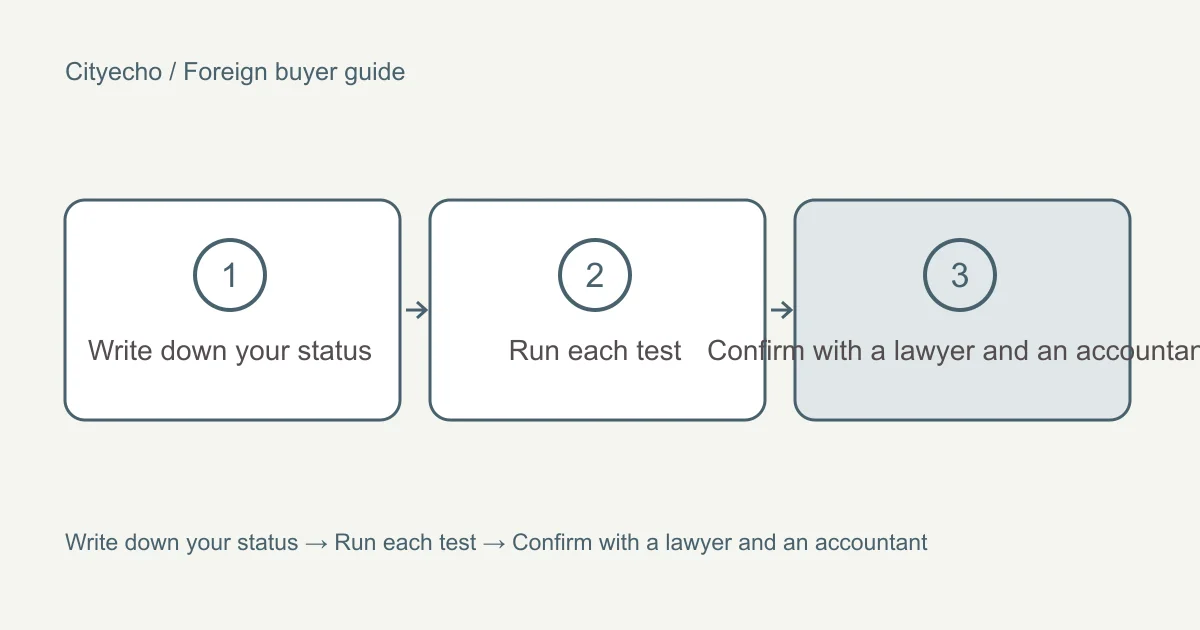
Write down your status on the day you expect to sign: citizenship, immigration status and permit dates, where your spouse and children live, where you earn your income, and how you plan to hold title. Then take that list to a BC lawyer for the ban and the transfer tax, and to an accountant who works with non-residents for income tax.
Status also decides who can claim the newcomer GST rebate. The Canada Revenue Agency's first-time home buyers' GST rebate is open only to a Canadian citizen or permanent resident who is at least 18 and buys the home as a primary place of residence. Our journal article on GST on new construction homes explains the rebate in full.