

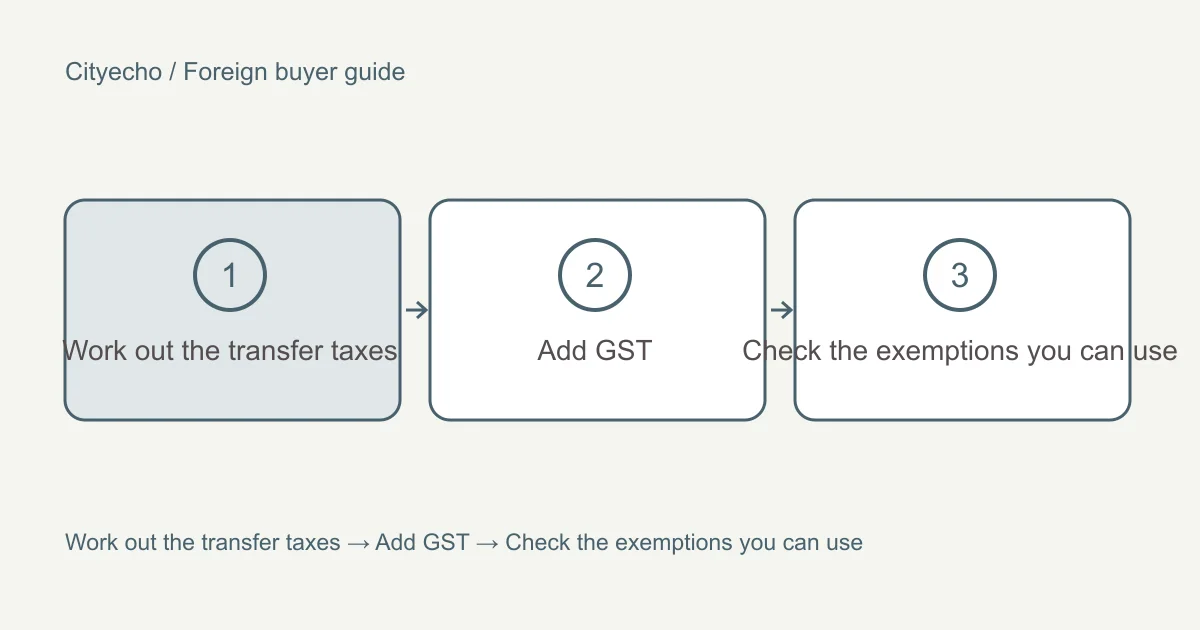
A buyer from outside Canada pays more tax on a new Coquitlam house than a Canadian buyer pays on the same house. Three taxes apply when you buy, and two of the exemptions that lower the bill for Canadians are closed to you.
Two exemptions that lower the bill for Canadians, the newly built home exemption and the first-time buyer GST rebate, require Canadian citizenship or permanent residence, and a foreign buyer pays the 20% additional tax on top. Who counts as a foreign buyer for each tax is set out in the chapter on who counts of our foreign buyer guide. The taxes you pay every year after you buy are in the yearly taxes chapter.
The three taxes
| Tax | Who sets it | Rate | Who pays it |
|---|---|---|---|
| General property transfer tax | Province of British Columbia | 1%, 2% and 3% across value bands, with a further 2% on residential value above $3,000,000 | Every buyer |
| Additional property transfer tax | Province of British Columbia | 20% of the fair market value of the foreign buyer's share | Foreign nationals, foreign corporations and taxable trustees |
| GST | Government of Canada | 5% in British Columbia | Every buyer of a new house from a builder |
Every rate here was read on the government pages listed at the end of this chapter on 9 November 2026. Governments change rates, so check them again before you sign.
General property transfer tax
The province's property transfer tax page, updated on 3 December 2025, sets the general rates. The tax is 1% of the fair market value up to and including $200,000, 2% of the value above $200,000 up to and including $2,000,000, and 3% of the value above $2,000,000. A further 2% applies to residential value above $3,000,000.
The tax is based on the fair market value on the day the transfer is registered at the Land Title Office. The province says you or your legal professional must file a property transfer tax return, and that most transfers are completed by a legal professional.
Canadian buyers of a new house can use the newly built home exemption. It needs a fair market value of $1,100,000 or less, use as a principal residence, and a buyer who is a Canadian citizen or permanent resident. A foreign national cannot use it. On 9 November 2026, every new detached house for sale in Coquitlam also asked more than $1,100,000.
The 20% additional tax
The additional property transfer tax applies to foreign nationals, foreign corporations and taxable trustees buying residential property in the Metro Vancouver Regional District and four other regional districts. Coquitlam is in Metro Vancouver.
The rate is 20% of the fair market value of your proportionate share. The province defines that share as the percentage interest you register on title. Its own example is a foreign entity taking a 70% interest, which pays the 20% on 70% of the value.
The province lists three exemptions: a transfer that is exempt from property transfer tax, a confirmed BC Provincial Nominee, and a purchase on behalf of a Canadian-controlled limited partnership. It lists no exemption for a newly built home. A buyer who becomes a permanent resident or citizen within one year of registration, and meets the other conditions, may get the tax back, as the chapter on who counts explains.
GST on a new house
A new house sold by a builder carries GST. The Canada Revenue Agency's rates table lists 5% for British Columbia. The table lists British Columbia as a GST province, and the 5% applies to the price of the house.
Two GST rebates lower this bill for some buyers, and both are hard or impossible for a foreign buyer to use.
The first-time home buyers' GST rebate requires you to be a Canadian citizen or permanent resident, at least 18, and buying the home as your primary place of residence. A foreign national does not qualify.
The GST new housing rebate is for an individual buying the home for use as their own primary place of residence or a relation's. Corporations and partnerships cannot claim it. A buyer who lives abroad and does not move in, or rents the house to an unrelated tenant, does not meet the residence test. The GST chapter of the costs and taxes guide covers the amounts and the price limits.
A worked example
This example uses a hypothetical new Coquitlam house with a fair market value of $2,400,000 and a builder's price of $2,400,000 before GST. The buyer is one foreign national who registers 100% of the title and has no exemption.
| Item | How it is worked out | Amount |
|---|---|---|
| General tax, first band | 1% of $200,000 | $2,000 |
| General tax, second band | 2% of $1,800,000 | $36,000 |
| General tax, third band | 3% of $400,000 | $12,000 |
| Additional property transfer tax | 20% of $2,400,000 | $480,000 |
| GST | 5% of $2,400,000 | $120,000 |
| Total taxes at purchase | $650,000 |
The general tax comes to $50,000. No further 2% applies, because the value is below $3,000,000. The taxes add $650,000 to a $2,400,000 house, which is 27.08% of the price.
Two cautions. First, ask your lawyer which value is used for the transfer tax on a new house where GST is added to the price, because the province's examples do not address GST. Second, a real purchase has more costs than these: legal fees, title insurance if you buy it, and the adjustments on the builder's statement. The costs and taxes guide lists them.
How this compares with a Canadian buyer
A Canadian citizen or permanent resident buying the same $2,400,000 house pays the same general transfer tax of $50,000 and the same GST of $120,000. The newly built home exemption does not help them either, because the value is above $1,100,000. Neither does the regular GST new housing rebate, which the GST chapter shows is limited to lower prices.
So the Canadian buyer's taxes come to $170,000 and the foreign buyer's to $650,000. The whole difference, $480,000, is the 20% additional tax. A buyer who expects permanent residence within a year should check the refund conditions, and talk to a lawyer about timing before signing.
Working back from your budget
If you know the total cash you can spend on the house and its taxes, you can work out the highest price you can pay. For a house priced between $2,000,000 and $3,000,000, bought by one foreign national with no exemption, the general tax is 3% of the price minus $22,000. Adding the 20% additional tax and the 5% GST, the total cost is 1.28 times the price, minus $22,000.
So a budget of $3,000,000 for the house and these three taxes allows a price of $2,360,937, because $3,022,000 divided by 1.28 is $2,360,937.50. Check the result, rounded to the dollar: general tax $48,828, additional tax $472,188 and GST $118,047. Before rounding, these three taxes and the price total exactly $3,000,000.
This shortcut works only inside that price band and only for these three taxes. Your lawyer's figures replace it once you have a real house and a real contract.
Buying with a Canadian
When a foreign national buys with a Canadian spouse or partner, the federal ban allows the purchase, and the 20% tax applies only to the foreign buyer's registered share. On the same $2,400,000 house, a 50% foreign share gives an additional tax of $240,000. The general tax and the GST stay the same, because they apply to the whole purchase.
How you split the title is a legal and tax decision with effects years later, on the vacancy tax, on income tax when you rent, and on a sale. Decide it with a lawyer and an accountant before you sign, and register the split you agreed. Our journal article on buying with family covers co-ownership agreements.
When the money is due
The transfer taxes are worked out on the value on the day the transfer is registered at the Land Title Office, and the return is filed at registration. The province says most transfers are completed by a legal professional, who registers the transfer on completion day. GST is paid to the builder as part of the price. So plan for all three taxes on the completion day, with the down payment and the rest of the price.
A buyer sending money from abroad should allow time for the transfer to arrive and clear. The chapter on paying from outside Canada explains the identity checks, the cash rules and the mortgage limits that apply.