

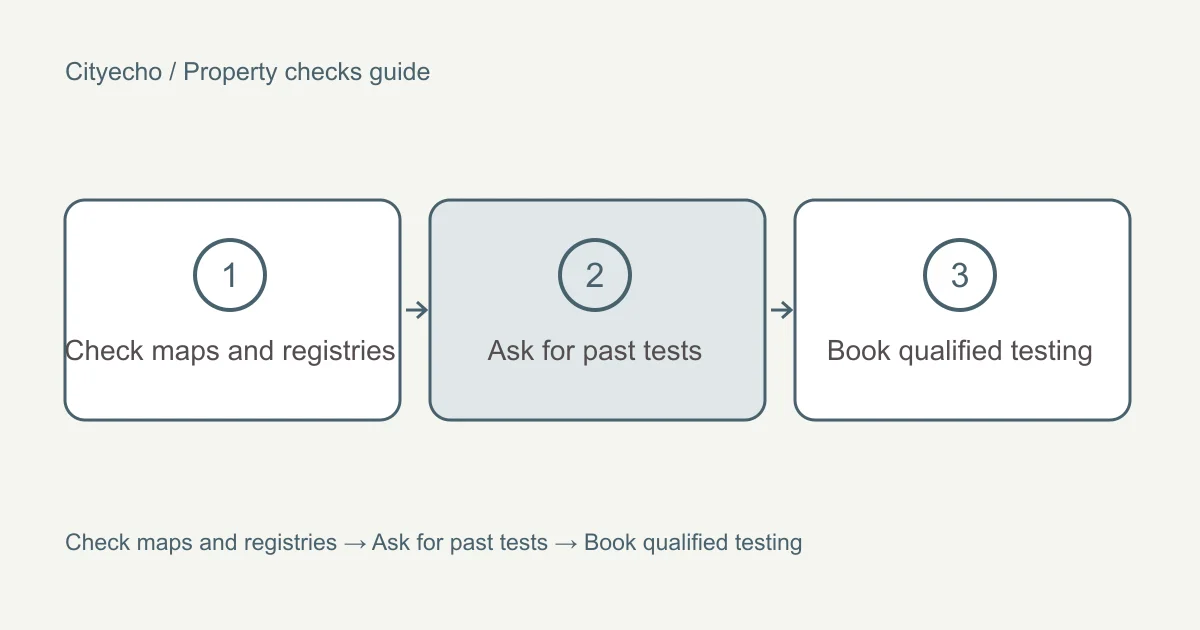
Some of the risks in an older house cannot be seen during a viewing. Asbestos can sit inside a ceiling finish or under a floor. Radon is a gas with no colour or smell. Flood hazard, wildfire threat and past contamination depend on where the lot is and what happened on it. For each of these, a buyer can check some things alone, from public maps and registries, and other things need testing by a qualified person.
This chapter is part of the property checks guide. A buried heating oil tank is covered in its own chapter on buried oil tanks, with the journal article on oil tank searches. Water from the ground and the pipes is covered in drainage and services.
What you can check yourself and what needs testing
| Hazard | What you can check yourself | What needs a qualified person |
|---|---|---|
| Asbestos | The year the house was built, and materials to list as questions | Sampling by a licensed asbestos surveyor |
| Radon | Ask for past long term test results and where they were taken | A test of at least 3 months, and mitigation by a certified professional |
| Flood | Provincial and city flood maps for the address | City staff for a final determination, and an engineer for site questions |
| Wildfire | Provincial threat maps for the area | A site level assessment, and your insurer's view |
| Contaminated land | The free iMapBC layer, and past uses you can learn about | An environmental professional |
Asbestos in houses built before the 1990s
WorkSafeBC's asbestos campaign for homeowners says asbestos was used for fire protection and insulation in more than 3,000 building materials from the 1950s to the 1990s. It names drywall, textured ceiling coat, insulation, vinyl flooring and window putty as materials that often contained it. It says that if a home was built before 1990, it is likely that at least some parts contain asbestos that could be released by renovation, demolition or maintenance. Newer homes can also contain asbestos if older materials were used.
WorkSafeBC's asbestos hazards page adds that you cannot tell whether a material contains asbestos by looking at it. If you suspect it, do not touch or move it.
What a buyer can check: the year the house was built, from the listing or the city file, and the materials visible during a viewing. Record them as questions. Home inspection contracts must state whether the inspector will inspect for asbestos, as the home inspection chapter explains.
What needs testing: WorkSafeBC tells homeowners to get the home tested before a renovation, demolition or maintenance that could disturb asbestos. The steps are to hire a licensed asbestos surveyor, who takes samples, sends them to a lab and reports where asbestos is. Then a licensed abatement contractor contains or removes it and confirms the work in a report. WorkSafeBC says anyone you hire for this work must be licensed in BC, and that hiring unlicensed contractors can lead to a stop work order and added costs.
For a buyer, the practical question is what you plan to do after completion. If you plan to renovate, the asbestos survey is part of the cost and the timeline of that work. Ask the seller whether any survey or abatement report exists.
Radon
Health Canada's page on what you need to know about radon describes radon as a radioactive gas from uranium in the ground that can enter a home undetected. It says all homes have some radon, and the only way to know the level is to test. It gives the Canadian guideline as 200 becquerels per cubic metre.
Health Canada's page on testing your home says to conduct a long term test for a minimum of 3 months. The what you need to know page says fall or winter is the ideal time. The Government of Canada radon guideline recommends corrective action when the average annual level in the normal occupancy area exceeds 200, and action within one year when a test is above the guideline. It defines the normal occupancy area as any part of the building where a person is likely to spend more than 4 hours a day.
That test length matters for a purchase. Compare it with your subject deadline: a test started after your offer is accepted will finish months later. BCFSA's consumer guide to radon says there is currently no legal requirement to test a property for radon. It suggests a buyer first ask whether the seller has done a long term test, ask for a copy of the results, and ask where in the home the test was done. If no test was done, it suggests a buyer may request a holdback to fund mitigation if later testing shows high levels. BCFSA also says radon levels above 200 Bq/m3 are considered a material latent defect that a real estate professional must disclose.
Health Canada says testing can be done with a do it yourself kit or by a professional certified under the Canadian National Radon Proficiency Program, and that a certified mitigation professional can reduce high levels.
Flood information
The Province's floodplain mapping page explains what a floodplain map shows: areas that may flood, and sometimes flood construction levels and setbacks. It says floodplain maps outline areas highly susceptible to flooding, and that flooding may still occur outside those areas. It says that since 2003, local governments hold the authority for most floodplain development decisions. Older provincial floodplain maps are available in the ClimateReadyBC Flood Study Explorer.
For a Coquitlam address, the city's building permits FAQ says QtheMap identifies lots that may be affected by high water levels, and recommends contacting the Building Permits Division for a final determination. For Port Coquitlam, the drainage and services chapter explains where PoCoMAP shows flood construction levels.
Wildfire information
The Province publishes the Provincial Strategic Threat Analysis, in a 2021 update. The Province says it maps potential wildfire threats to communities, infrastructure and natural resources, and that local governments, private landowners and others can use it to review threat ratings in their areas and see how much prevention work, such as FireSmart activities, has been done. It rates threat across wide areas. For a lot that backs onto forest, ask the city and your insurer what applies to that address.
Contaminated land and the site registry
The Province keeps a public site registry. Its site information page says the registry holds records about the identification, investigation and remediation of contaminated sites. You can search the Environmental Remediation Sites layer in iMapBC for free. A full search goes through BC Registries and Online Services, where a Site Details Report costs $150 plus a service charge and GST. The page says the existence or absence of information in the registry gives no assurance that a site is or is not contaminated.
The Province's page on identifying and disclosing sites that may be contaminated explains the site disclosure statement. It applies to sites that have had one of the commercial or industrial uses in Schedule 2 of the Contaminated Sites Regulation. The Province says a commercial activity on residential land must be declared as a Schedule 2 use, while a private resident doing occasional repairs on personal vehicles is not a Schedule 2 use. It tells owners to give a prospective buyer a copy of the statement.
Coquitlam's building permits FAQ also answers a buyer question: to find out whether a house was used as a grow op, you must attend or contact the Building Permits Division.
Questions for the seller
Ask the seller, in writing and through your real estate professional, for any records on these hazards. Has an asbestos survey been done, and was any material removed or contained? If so, who did the work, and is there an abatement report? Has the house been tested for radon, over what period, on which floor, and with what result? Was any radon mitigation installed? Has the house or the lot ever flooded? Has the property had any commercial or industrial use, and has a site disclosure statement ever been prepared?
Keep each answer with its date and the name of the person who gave it. A report is stronger evidence than a verbal answer. Where the seller does not know, record that as well. An unknown answer is a reason to test or to discuss a holdback, and your lawyer or notary can explain how either would be written into the contract.
Putting the checks in order
Start with the free sources during the subject period: the flood maps, the wildfire threat maps, iMapBC, and the city's answers. Ask the seller for any asbestos survey, radon test and environmental report. Then book testing for anything the records leave open, and discuss any item that cannot be tested in time with your lawyer or notary and your real estate professional.