

A home inspection gives you a licensed person's opinion on the visible condition of a house on one day. For a detached home in Coquitlam or Port Coquitlam, that opinion is often the main physical evidence you have before a subject deadline. It helps to know exactly what the inspection covers, what the contract leaves out, and how to turn the report into a list of next steps.
This chapter is part of the property checks guide. It starts after you have a house in mind. For what to look at during an ordinary showing, use the house viewing chapter of the home buying guide. For a room by room list to bring on the day, the journal article on the BC home inspection checklist covers that narrower task.
Three kinds of evidence on one inspection day
Keep three kinds of information apart as you read this chapter. The first is what you can observe yourself: a stain, a sloped floor, a musty smell, a door that sticks. The second is what a document proves: the inspection contract, the written report, a permit record, a receipt for past work. The third is what only a qualified person can decide, such as whether a crack is structural or whether wiring is safe.
A home inspector sits between the first and third groups. The inspector looks at more than you can and knows what the signs of common problems look like. Consumer Protection BC puts it plainly on its home inspection page: a home inspection is a visual inspection only, inspectors are trained to recognise signs of major problems, and they are not experts in all fields. It adds that an inspection can help reduce risk and cannot remove it.
That description sets the right expectation. The report tells you where to look harder. When it recommends a specialist, that recommendation is a finding in its own right.
Who licenses home inspectors
British Columbia licenses home inspectors. The Province's home inspectors page states that licensing is mandatory and that Consumer Protection BC licenses inspectors and enforces the rules. The rules come from the Business Practices and Consumer Protection Act and the Home Inspector Licensing Regulation.
Consumer Protection BC says a licensed inspector must meet education and training requirements, be insured, and complete a criminal record check. On its obligations page for licensees, it lists the insurance: $1 million of professional liability coverage and $1 million of general liability coverage. It also says the licence number must appear on the inspector's contracts and advertising.
Before you book, search the inspector's licence on the Consumer Protection BC site and check for any enforcement action. Consumer Protection BC also suggests getting at least three written estimates and choosing on qualifications and reputation as well as price. Book early. A subject period is short, and a good inspector's calendar can fill.
The contract sets the scope
The inspection contract is the document that decides what the inspector will look at. Section 12 of the regulation lists what it must contain. The contract must give the address of the property, say what the inspection will cover, and state whether the inspector will inspect for mould and whether the inspector will inspect for asbestos. It must say whether the inspection is non-invasive or list the invasive procedures the inspector will use. It must also carry a fixed statement explaining that home inspectors are licensed and regulated under the Act.
The same section limits what the contract can do. It must not exclude a garage or carport, attached or detached. It must not limit the inspector's liability or the amount of that liability. It must not limit the time you have to make a claim. Consumer Protection BC notes that the Limitation Act, which has a basic limitation period of two years, may apply.
Read the contract at least a day before the inspection. Look for three things. First, the list of what is covered, and anything listed as excluded, such as a pool, a detached shop, or a secondary suite. Second, the mould and asbestos lines. Third, the word non-invasive. Consumer Protection BC notes that most inspections are visual, so the inspector is limited to what can be checked and seen. On a house built before the 1990s, many of your questions sit behind finished surfaces.
If the contract leaves out something you care about, ask whether the inspector can add it or whether a specialist is the better choice. Consumer Protection BC says that if required information is missing from the contract, you should work with the inspector to correct it before you sign.
Inaccessible areas and what they mean
Every report has limits written into it. Section 13 of the regulation requires the report to specify what is not covered by the home inspection. That list includes items the contract excluded and items the inspector could not reach on the day.
Examples include a crawlspace with a small or blocked hatch, an attic with no safe access, a roof too steep or wet to walk, a basement wall behind stored boxes, and a finished ceiling that hides the plumbing. A report might say that an area was not inspected, was partly visible, or was viewed from a distance.
Treat each of those lines as an open question with a deadline. You cannot assume the hidden area is in the same condition as the visible ones. Ask the seller, through your real estate professional, whether the blocked area can be cleared. Ask the inspector whether a return visit before subject removal is possible and what it would cost. For a crawlspace, drainage, a buried tank or a sewer line, a specialist may be the only person who can answer. Those checks have their own chapters: buried oil tanks, drainage and services, and environmental and hazard checks.
BCFSA's guide to disclosures explains why this matters. It describes material latent defects as hidden defects that cannot be discovered on ordinary inspection, and it says a listing real estate professional who knows of one must disclose it in writing. BCFSA's inspection guide adds that defects readily found during a property inspection do not have to be disclosed.
Reading the report as an opinion on condition
The regulation says what a report must contain. It must set out an opinion on the condition of each thing the contract required the inspector to inspect. It must identify the items on which the inspector recommends you get expert advice. It must list what the inspection did not cover. It must include your name and address, the inspector's name and licence number, the property address, and the date of the inspection. The inspector must deliver it on or before the date in the contract.
Notice what is missing from that list: prices. Consumer Protection BC advises that the inspector should not give estimates or refer you to a contractor, and that you should get repair quotes from independent contractors. The report describes condition. Repair cost and the effect on the price are questions for contractors and your real estate professional.
A practical way to read a long report is to sort each finding into one of four groups:
- Safety items, such as missing smoke alarms, exposed wiring or a damaged stair.
- Items that need a specialist, which the report must flag.
- Items at the end of their usual life, such as an older roof covering or water heater.
- Maintenance, such as clearing gutters or sealing gaps.
Then write, beside each finding in the first two groups, who will answer it and by what date. That list is what you take to your real estate professional and, where the contract terms are involved, to your lawyer or notary.
| What you have | What it can establish | Who to ask next |
|---|---|---|
| Your own viewing notes | What you saw and where | The inspector |
| The inspection contract | What was in scope, including mould and asbestos | The inspector, before signing |
| The written report | An opinion on the condition of covered items, and what was not covered | Specialists named in the report |
| A contractor's written quote | A price for defined work | Your real estate professional and lender |
The inspection inside the purchase timeline
In most resale purchases, the inspection happens during a subject period written into the contract of purchase and sale. The subject clause gives the buyer a set number of days to be satisfied with an inspection. Book the inspection so the report arrives well before the deadline in that clause.
BCFSA's consumer guide to property inspections addresses the questions that arise in a busy market. A seller does not have to accept an offer that includes an inspection subject. If the seller removes the clause in a counter offer, BCFSA advises you to speak with your real estate professional about the risks. On waiving an inspection, BCFSA calls it a personal decision to make once you understand the risks, and notes that defects readily found by an inspection do not have to be disclosed. The guide also says a buyer may choose any inspector unless the contract says otherwise.
If you plan to write an offer without an inspection subject, one option is an inspection before the offer date. Ask the listing side whether the seller allows it, and remember that the scope and inaccessible area rules above still apply.
Attending, asking and keeping records
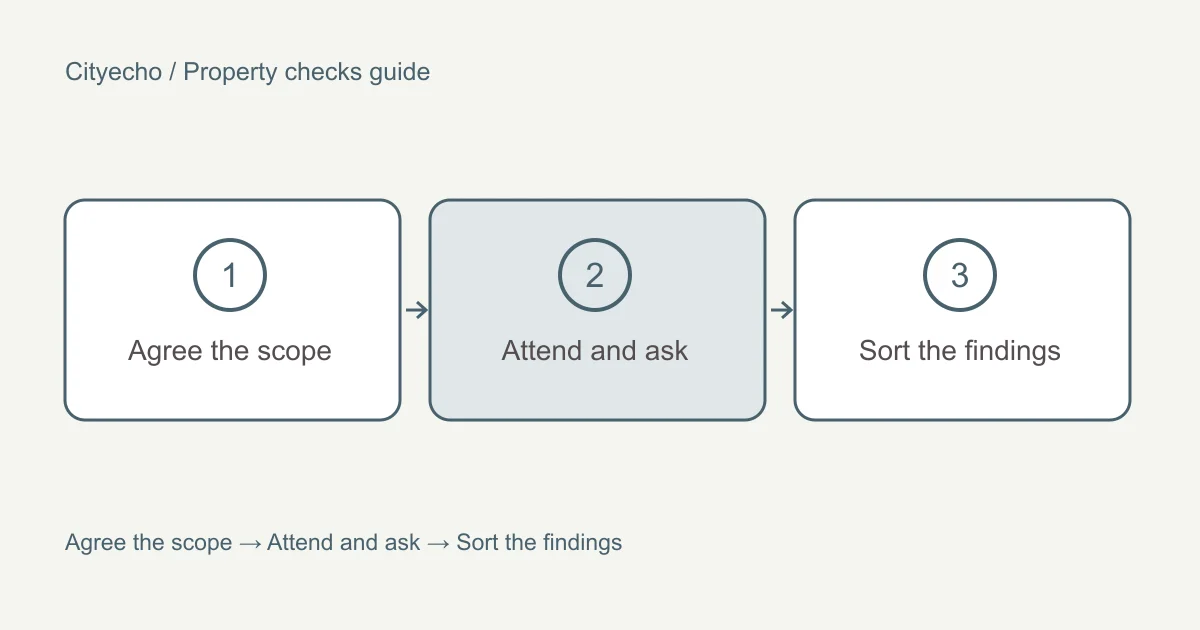
Consumer Protection BC says you are welcome to attend the inspection. It suggests asking for a walk-through and a verbal summary before the written report is prepared. Attending lets you see what the inspector could and could not reach. It also gives you a chance to ask what a finding means in plain words.
Bring the signed contract, your viewing notes, and any documents the seller has provided, such as a disclosure statement or past repair invoices. Ask the inspector to point out anything that needs a specialist. Ask what the inspector would want to see before calling an area satisfactory.
Keep the report, the contract and your notes together after the purchase. If something the inspector missed appears later, those records show what was in scope and what the report said. Consumer Protection BC says that if a report lacks required information, you can ask the inspector to correct it, and that you can contact Consumer Protection BC if you cannot resolve the issue.
Where the inspection leaves off
Title, permits and the status of a suite are separate checks. They rest on records held by the Land Title and Survey Authority and the city. Continue with permits and unpermitted work for alterations you saw during the inspection, and with title search and charges for what is registered against the land.
If the report raises a question you cannot answer before the subject deadline, raise it with your real estate professional early. The options, such as asking for more time, asking for a price change, or not removing the subject, depend on your contract. A lawyer or notary can explain what the contract allows.