
Survey Certificate or Title Insurance in BC: What Each One Actually Does
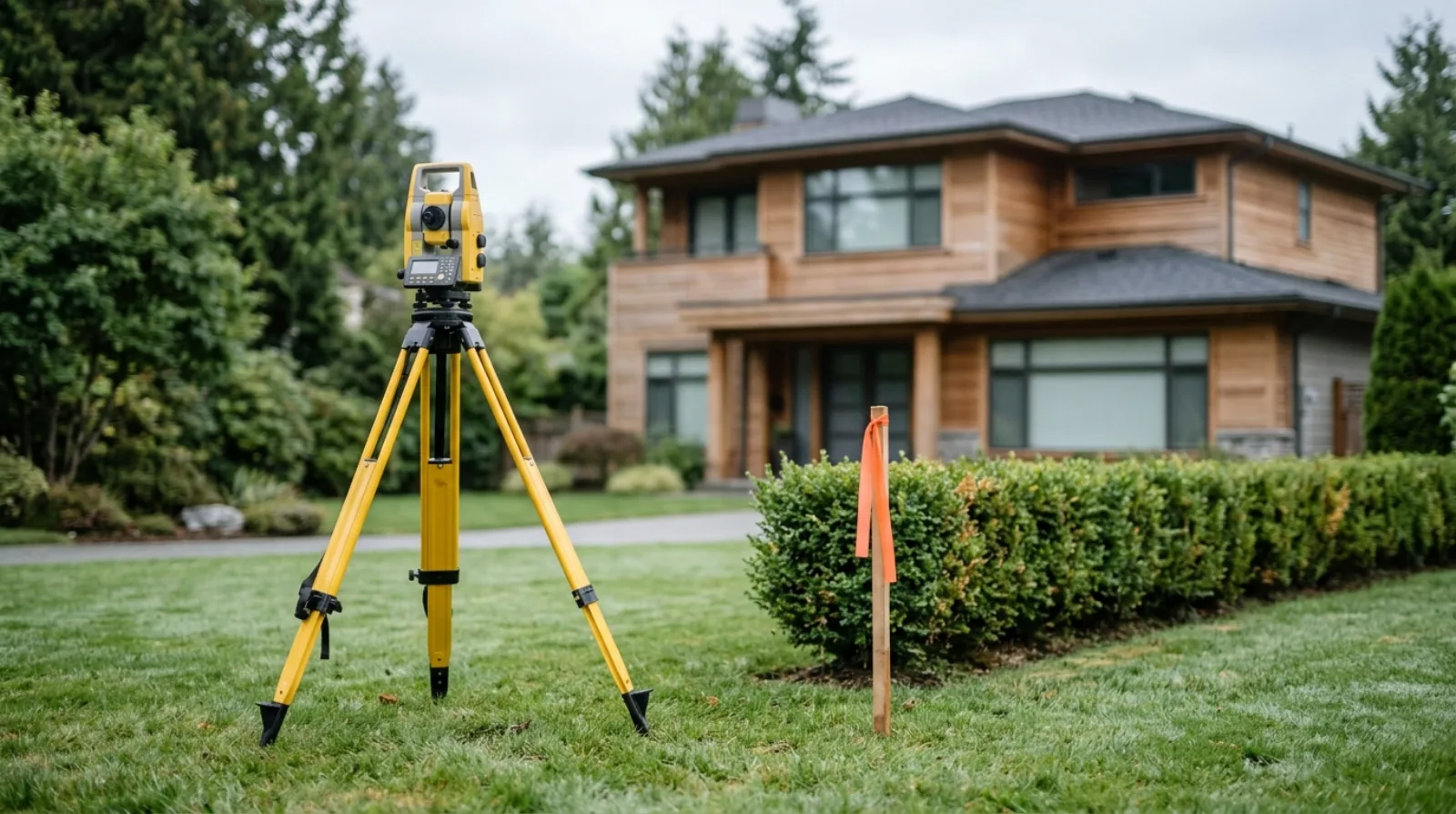
Somewhere around two weeks before completion, a form arrives from your lawyer or notary asking you to choose between a survey certificate and title insurance.
Most BC buyers tick title insurance. It is cheaper, it can be arranged in a day, and the person handing over the form usually says the lender accepts it. All of that is true.
It is still worth understanding what the two documents do, because they do not do the same job, and the gap between them matters on exactly one kind of property: the kind you intend to build on.
Start with what the land title register proves
British Columbia runs a Torrens land title system, and it is a good one. The Land Title and Survey Authority describes it as regarded among the very best in the world.
Registration gives you indefeasible title, which the LTSA defines plainly: a title that is indefeasible cannot be defeated, revoked or made void. Behind it sits an Assurance Fund that compensates owners who are financially affected by a title registration error or who become the innocent victim of title fraud. The LTSA also notes that title fraud is exceedingly rare in British Columbia.
So ownership is solid. Here is the part almost nobody is told at closing.
The Land Title Practice Manual, which is the LTSA's own reference work, states that the British Columbia Torrens system does not guarantee the accuracy of property boundaries. The Land Title Act deals with this separately: section 100 provides for depositing a reference plan where boundaries are re-surveyed, and Part 23 gives the minister authority to order a special survey.
Read those two facts together and the whole question becomes clear. The register tells you which parcel you own. It does not tell you where that parcel's edges run across the dirt.
Who is allowed to answer the boundary question
Under the Land Surveyors Act, boundary work is reserved. The Act's definition of the practice of land surveying covers activities to determine, locate, define, describe, establish or re-establish boundaries, and to certify the location of a natural or artificial feature relative to a boundary. Section 59 restricts that practice to practising land surveyors and restricts use of the designations B.C.L.S. and P.L.S.
Other professionals can do related work, provided it does not involve determining or certifying a boundary. Your lawyer cannot tell you where the line is. Your realtor cannot. Your neighbour's fence certainly cannot, and a fence being in the wrong place is the single most common way this surfaces.
Only a BC Land Surveyor can answer it, and a survey certificate is the document where they answer it.
What each product actually is
A survey certificate is a measurement. A BC Land Surveyor attends the property, works from the registered plans and the survey monuments, and produces a drawing showing the parcel boundaries, where the buildings and improvements sit inside them, and whether anything crosses a line, a setback or an easement. Some transactions use a building location certificate instead, which concentrates on where the structures sit relative to the boundaries. Your lawyer or notary will confirm which form your lender wants.
Title insurance is an indemnity policy. It does not measure anything and it does not prevent anything. If a covered problem surfaces later, the insurer pays under the terms of the policy. Typical coverage includes title defects, registration errors, fraud against the title, and certain boundary and encroachment problems.
That last category is why the two get presented as alternatives. They are not substitutes so much as different responses to the same risk: one tells you the answer now, the other writes a cheque later.
A payout is useful when a problem you could not have foreseen arrives on your doorstep. It helps far less when the problem is a garage you are about to build two feet over the line, because by then the money arrives after the mistake is already in the ground.
The lender policy trap
This one costs people real money, so read it twice.
Title insurance comes in two forms. A lender policy protects the lender's security interest, up to the mortgage amount. An owner policy protects your own equity.
If your lender required title insurance as a condition of funding and a lender policy was issued, the lender is covered. You are not. A claim under that policy pays down the mortgage, and your down payment and your equity are not part of the arrangement.
Ask your lawyer or notary one direct question: whose name is on the policy being issued, and does it cover me as owner? An owner policy is usually a modest addition when bought at the same time. It is much harder to add later.
Cost and timing, honestly
I am not going to quote you a price, because survey fees depend on the lot, the terrain, how much of the original survey evidence still exists in the ground, and how busy the surveyor is. Title insurance premiums depend on the property value and the insurer. Both change over time, and a number written into a blog post in 2026 will be wrong by the time somebody reads it.
What is stable is the shape of the comparison:
- Title insurance is the cheaper of the two on a typical single family purchase, and it is a one-time premium paid at closing rather than an annual bill.
- Title insurance can usually be arranged by your lawyer or notary within a day, which is why it rescues so many tight completion dates.
- A survey has to be scheduled, attended and drafted, so it needs lead time. Ordering one late is a common reason completions get pushed.
Ask for both figures on your specific property before you decide. Your lawyer or notary can quote the premium, and a local BC Land Surveyor will quote the survey on the address. Both of these belong in the budget alongside everything else in closing costs for BC buyers.
How to decide
The test I give buyers is one question: are you going to build anything?
A fence, a deck, a garage, a carport, an addition, a pool, a retaining wall. If the answer is yes, or might be yes within a few years, get the survey. An insurance payout does not move a foundation. It does not un-pour concrete, it does not rebuild a deck the City has ordered removed, and it does not repair the relationship with the neighbour whose land you built on.
Get the survey when:
- You are buying a detached house on a lot and plan to build or fence.
- The fences look wrong, or the neighbour's shed, garage or driveway appears to sit close to the line.
- There is a lane, a shared driveway or an easement in the picture.
- The lot is older, irregular or sloped, or the original survey evidence is likely to be disturbed.
- You are buying for redevelopment, where every setback calculation starts from the boundary. If you are weighing a lot for a small multi-unit build, the boundary is the first input, as we cover in the Cambie Corridor multiplex guide.
Title insurance alone is a reasonable choice when:
- You are buying a strata lot, where the unit boundaries come from the strata plan and you will not be building on the exterior.
- You have no construction plans and the property is straightforward.
- An existing survey is available and the seller will sign a statutory declaration that nothing has changed since it was made.
And this is not either/or by nature. Buyers who are building sometimes take both: the survey for the boundary, the owner policy for the title defects and fraud that no survey would catch.
The old survey question
Lenders will often accept an older survey certificate supported by a statutory declaration from the seller confirming that no buildings or structures have been added or altered since the survey date.
That declaration is carrying the weight of the whole document, so treat it seriously. If a deck went on in 2019, or a shed appeared, or a fence was moved, the survey no longer describes the property as it stands. Compare the survey drawing against what you actually saw at the viewing. If something is on the ground that is not on the drawing, the declaration cannot be signed truthfully and the survey is not current.
This is the same category of pre-completion verification as the other documents you are checking. The BC home inspection checklist covers the physical condition side, and title search and charges explained covers what is registered against the title itself.
What to ask, and when
Do this at the start of the conveyancing rather than two weeks out:
- Ask your mortgage broker or lender whether a survey is required, or whether title insurance is accepted on this property.
- Ask your lawyer or notary which policy they intend to order, whether it is a lender policy or an owner policy, and what the owner policy adds.
- Ask the listing agent whether an existing survey certificate is on file, and what its date is.
- If you plan to build, order the survey as soon as your conditions are removed rather than waiting for the closing paperwork.
What this comes down to
- BC's land title system guarantees ownership, backed by indefeasible title and the Assurance Fund.
- The Land Title Practice Manual states the system does not guarantee boundary accuracy.
- Under the Land Surveyors Act, only a practising BC Land Surveyor may determine or certify a boundary.
- Title insurance pays money after a covered problem surfaces. It is a one-time premium and can be arranged quickly.
- A survey certificate shows the lines before you act on them.
- A lender policy does not cover you. Confirm whether an owner policy is being issued.
- If you intend to build anything, get the survey.
- Contact our team to check whether a survey certificate exists for a specific address, or browse listings.
Plan your next step
Work through neighbourhood checks before you write, and use the home-buying guide to line up your lawyer or notary early, so the survey question comes up while there is still time to order one.
Frequently asked questions
Does BC's land title system guarantee my property boundaries?
No. The land title system guarantees ownership rather than geometry. The Land Title Practice Manual states that the British Columbia Torrens system does not guarantee the accuracy of property boundaries. Registration gives you indefeasible title to the parcel, and the Land Title Act provides for depositing a reference plan where boundaries are re-surveyed under section 100. Where the line physically runs on the ground is established by survey.
Who is allowed to determine a property boundary in BC?
Only a practising BC Land Surveyor. The Land Surveyors Act reserves the practice of land surveying, which its definitions describe as work to determine, locate, define, describe, establish or re-establish boundaries, and to certify the location of natural or artificial features relative to a boundary. Section 59 restricts that practice and restricts the use of the designations B.C.L.S. and P.L.S. Other professionals may do related work provided it does not involve determining or certifying a boundary.
What is a survey certificate?
It is a document prepared by a BC Land Surveyor showing the parcel boundaries, where the buildings and other improvements sit within them, and whether anything crosses a line or sits inside a setback or an easement. Some transactions instead use a building location certificate, which focuses on where structures sit relative to the boundaries. Your lawyer or notary will tell you which form your lender will accept.
What does title insurance actually cover?
It is an indemnity policy, so it pays money when a covered problem surfaces rather than preventing the problem. Typical coverage includes title defects, registration errors, fraud against your title, and certain boundary and encroachment problems. Coverage varies between insurers and between policies, so read the specific policy wording and its exclusions before you rely on any single item in that list.
Is there a difference between a lender policy and an owner policy?
Yes, and this catches people out. A lender policy protects the lender's security interest up to the mortgage amount. It does not pay you. An owner policy protects your own equity in the property. If your lender required title insurance and you only bought the lender policy, you personally are not covered. Ask your lawyer or notary which policy is being issued and whose name is on it.
Does my lender have to accept title insurance instead of a survey?
That is the lender's call rather than a rule of law. Institutional lenders in BC commonly accept title insurance in place of an up-to-date survey certificate on residential transactions, and it has become the usual route. Some lenders, and some property types, still call for a survey. Ask early, because ordering a survey late is what delays closings.
I am buying a condo. Do I need to think about this at all?
The boundary argument is much weaker for a strata lot, because your unit boundaries are set by the strata plan and you are not going to build anything on the exterior. The title-defect and fraud side of the coverage still applies to you. Most condo buyers take title insurance and do not order a survey, which is a reasonable position.
When would a survey certificate be worth the extra cost?
When you plan to build. A fence, deck, garage, addition or pool all need the line on the ground before work starts, and an insurance payout does not relocate a foundation that was poured in the wrong place. It is also worth it on older detached lots where fences look out of position, where a lane or a shared driveway is involved, or where a neighbour's structure appears close to the line.
Can I rely on an old survey the seller already has?
Sometimes. Lenders will often accept an older survey supported by a statutory declaration from the seller confirming nothing has been built or altered since it was made. That declaration is doing real work, so it is only as good as its accuracy. If a deck, shed, fence or addition went in after the survey date, the document no longer shows the current situation.
Does title insurance replace a lawyer or notary?
No. Someone still has to search the title, review the charges registered against it, prepare and register the transfer documents, and handle the money. Title insurance sits alongside that work as a backstop for problems the search cannot rule out. Budget for the legal fees separately.
Sources
- Land Title Practice Manual, Overview of Land Surveys Legislation, Land Title and Survey Authority of BC (accessed September 13, 2026)
- Land Title and Survey Authority of BC, Learn About Title Security in BC (accessed September 13, 2026)
- Land Surveyors Act, RSBC 1996, c. 248 (accessed September 13, 2026)
- Land Survey Act, RSBC 1996, c. 247 (accessed September 13, 2026)