

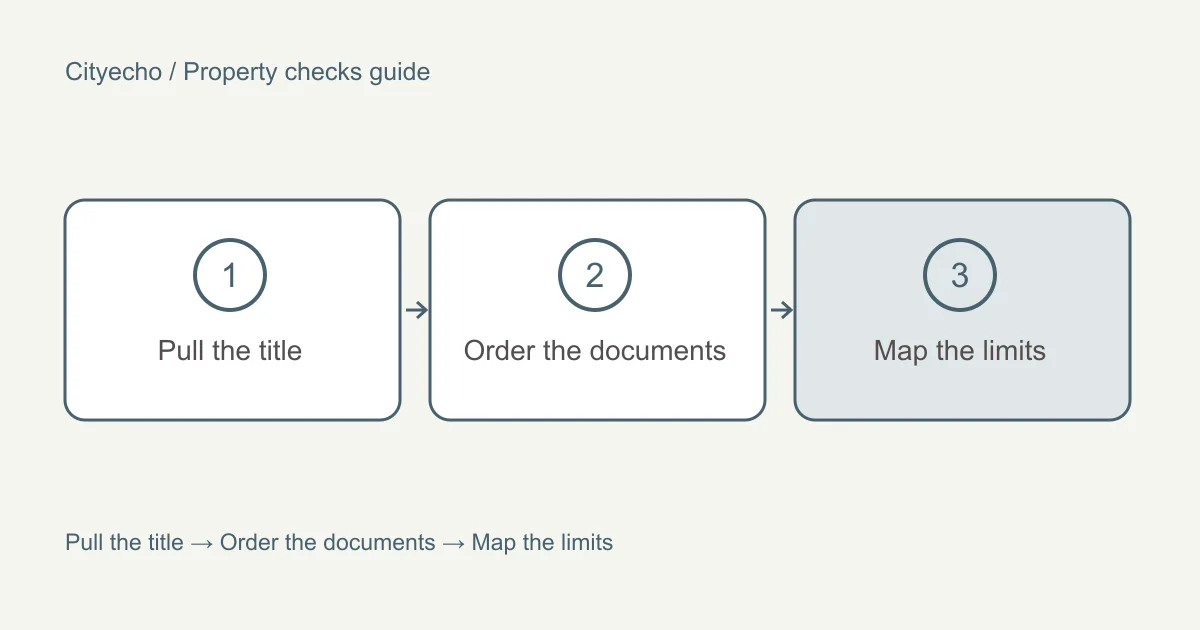
The title is the official record of who owns a piece of land in British Columbia and what rights other people hold over it. For a detached house in Coquitlam or Port Coquitlam, the title can carry rights for the city, for a utility, for a neighbour, or for someone who was not paid for work. Each of those rights can limit what you may build, where you may dig, and who may come onto the lot.
This chapter is part of the property checks guide. The journal article on title search charges explained covers the same charges in a shorter form. Here the focus is on what a buyer can see, what each document proves, and which questions belong with a lawyer or notary.
What the title records
The Land Title and Survey Authority, called LTSA, keeps the title records for the province. LTSA's page on finding information on a title lists what a title shows: the registered owners, the legal description of the parcel, the parcel identifier, any charges, and legal notations registered against the title. The parcel identifier is a unique nine digit number, called the PID.
LTSA explains that charges, also called encumbrances, must be formally registered against the title. It also explains that LTSA staff check ownership each time a property is sold or when interests such as leases, statutory rights of way, easements and restrictive covenants are created.
British Columbia uses a system in which the register itself is the evidence of ownership. LTSA's page on title security says that under this system, legal title changes only by registration, and that an Assurance Fund compensates owners who lose money through a title registration error or title fraud. Section 23 of the Land Title Act makes a registered title conclusive evidence of ownership, subject to a list of exceptions. That list includes charges and claims of builders lien noted on the title, municipal charges and taxes, and a lease of three years or less where the tenant is in actual occupation.
How a buyer gets the title and the documents
You cannot search a title by street address. LTSA says the address on a title may not be the civic address, so a civic address cannot be used to search through an LTSA account or at a land title office counter. LTSA points to ParcelMap BC to find the legal description and PID from an address first.
A title search lists each charge by type, number and date. The terms of the charge sit in a separate registered document. LTSA's page on how to order a document or plan says you need the document number, which is usually on the title, and gives easements as an example of a document. A plan number is often part of the legal description.
LTSA's fee list, as at April 1, 2026, shows a customer fee of $11.06 for a title search and $17.78 for a document or plan order. Searches through an LTSA account also carry a service charge. LTSA says it cannot answer questions about what a record means or research on your behalf, and it points people to professionals for that work.
In practice, your lawyer or notary will search the title before completion. BCFSA's guide to completing your purchase lists searching the title for anyone else's legal rights, and for registered easements or restrictive covenants, among their tasks. Getting a copy of the title early, during the subject period, gives you time to order the documents and ask questions before you commit.
Easements
An easement gives a neighbouring parcel a right over part of your land, or gives your land a right over a neighbour's. The City of Coquitlam's building and construction page describes an easement as an agreement between two private property owners whose properties adjoin, granting access to each other's property for a set purpose. For a private easement between neighbours, the city recommends consulting a private lawyer.
The Land Title Act provides for an easement created to benefit other land to be noted on the title of that other land as well. So a charge may appear on the title of the lot that carries the burden, and a matching entry on the lot that holds the benefit.
What a buyer can observe: a shared driveway, a path to a back lot, a drain line crossing a corner. What the document proves: where the easement runs, what it allows, and who must maintain it. What needs a professional: whether your plans for a fence, a garage or an addition would interfere with it.
Statutory rights of way
A statutory right of way is an easement with no neighbouring parcel that benefits. Section 218 of the Land Title Act lets an owner grant one to the Crown, a municipality, a regional district, the South Coast British Columbia Transportation Authority, a utility and certain other bodies, for any purpose needed to operate and maintain their works. Registration makes it a charge on the land. The terms in the document bind the owner who granted it and every later owner.
Coquitlam's building and construction page describes a right of way as an allowance given by a private owner to the municipality or government to enter the property for a municipal purpose, such as water, sewer, road access and other utility services. The same page says you can view legal lot plans and rights of way at the Engineering and Public Works counter at City Hall.
On a house lot, a right of way may hold a sewer or storm pipe. It can limit where you place a building, a pool or large trees. The drainage and services chapter explains how to find out which pipes serve the house, and the survey chapter explains what happens when a structure sits over a right of way.
Covenants
A covenant is a registered promise about how land will or will not be used. Section 219 of the Land Title Act allows a covenant in favour of the Crown, a municipality, a regional district, the South Coast British Columbia Transportation Authority or certain other bodies to be registered against a title. Such a covenant can control the use of the land or of a building, whether the land is built on and how, and whether it can be subdivided. It is enforceable against the owner who signed it and against every later owner.
Coquitlam's page describes a covenant as an agreement that normally puts restrictions on land and its use. Port Coquitlam's building permit pages tell owners to identify any encumbrances on title, naming easements, rights of way, restrictive covenants and land use contracts, before designing a project.
The only way to know what a covenant on a lot requires is to read the registered document. If you plan to add a suite, a laneway home or an addition, read every covenant before you remove subjects, and take the questions on what the zoning allows to the land and zoning guide.
Building schemes
A building scheme is a set of restrictions that applies to a group of lots sold under one plan of development. The Land Title Act defines it as a scheme in which each buyer enters into a restrictive covenant with the common seller, so the restrictions work as a special local law for that land. Under section 220, an owner selling two or more parcels can register a declaration of building scheme. From the date the registrar endorses it, the restrictions run with and bind all the land in the scheme.
The owners for the time being of the land in the scheme may consent to change or discharge it. Section 220 also says that after October 30, 1979, a building scheme can only be created in the statutory form, with limited exceptions.
A building scheme can restrict the use of each lot and the buildings on it. On an older subdivision, the scheme may have been written decades ago. It still binds the lot until it is modified or discharged. Your lawyer can tell you who could enforce it and whether any part has been discharged.
Liens and other financial charges
A mortgage is the most common financial charge. BCFSA's completion guide lists making sure the seller's old mortgage is properly discharged, if required, as part of the lawyer's or notary's work.
A claim of builders lien works differently. Under section 15 of the Builders Lien Act, a contractor or supplier makes a claim by filing it in the land title office, and the registrar notes it on the title. Section 20 sets the time to file: up to 45 days after a certificate of completion is issued, or up to 45 days after the contract or the work is completed or abandoned. The Act bars a claim under $200.
For a house that was renovated shortly before the sale, that timing matters. A title search today shows only the claims already filed. Ask the seller what work was done in recent months and ask your lawyer or notary how the contract and the completion process deal with a lien filed after you search.
A note under section 57 of the Community Charter can also appear on title. It records that a building inspector found work done without a required permit or inspection, or a condition that breaks building rules. The permits chapter explains what that note means.
| Charge | Who holds the right | What it can limit |
|---|---|---|
| Easement | The owner of a neighbouring parcel | Use of the part of the lot it crosses |
| Statutory right of way | A public body or utility | Building or digging over its pipes or lines |
| Section 219 covenant | A public body, such as the city | Use, building, siting or subdivision |
| Building scheme | The other owners in the scheme | Use of each lot and its buildings |
| Claim of builders lien | An unpaid contractor or supplier | A clean transfer until it is dealt with |
Turning the title into questions
Once you have the title and the documents, make one line per charge. Write the charge number, its type, who holds it, and what it limits in plain words. Then mark the ones that touch your plans for the lot. Take that list to your lawyer or notary and ask three questions for each marked charge: what it allows, who can enforce it, and whether it will remain after completion.
Keep the title search date on the list. The title can change between your search and the day ownership transfers, so ask your lawyer or notary when they will search it again.