

A basement with a separate entrance, a second kitchen and a bedroom may be listed as a suite. Whether it is a lawful secondary suite is a separate question, answered by city records. The difference affects the utility bill, what the city can require of the owner, what you tell your insurer, and whether your lender counts the rent.
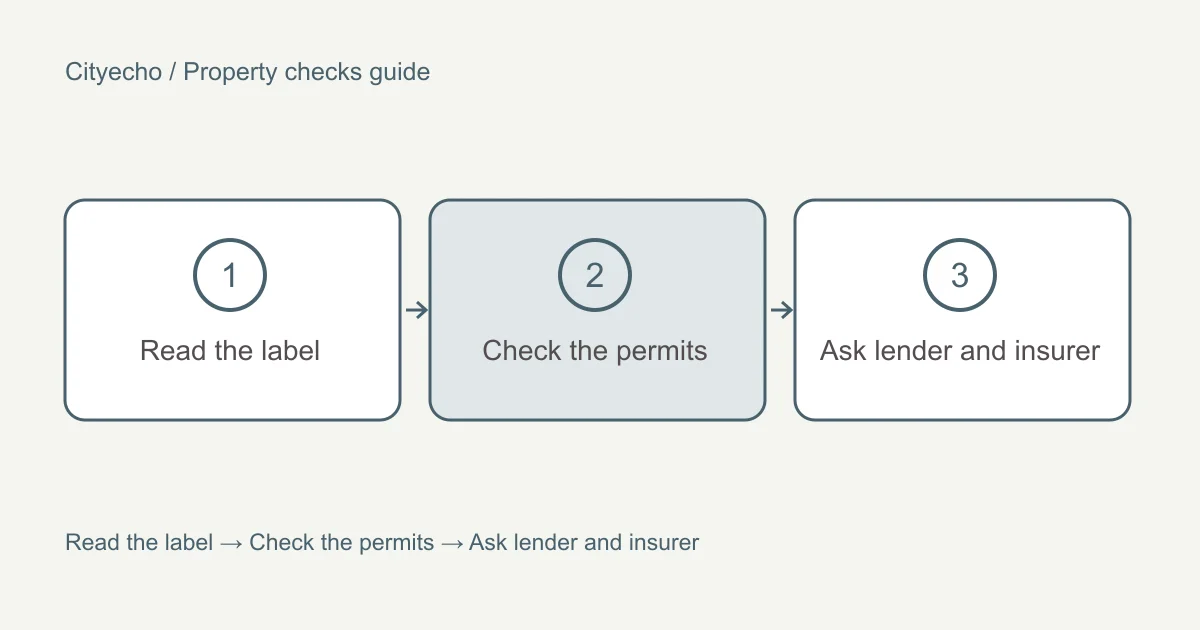
This chapter is part of the property checks guide. It builds on the permits chapter, which explains how to request a city file. If a tenant lives in the suite now, read buying a tenanted home as well.
Three kinds of evidence about a suite
What you can observe: a separate entrance, a full kitchen, a bathroom, a locked door between the suite and the main house, a tenant's belongings. These show how the space is used today. Its permit status comes from the city file.
What a document proves: building and plumbing permits for the suite, with passed final inspections; the utility bill, which shows how the city charges the house; a tenancy agreement, which shows who lives there and on what terms.
What needs a professional: whether an unauthorized suite could be brought up to code and at what cost, which a designer or contractor can assess; how the rent affects your mortgage, which only your lender decides; and how the policy treats the suite, which your insurer decides.
What Coquitlam requires
Coquitlam's secondary suites FAQ defines a secondary suite as a separate living area contained within a single family dwelling. It must work as a self contained unit with a kitchen, a bathroom and at least one bedroom, and have at least one door leading directly outside. It may share common space on the same floor, such as a laundry room.
The FAQ sets three limits. A suite may only be located in a single family dwelling. A single family dwelling may not contain more than one suite. And all secondary suites require building permits to be legal. It also says most single family homes, or lots zoned for single family dwellings, would be permitted to have a suite.
The FAQ says a suite stays part of the house. It has no certificate of title of its own, cannot be stratified, and shares the house's address and city services such as garbage and recycling.
On enforcement, the FAQ says that upon complaint, the city will investigate whether a suite is permissible and legal. A homeowner found with an illegal suite will be required to legalize or remove it and may face a bylaw compliance fine.
What Port Coquitlam requires
Port Coquitlam's secondary suites page, as read on 30 September 2026, says secondary suites are only permitted in the RS-1, RS-2, RS-3 and RS-4 zones, and refers to the Zoning Bylaw for those zones. It says building permits are required before building or altering secondary suites, and points to the city's Secondary Suites Guide for construction and BC Building Code details.
The same page says the permit fee doubles if work started without a building permit. It also describes the inspections the Building Division carries out, from forms through framing and insulation to occupancy and final inspection.
For a buyer, the first check in Port Coquitlam is the zone. The second is the permit file. Check the zone on PoCoMAP, and ask the city to confirm. For the wider question of what the zoning on a lot allows now and in future, see the land and zoning guide.
Authorized, unauthorized and simply occupied
A suite can be lived in without being authorized. The utility charges show that the cities treat these as different cases.
Coquitlam's FAQ lists two utility charges. A home with an authorized secondary suite pays the standard utility tax plus a 40 percent surcharge. A home with an unauthorized secondary suite pays the standard utility tax plus a 100 percent surcharge. A recent utility bill for the house may therefore tell you how the city has classified it.
Port Coquitlam's secondary suite exemptions page says homes with suites receive utility billings for both the main dwelling and the suite. It defines the suite, for billing, as one or more rooms that form a single unit used as a residence, with cooking, eating, sleeping and sanitary facilities. For 2026, it tells eligible owners to deduct $964 for the full suite charge, or $482 for the 50 percent exemption that applies when a parent or grandparent lives in the suite. Exemptions must be claimed each year by December 31.
| Question | Coquitlam | Port Coquitlam |
|---|---|---|
| Where can a suite be? | In a single family dwelling, one suite at most | In the RS-1 to RS-4 zones, per the city page |
| What makes it lawful? | Building permits | Building permits |
| Utility charge | 40 percent surcharge if authorized, 100 percent if unauthorized | A second billing for the suite |
| Where to check | Building Division, with purchase agreement | Property Information Portal and Building Division |
Checking the suite in the house you are buying
Start with the city file. Coquitlam's FAQ says that if you are unsure whether a secondary suite or basement finish is legal, you can email the Building Division. Its building permits FAQ adds that realtors and prospective buyers must show a valid purchase agreement to obtain plans or a form survey. In Port Coquitlam, use the Property Information Portal and ask the Building Division.
Then compare the file with the house. Is there a permit for the suite itself, with a passed final inspection? Does the suite you saw match the one on the permit, in size and layout? Were later changes permitted?
Coquitlam's FAQ describes what legalizing a suite can involve. The suite must be separated from the main dwelling by walls, floors and ceilings with a required fire resistance rating and sound rating. Bedroom windows are part of the exit requirements, and in an older house some may need to be replaced. The electrical system may need an upgrade, with requirements from Technical Safety BC. Smoke alarms must be continuously powered and connected so that one alarm sets off the rest.
A contractor or designer can tell you what those items would mean for the house you are looking at, and what they would cost.
Parking, alarms and other details
Coquitlam's FAQ mentions parking among the reasons to legalize a suite, and says one parking space is a requirement. Look at where a tenant would park on the lot you are buying, and ask the city whether the space meets its rules.
The FAQ also covers alarms. When a suite is decommissioned, it says fire safety in the former suite's sleeping area must meet current standards. It says smoke alarms are mandatory in homes built after December 1981, and strongly recommended in all homes regardless of age.
Heating is another detail to check. Coquitlam's FAQ says homes with shared forced air systems will need heating and ventilation separated for health and safety reasons. If you want to control energy use in each unit separately, separate heating and controls are needed. A home inspector can tell you what heating the house has. A heating contractor can tell you what separating it would involve.
If the suite is unauthorized
Coquitlam's FAQ describes the choices. You can apply to legalize the suite. Or you can remove it. It lists two removal options. The first removes all cooking facilities, with a gas or electrical permit from Technical Safety BC to remove the stove and terminate the supply. The second removes the locks between the suite and the main house, so the space is permanently open to the rest of the dwelling. Either way, the owner files the city's Suite Removal Form. The FAQ says you must apply for suite removal by December 1 to qualify for an adjustment the next year.
The FAQ also notes that you may still need building and plumbing permits for any work done to the home after it was first built, even if you remove the suite.
Lender and insurer: two separate questions
Your lender and your insurer look at a suite for different reasons, so ask each of them directly.
The insurer needs to know the house has a suite and whether it is rented. The Financial Consumer Agency of Canada's home insurance page says that if you share your home or rent a part of it, you must inform your insurance company. Ask the insurer, before completion, how the policy treats rented space.
The lender decides whether to count rent from the suite toward your application, and on what terms. Those rules belong to the lender. Ask early, in writing, and tell the lender whether the suite has permits. The journal article on what lenders check at pre-approval covers the rest of the lender's review. If the purchase only works with the rent counted, make that the first question, because the answer affects every other step.