

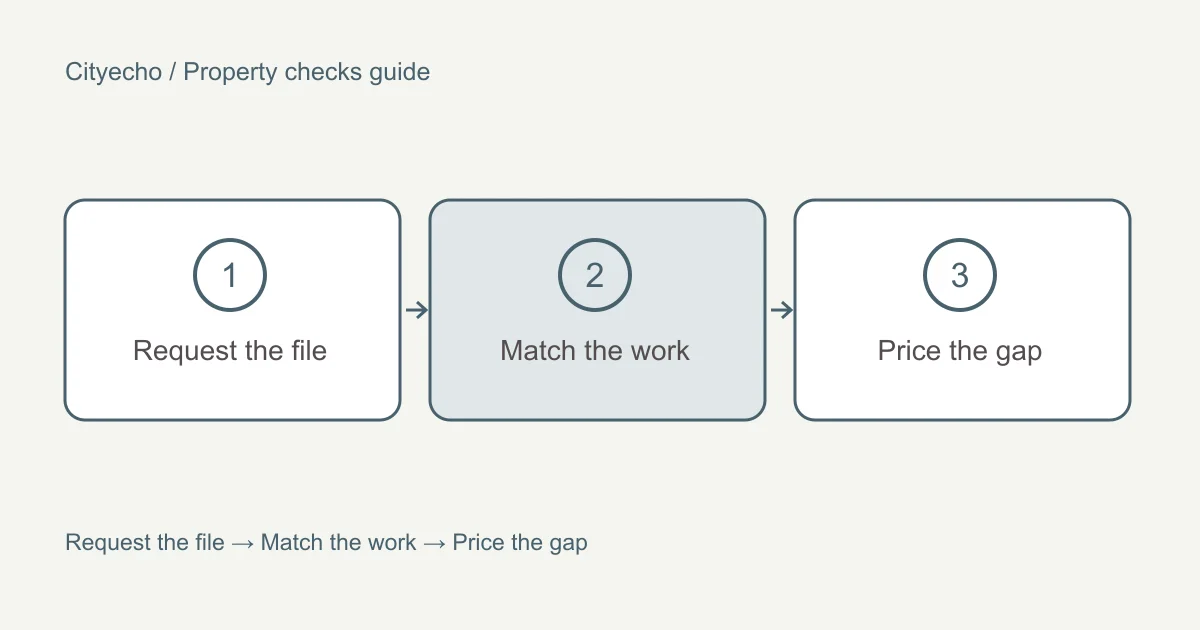
A basement finished last year, a sunroom added in the 1990s, a bathroom moved to a new spot. Each of these may have needed a permit under the rules in force when the work was done. When a house changes hands, the permit history tells you which alterations the city reviewed and inspected. Any gap between that history and the house in front of you becomes a question for the buyer.
This chapter is part of the property checks guide. It follows the home inspection chapter, because the inspection is often where you first notice an alteration worth checking. For suites in particular, the secondary suites chapter explains each city's own rules.
What each type of evidence can show
What you can observe: newer windows in an old wall, a basement with a kitchen, a garage converted to a room, a deck higher than the ground floor, fresh drywall in one area. Your own notes and the inspection report record these.
What a document proves: a permit shows the city accepted plans for the work. An inspection record shows a city inspector looked at it at stages. A passed final inspection shows the city closed the permit. These documents cover only the work the city reviewed.
What needs a professional: whether unpermitted work meets the building code, what it would take to bring it up to standard, and what that would cost. A designer, engineer or contractor answers those questions. Your lawyer answers what the contract lets you do about them.
Asking the City of Coquitlam for its records
Coquitlam's building permits FAQ explains the request. Depending on the age of the home, the Building Division may have a record of the plans and a form survey, for a fee. To enquire, you email the Building Permits Division. Realtors and prospective buyers must show a valid purchase agreement. Homeowners must provide proof of ownership. A person who is not the owner must provide a completed Agent Authorization Form for Permit Application or File Access, signed by the owner.
Coquitlam's building and construction page carries a notice, as read on 30 September 2026, that the Building Division's records are being digitized and may be temporarily unavailable. It gives the Building Permits email and the phone number 604-927-3441. Ask early in the subject period, and ask the city how long the request will take.
The same page describes the purpose of a permit. It says a building permit ensures the work aligns with the health and safety requirements in the building code and with the community's goals set out in bylaw.
When you receive the file, write down each permit number, what it covered, the date it was issued and whether it shows a passed final inspection. You will use that list in the rest of this chapter.
Asking the City of Port Coquitlam for its records
Port Coquitlam's online services page lists a Property Information Portal, described as a place to view and print property information reports for addresses located in Port Coquitlam. Start there with the civic address.
For older records or anything the report leaves unclear, contact the Building Division. Port Coquitlam's single-family permit page lists City Hall at 2580 Shaughnessy Street, phone 604-927-5411, open Monday to Friday, 8:30 a.m. to 4:30 p.m., excluding statutory holidays. Ask for the permit and inspection history of the address, and ask whether any permit on the file is still open.
That page also explains why the city wants permits taken out. Among its reasons, it lists making sure owners will not have to tear work down and start over, avoiding extra permits and fees, and reassuring buyers who avoid purchasing buildings with unauthorized construction.
What an open permit means
A permit is open when it was issued and the work never reached a passed final inspection. Both cities require inspections at stages. Coquitlam's FAQ says that after a permit is issued you must schedule inspections at regular stages before moving to the next stage. It lists what must be on site for a final inspection: all approved permits and documents, and the final approval slips for the other permits, such as plumbing, gas, electrical and sprinklers.
Port Coquitlam's permit page describes inspections of forms, under slab, framing, insulation, occupancy and final. It says all documents from registered professionals must be received before the final inspection is scheduled, and that each permit issued with the building permit must have received final inspection with no outstanding deficiencies.
An open permit in the file raises three questions. Was the work finished? Was it inspected at the stages the city requires? And what would the city need now to close the permit? Ask the seller, and ask the city. Only the city can say what closing the permit requires, so get its answer in writing before the subject deadline.
Coquitlam's FAQ also says electrical and gas inspections are performed by Technical Safety BC. A complete record for a renovation can therefore include approvals from the city and from the province.
Unpermitted work and what a buyer takes on
When work was done without a permit, it stays with the house after the sale. The city's tools apply to the land and its owner. Section 57 of the Community Charter, for example, directs notice to the registered owner. Three things can follow.
First, higher fees to fix it. Port Coquitlam's Fees and Charges Bylaw, 2025, No. 4415, in effect from January 1, 2026, charges double the application and issuance fee when work that needs a permit is started before the permit is issued. Its single-family permit page says the permit fee doubles if work has started without a permit.
Second, a note on the title. Section 57 of the Community Charter lets a building inspector recommend that council consider a resolution when the inspector discovers that something needing a permit or an inspection was done without the permit, or without the inspection being satisfactorily completed. The section also covers conditions that break building rules and make a building unsafe or unlikely to be usable for its expected life. The owner gets notice and a chance to be heard. If council confirms the recommendation, the corporate officer files a notice in the land title office, and the registrar notes it on the title. Port Coquitlam's fee bylaw lists a $600 filing fee for that notice.
Third, the cost of the work itself. Opening walls for inspection, upgrading to current rules, or removing the work can all cost money. Coquitlam's FAQ notes that work without a permit still needs to comply with the city's bylaws and the BC Building Code.
Section 58 of the Community Charter explains how a section 57 note comes off. When a building inspector reports that the condition has been fixed, the corporate officer must file a cancellation notice. An owner can also apply to council, and then to the Supreme Court, to have the note cancelled.
| What you find | What it shows | Next question |
|---|---|---|
| Permit with passed final inspection | The city reviewed and closed that work | Does the work on site match the permit? |
| Permit with no final inspection | The permit may still be open | What does the city need to close it? |
| Visible work with no permit | No city record of review | What would it take to permit or remove it? |
| Section 57 note on title | Council filed a notice about the land | What is in the file at City Hall? |
Matching the house to the file
Walk the house with the permit list in hand. For each alteration you can see, find the permit that covers it. Items to check include a finished basement, a suite, an addition, a deck, a detached garage, a retaining wall and moved plumbing. Coquitlam's FAQ lists, among work that needs a permit, building or legalizing a secondary suite, creating new rooms, adding an accessory building or garage over 10 square metres, and building a retaining wall over 1.2 metres in height.
Where there is no match, write the gap down in plain words. Then ask a qualified contractor or designer what it would take to bring that work into line, and what it might cost. Coquitlam's FAQ also answers a specific buyer question: to learn whether a house was used as a grow op, you must attend or contact the Building Permits Division.
Taking the gaps to the right people
Your real estate professional can raise the gaps with the seller before the subject deadline. The seller's own answers about renovations may appear on a disclosure statement, which the journal article on the property disclosure statement explains. Your lawyer or notary can explain what the contract allows and how any agreement about the work should be written. Tell your lender and insurer what you found and ask whether it changes their decision. If you plan further changes to the lot, the land and zoning guide explains what the zoning allows, and the title chapter explains how to read the charges that may limit new work.