

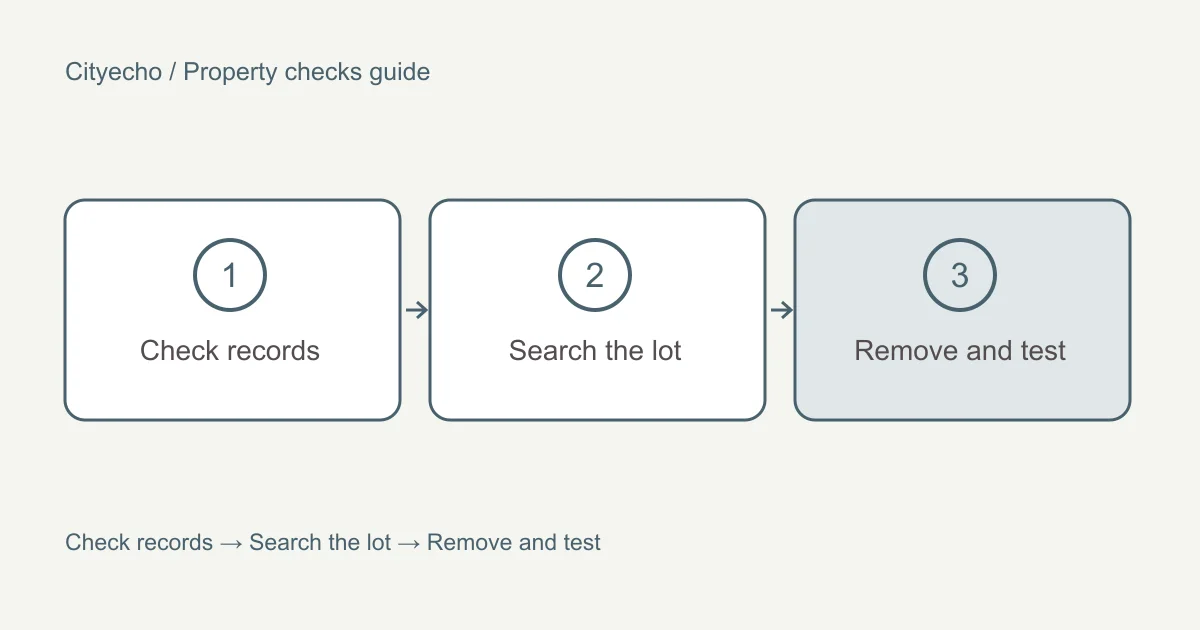
An older detached house in Coquitlam or Port Coquitlam may once have been heated by an oil furnace, with its fuel kept in a tank. Where that tank was buried in the yard, it can stay in the ground after the house changes to another fuel. A buyer who does not ask can end up owning an old steel tank, the oil left inside it, and any soil it has affected.
This chapter is part of the property checks guide. The journal article on oil tank searches and buried tanks in BC covers the search itself in shorter form. Here the focus is on the records to ask for, how the local fire departments treat removal, and who deals with contamination.
Three kinds of evidence about a buried tank
What you can observe: a fill pipe or vent pipe sticking out of the ground or the side of the house, a capped pipe through a basement wall, an old oil furnace, or a patch of lawn that looks different. Your home inspector may note these too. Seeing no pipe tells you only that no pipe is visible today.
What a document proves: removal records filed with the fire department, receipts from a removal contractor, an environmental report on soil testing, and a written search report from a contractor. Each document proves what it states, for the area and date it covers.
What needs a professional: searching the lot, removing a tank, testing the soil and planning any clean up. Those tasks belong with qualified contractors and environmental professionals.
Why this matters for Tri-Cities houses
Coquitlam Fire/Rescue publishes an operational guideline for the removal of underground storage tanks, listed on the city's fire policies and permits page. Its scope covers tanks at fuel stations and other sites, and it names residential fuel storage tanks used for oil burning appliances. That is the tank that fed an old house furnace.
The guideline, revised in October 2012 and posted on the city site as read on 30 September 2026, refers to the BC Fire Code and to the city's Fire Prevention and Life Safety Bylaw. It sets out what an owner or occupant must do to take a tank permanently out of the ground.
In Port Coquitlam, the Fees and Charges Bylaw, 2025, No. 4415, in effect from January 1, 2026, lists a $200 fuel dispensing or underground tank permit under the city's Fire and Emergency Services Bylaw. It also lists a $500 charge for failing to obtain a permit for underground storage tank installation or removal. Confirm the current process with Port Coquitlam Fire and Emergency Services before any work.
Records to ask for first
Start with the seller. Ask in writing whether the house was ever heated by oil, whether a tank was ever on the lot, and whether one was removed. If a tank was removed, ask for the full set of documents described below.
Next, ask the fire department. Coquitlam's guideline requires the owner to send documents to the department when a tank comes out, and it records a site inspection before the hole is backfilled and a final inspection afterwards. So the department may hold a record for the address. Ask Coquitlam Fire/Rescue, or Port Coquitlam Fire and Emergency Services, what it holds.
Then check the provincial site registry. The province's site information page says the registry holds records about the identification, investigation and remediation of contaminated sites. It also says the existence or absence of information in the registry gives no assurance that a site is or is not contaminated. Treat it as one record among several.
How a search is carried out
If the records leave doubt, the next step is a search of the lot by a qualified contractor or environmental professional. BCFSA's consumer guide to oil tanks describes a subject you can add to an offer, such as having an environmental engineer inspect the area.
Before you hire, ask the searcher to put three things in writing. First, the method they will use. Second, the area of the lot they will cover, including any parts they cannot reach, such as under a deck, a paved area or the house itself. Third, exactly what the report will state if they find nothing. A report that covers the open yard does not speak for the ground under a garage slab.
Book the search early in the subject period. If it finds a tank, you will need time for the next steps before your deadline.
What removal involves in Coquitlam
Coquitlam's guideline sets out the steps for permanently removing an underground tank. It says a separate permit application is not required for removal. Instead, the department must be told in writing, with a scaled site plan showing the tanks and piping. The owner must submit proof of ownership, in the form of a recent title certificate. An occupant removing a tank must provide the owner's written permission.
For single and two family homes, the guideline applies items 4 and 6 of its directive. Item 4, which follows a national code of practice for storage tanks, requires:
- the remaining liquid to be removed and disposed of by a qualified waste management contractor;
- the tank and its piping to be removed and taken to a suitable waste receiving centre; and
- if the site is contaminated with petroleum products, remediation to the criteria in the Contaminated Sites Regulation under the Environmental Management Act.
Item 6 lists the documents to give the fire department after removal: written confirmation from the owner that the tank is out, a bill of lading for the removed liquid, a bill of lading for the tank and equipment, written confirmation from a qualified electrician that related wiring was terminated, and a copy of the environmental report for any soil remediation and testing.
That list is a useful checklist for a buyer. When a seller says a tank was removed, ask for each of those documents.
| Document | What it shows | Who issues it |
|---|---|---|
| Owner's written confirmation | That the tank and parts were removed | The owner at the time |
| Bill of lading for the oil | Where the remaining liquid went | The waste contractor |
| Bill of lading for the tank | Where the tank and piping went | The transport company |
| Electrician's confirmation | That related wiring was terminated | A qualified electrician |
| Environmental report | Soil testing and any remediation | An environmental professional |
Soil testing and contamination
A tank that leaked can affect the soil around it. Coquitlam's guideline asks for a copy of the environmental report for any soil remediation and testing done as a result of removal. If contamination is found, the guideline requires remediation to the Contaminated Sites Regulation criteria.
The province's site remediation page says the Environmental Management Act, the Contaminated Sites Regulation and related protocols set the framework for identifying, investigating and cleaning up contaminated sites. Only testing by a qualified professional can say whether soil is affected and how far.
Who carries the obligation
The fire department's guideline puts the steps on the owner or occupant who removes the tank. The province's page on identifying and disclosing sites that may be contaminated directs readers to the Environmental Management Act, Division 3, and Part 7 of the Contaminated Sites Regulation for who is responsible for paying remediation costs. It advises getting advice from an environmental professional familiar with that legislation.
On disclosure, BCFSA's oil tank guide says a known tank that is leaking or causing damage may be a material latent defect, which must be disclosed to a buyer before a contract is made. For a buyer, the practical steps are the same either way: ask, check records, and search where doubt remains.
If a search finds a tank during the subject period
A tank found before you remove subjects gives you information while you still have choices. Write down what the search report says: the location, whether the tank appears to hold liquid, and what the report recommends next. Share it with your real estate professional and your lawyer or notary the same day.
The next steps depend on your contract and on what the seller agrees to. A seller may agree to remove the tank before completion under the fire department's process, and to hand over the full set of documents listed above. The parties may agree on more time for testing. Or you may decide not to go ahead. Each of these needs written terms, and your lawyer or notary should prepare or review them. Keep copies of every report, because a later buyer of the house will ask you the same questions.
Building it into the contract
BCFSA mentions two tools a buyer can discuss: a subject for an inspection by an environmental engineer, and a holdback of funds to deal with remediation if a tank is found. The wording of either belongs with your lawyer or notary. Your real estate professional can raise the subject with the seller's side. For the other environmental checks on an older house, continue to the environmental and hazard checks chapter, and for services buried in the same yard, see drainage and services.