

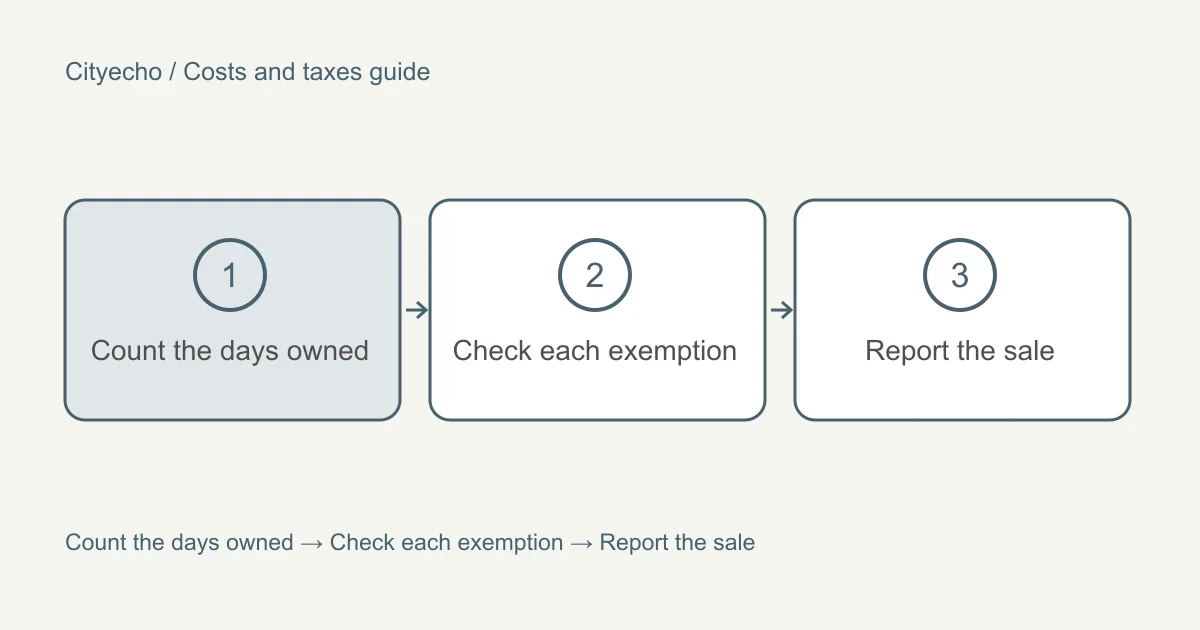
Selling a home can create tax as well as costs. For an owner whose home was solely their principal residence for every year they owned it, the Canada Revenue Agency does not tax the gain. For owners who sell soon after buying, or who rented the home, two other sets of rules apply: B.C.'s home flipping tax and the federal residential property flipping rule. This chapter explains how each one works and where they overlap.
It belongs to the costs and taxes guide. For the costs a seller pays on completion day, such as commission, legal fees and the mortgage payout, see the completion day chapter of the selling guide. This chapter deals with tax only. Tax on a sale depends on your own facts, so take the details here to an accountant or tax lawyer before you list.
The costs a seller pays, in brief
BCFSA's page on what costs come with selling a home lists them. They are the commission you agreed to pay your real estate brokerage, the legal fees to discharge your mortgage, the legal or notary fees for the transfer, GST on the commission and legal fees, any prepayment penalty on your mortgage, and your share of the year's property tax if it has not yet been paid. The taxes in this chapter come on top of those costs, and they are paid later, through a tax return.
The B.C. home flipping tax
The province's home flipping tax page, updated 8 June 2026, says the tax applies to the profit you earn from selling a property in British Columbia, including a presale contract, if you owned it for less than 730 days. It is imposed under the Residential Property (Short-Term Holding) Profit Tax Act, which took effect on 1 January 2025.
The province stresses that this tax is separate from the federal property flipping rules and from federal and B.C. income tax. You file a separate return for it. A property bought before 2025 can still be caught if it is sold on or after 1 January 2025 and was held for less than 730 days.
The tax applies to residential property: properties with a housing unit, properties zoned for residential use, and rights to acquire them, such as an assignment of a presale contract. The province says a person includes an individual, a corporation, a partnership or a trust, and that the seller may live in B.C. or anywhere else.
Rate, days and the return
The province sets the rate at 20% of net taxable income for a property sold within 365 days of acquiring it. The rate then decreases over the next 365 days. At 730 days the tax no longer applies. The province offers a step-by-step calculator on the same page.
Days are counted from the day you acquire the property to the day you dispose of it. The province says the day you acquire is generally the day you pay for the property, which for most people is the completion date. The day you dispose is generally the day you receive the money, which for most people is also the completion date. Presales and transfers from a related person are counted differently.
If you are subject to the tax, you must file a home flipping tax return within 90 days of the sale. You must also file if your exemption only applies once you file. If you held the property for more than 729 days, or your exemption applies without a return, you do not file. Our journal article on the B.C. home flipping tax gives worked examples.
Deductions and exemptions under the flipping tax
The province allows a primary residence deduction of up to $20,000 from taxable income. You qualify if you owned the property for at least 365 consecutive days before selling and lived in a housing unit on it as your primary residence while you owned it. The deduction does not apply to the assignment of a presale contract.
The province's exemptions page, updated 7 May 2026, sorts exemptions into two groups. Some apply only after you file a return: life circumstance exemptions, exemptions for builders and renovation activity, and exemptions for sales between related persons. Others apply without a return, such as property in listed First Nations lands, certain exempt entities, and property used only for commercial purposes the whole time it was held.
Gifts are not exempt by default. The province says a gift from a related person is treated as acquired on the day the related person first acquired it, so the two holding periods are added together. The cost of a gifted property is set at $0.
The federal residential property flipping rule
The Canada Revenue Agency's principal residence page sets out the federal rule. Any gain from selling a housing unit in Canada, including a rental property, or a right to acquire one, that you owned or held for less than 365 consecutive days is deemed to be business income. The principal residence exemption cannot be used on it. A loss on such a property is deemed to be nil.
The federal rule does not apply if the sale happened because of, or in anticipation of, one of the life events the agency lists. They include the death of the owner or a related person, a related person joining the household, a relationship breakdown after at least 90 days apart, a threat to personal safety, a serious illness or disability, an eligible move for work or school that brings the new home at least 40 kilometres closer, an involuntary job loss, insolvency, and destruction or expropriation of the property.
The two flipping rules can apply to the same sale. A home sold after 300 days, with no life event, can fall under the federal rule and the B.C. tax at once. Each has its own exemptions and its own return. Ask a tax professional to review both before you accept an offer on a home you have held for a short time.
The principal residence exemption
The agency says that if a property was solely your principal residence for every year you owned it, you do not pay tax on the gain when you sell. A principal residence can be a house, a condominium, an apartment in a duplex, and several other kinds of housing unit. You, your spouse or common-law partner, or your child must have lived in it at some time during each year you designate.
Only one home per family can be designated for each year from 1982 onward. The land that counts is usually limited to half a hectare. The agency also describes a rule that lets you treat both homes as eligible in a year when you sell one and buy another, as long as you were resident in Canada in the year you bought.
You must report the sale. Since the 2016 tax year, the agency only allows the exemption if you report the sale and the designation on your return, using Schedule 3 and Form T2091(IND). The agency accepts a late designation in some cases, but a penalty may apply.
When the home was rented or partly rented
Renting changes the calculation. If you used part of your home to earn income, the agency says you split the selling price and cost between the part you lived in and the part used for income, using floor area or number of rooms. Only the gain on the income part is reported as a capital gain. The whole property can keep principal residence status if the income use was ancillary to the home, you made no structural change, and you claimed no capital cost allowance.
If you move out and rent the whole home, the change of use is treated as a sale at fair market value on that date. The agency lets you elect under subsection 45(2) of the Income Tax Act to avoid that deemed sale. While the election applies, you can designate the home as your principal residence for up to four years, provided you designate no other home and remain resident in Canada. The limit can extend where an employer relocation meets the agency's conditions.
The reverse also has a rule. If you move into a former rental, you may be able to elect under subsection 45(3) to postpone reporting the gain until you sell, if no capital cost allowance was claimed after 1984. A home that was rented may also carry the speculation and vacancy tax questions covered in the speculation and vacancy tax chapter.
Keep records from the day you buy: the price, the closing costs, the cost of major improvements, the dates you lived in the home and the dates it was rented. The deposits and adjustments chapter explains the statement of adjustments, which is one of the records that shows your purchase cost. A presale assignment raises GST questions as well, covered in the sales tax on new homes chapter.