

Property transfer tax is a one-time provincial tax that most buyers pay in British Columbia. It is charged once, when the transfer of the home is registered at the Land Title Office, and it depends on the value of the home on that day. The province sets the rates, and your lawyer or notary files the return and pays the tax on your behalf.
This chapter is part of the costs and taxes guide. It explains how the tax is worked out, when it is due, and when a foreign buyer pays an extra 20%. The exemptions for first-time buyers and newly built homes have their own chapter, first-time and new home exemptions. Read the two together if you think an exemption may apply to you.
What the tax is charged on
The province charges property transfer tax on the fair market value of the land and buildings on the day the transfer is registered. Its property transfer tax page, read on 30 September 2026, defines fair market value as the price a willing buyer would pay a willing seller on the open market on the date of registration.
In most ordinary sales the purchase price is the fair market value. The province says the price is generally the best measure when the home was offered on the open market and the transfer is registered within a few months of the contract. The province gives the example of a seller who lists the home with a real estate agent or advertises it for sale.
Other methods apply when a transfer does not happen on the open market, such as a transfer between relatives. The province names a recent independent appraisal and the BC Assessment value as possible measures. It also warns that the assessed value reflects the market on 1 July of the previous year, so it can differ from the value on the day you register.
The province also names one special case on the same page. A pre-sold strata unit, bought from a developer before it was built, has its own rule for the value used. If you signed a presale contract for a strata home, ask your lawyer or notary which value applies to your transfer. For a resale detached house, the ordinary fair market value rule is the one that applies.
The rate bands in effect on 30 September 2026
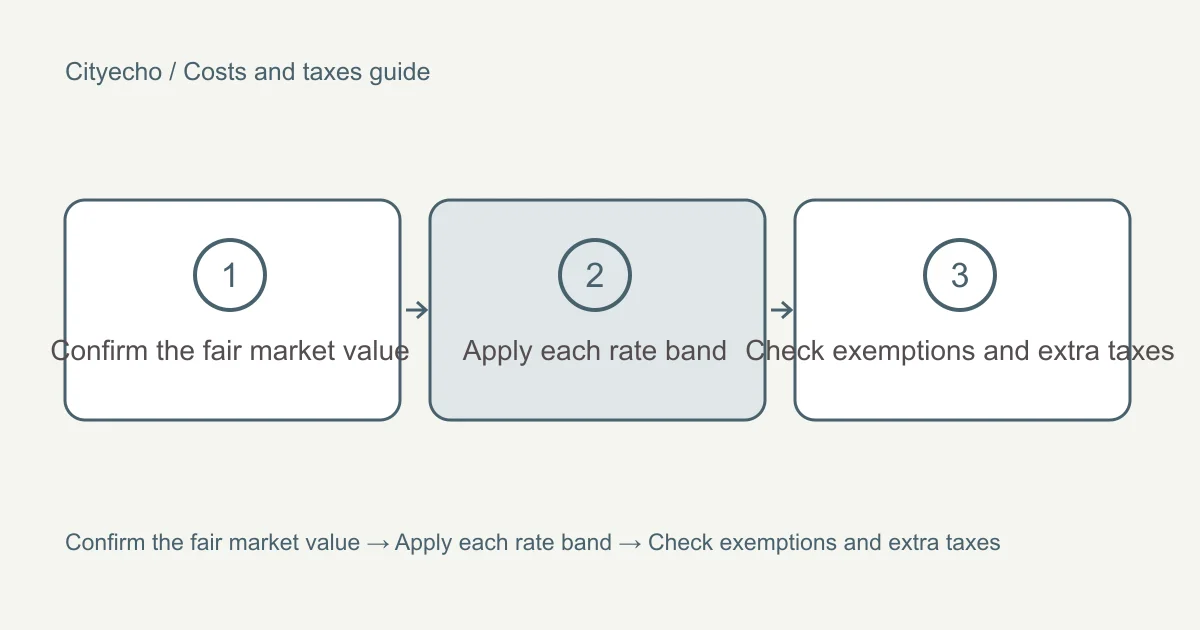
The general tax is worked out in bands. Each band has its own rate, and you pay each rate only on the part of the value that falls inside that band. The province lists the bands below on its property transfer tax page. These are the rates in effect on 30 September 2026.
| Part of fair market value | Rate on that part |
|---|---|
| Up to and including $200,000 | 1% |
| Above $200,000, up to and including $2,000,000 | 2% |
| Above $2,000,000 | 3% |
| Residential value above $3,000,000 | A further 2% |
The further 2% applies only to the residential part of a property. On a mixed property, such as a building with homes and shops, it applies to the residential part alone. For a detached house used only as a home, the whole value is residential.
These rates change only when the province changes them. Check the province's page again close to your completion date, because the tax is charged at the rates in force on the day of registration.
Worked examples on hypothetical prices
The prices below are hypothetical and chosen only to show the arithmetic. The method follows the province's calculation examples, which show $11,000 of tax on a $650,000 home.
On a fair market value of $1,500,000, the first $200,000 is taxed at 1%, which gives $2,000. The next $1,300,000 is taxed at 2%, which gives $26,000. The total general tax is $28,000.
On a fair market value of $2,500,000, the first band again gives $2,000. The second band covers $1,800,000 at 2%, which gives $36,000. The last $500,000 is taxed at 3%, which gives $15,000. The total is $53,000. No further 2% applies, because the value is below $3,000,000.
The province's own example for a $4,500,000 home shows the further 2% at work. The general bands give $113,000, and the further 2% on the $1,500,000 above $3,000,000 adds $30,000, for a total of $143,000.
When the tax is paid and who files it
The tax becomes payable when the transfer is registered at the Land Title Office. For a normal sale, registration happens on the completion date written in your contract. The province notes that in most cases a legal professional completes the transfer and files the property transfer tax return.
BCFSA's page on completing your purchase lists the property transfer tax return among the documents your lawyer or notary prepares. They also prepare the statement of adjustments, which shows the total funds you must provide. The tax is part of that total.
This timing matters for your cash plan. The tax is due at the same time as your down payment balance and your other closing costs. The deposits and adjustments chapter explains how those amounts come together on completion day.
The additional tax for foreign buyers in Metro Vancouver
A foreign national, a foreign corporation or a taxable trustee pays an additional property transfer tax on residential property in certain areas. The province's additional property transfer tax page, read on 30 September 2026, sets the rate at 20% of the buyer's proportionate share of fair market value.
The tax applies in five regional districts. The Metro Vancouver Regional District is one of them, together with the Capital, Fraser Valley, Central Okanagan and Nanaimo regional districts. The province's list of speculation and vacancy tax areas places the City of Coquitlam and the City of Port Coquitlam inside the Metro Vancouver Regional District, so a foreign buyer of a home in either city is inside the area where the tax applies.
The additional tax is charged on the buyer's own share. The province gives the example of a foreign national who registers a 70% interest: that buyer pays the additional tax on 70% of the residential value. On a hypothetical $1,500,000 home bought outright by a foreign national, the additional tax is $300,000, on top of the $28,000 of general tax.
The province lists some exemptions. A confirmed B.C. Provincial Nominee who buys a principal residence as an individual may claim an exemption once. Some Canadian-controlled limited partnerships may qualify under set conditions. A lawyer should confirm any exemption before you rely on it.
Refunds of the additional tax
A foreign buyer who later becomes a permanent resident or citizen may be able to apply for a refund. The province's refund page, read on 30 September 2026, sets out the conditions. The buyer must gain that status within one year of registration, move in within 92 days, and live in the home as a principal residence for at least a full year.
The refund application has a time window. It must be filed after the first anniversary of moving in and before 18 months from the registration date. The province also warns that a buyer who expects a refund takes on a risk, because there is no guarantee that permanent residence will be completed within 12 months.
Exemptions that can reduce the general tax
Some buyers pay less general tax because an exemption applies. The two exemptions most home buyers ask about are the first time home buyers' program and the newly built home exemption. Each has a value limit, a residence rule and conditions you must keep meeting during the first year.
Your lawyer or notary claims an exemption on the property transfer tax return at registration. If you qualify but do not claim it at that time, the province allows a refund application within a set window. The exemptions chapter covers each program's thresholds and what happens if you move out early.
If a home is newly built, the purchase may also carry federal sales tax. That tax has its own rebate programs and is explained in the sales tax on new homes chapter.
Budgeting for the tax before you write an offer
Work out the tax on the price you plan to offer before you make the offer. The arithmetic is simple, and the province also offers an online calculator on its main page. Add the result to your list of cash needed on completion day, next to your down payment and legal costs.
If you are a first-time buyer, check whether an exemption could apply before you set your price range. The thresholds are fixed dollar amounts, and a small change in price can move a home from a full exemption to a partial one. Our journal article on property transfer tax for first-time buyers gives worked examples for that situation.
Ask your lawyer or notary to confirm the amount once the contract is firm. They see the full transaction, including the share each buyer registers and any exemption claim. Their figure on the statement of adjustments is the one you pay.
Keep a copy of the filed return with your purchase records. It shows the value used, any exemption claimed and the tax paid. You may need it later if the province reviews the claim, because the province says all property transfers are subject to audit.