

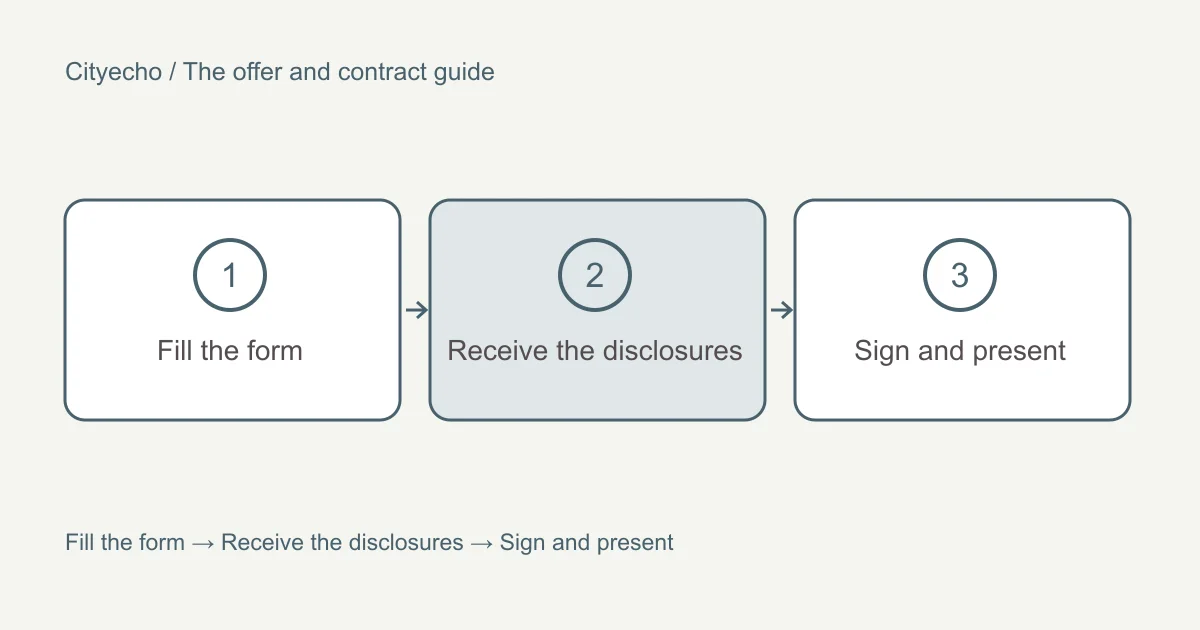
The Contract of Purchase and Sale is the one document a buyer signs that creates the sale. The licensee writes the terms on the standard form used in British Columbia residential transactions, the buyer signs, the seller accepts, and the contract binds both parties. The offer and contract pillar sets out the whole process. This chapter walks through the parts of the form, the three written disclosures a licensee must give before the offer is signed, and the Law and Equity Act section 59 requirement that the contract be in writing. Later chapters cover the subject conditions, the deposit, bidding against other buyers, the rescission period, assignments and the remedies when a deal collapses.
The form is standard because the risks are not. Each line on the first page sets a deadline, a dollar figure or a party's duty. A missed deadline cancels the contract. A missing included item leaves the buyer short on moving day. The whole form is a sequence of fields a buyer and licensee review together before an offer leaves the office.
The written requirement under the Law and Equity Act
The Law and Equity Act section 59, read on 5 October 2026, states a contract respecting land or a disposition of land is not enforceable unless there is, in a writing signed by the party to be charged or by that party's agent, both an indication the contract has been made and an indication of the subject matter of the contract. The section lists limited exceptions, including a part performance exception and an estoppel exception, that a lawyer argues before the Supreme Court. For a residential buyer, the practical rule is simple: a verbal offer does not bind the sale.
The written requirement works both ways. A seller who signs the Contract of Purchase and Sale is bound to deliver the property on the completion date. A buyer who signs is bound to pay the balance of the purchase price. Neither party can walk away because they changed their mind, except through a subject condition, the Home Buyer Rescission Period or a written mutual release.
The parts of the standard form
The Contract of Purchase and Sale begins with the parties: the buyer, the seller and the two brokerages. Each party is named by legal name, which the lawyer or notary later checks against government-issued identification. A buyer who intends to take title in a joint tenancy, as tenants in common, or through a trust writes those intentions on the form so the lawyer registers title correctly on completion.
The property is named by civil address and by legal description. The legal description, taken from the title register at the Land Title and Survey Authority, is the authoritative identifier. A strata property adds the strata plan number and strata lot number. The street address alone is not enough on registered documents.
The purchase price is written in figures and words. The deposit amount, the deposit due date and the brokerage that holds the deposit are each on their own line. Completion, possession and adjustment dates are each named. A viewing clause gives the buyer a right of entry for one or two visits before completion. The included and excluded items lines list the chattels and fixtures that pass with the sale.
The subjects section lists each condition the buyer or seller requires, with the subject removal date on each one. If both parties agree, a schedule attaches with the full language of a longer subject, for example a strata documents review subject that lists the documents required.
The three written disclosures a licensee must give
The BC Financial Services Authority disclosure information page, read on 5 October 2026, lists the mandatory disclosure forms a licensee gives in a trade in real estate. The Disclosure of Representation in Trading Services is given at the first substantive discussion. It names the licensee, the brokerage, the services the licensee will provide and whether the licensee represents the buyer, the seller or neither. The disclosure records the party's acknowledgement and sits in the brokerage's file.
The Disclosure of Risks to Unrepresented Parties is given when a licensee works with a party who does not have their own representation, for example a buyer who approaches a listing licensee directly. The disclosure names the risks of proceeding without the licensee's duty of agency. The licensee cannot advocate for the unrepresented party.
The Disclosure to Sellers of Expected Remuneration is given to a seller before an offer is presented. It names the commission the licensee expects to receive on the sale from the brokerage. A buyer sees this disclosure named in the Contract of Purchase and Sale through the commission paid by the seller to the two brokerages.
The three disclosures are the regulator's protection for the party. A licensee who omits them exposes the file to a BCFSA investigation. For a buyer, reading each disclosure before signing clarifies the role of each person at the table and names the money each party is paid on the sale.
The licensee prepares the form, the lawyer registers the title
A real estate licensee registered with BC Financial Services Authority prepares the Contract of Purchase and Sale and presents it to the seller through the seller's licensee. The BCFSA offers knowledge base page, read on 5 October 2026, is the regulator's guidance on how a licensee runs the step. The licensee reviews the subjects with the buyer, writes the terms on the form, checks the disclosures are given and presents the offer within the deadline the parties set.
After acceptance, the deal moves to the buyer's lawyer or notary. The lawyer or notary orders a title search, confirms the charges, prepares the Form A transfer and the Property Transfer Tax return, receives the mortgage instructions from the lender and arranges the trust funds for completion. The legal and registration costs chapter in the costs and taxes guide covers the fees and the registration step. The title search chapter in the due diligence guide covers the charges a title search reveals.
Dates on the first page carry the deal
The three dates on the Contract of Purchase and Sale do different work. The completion date is the day the money moves from the buyer's lawyer to the seller's lawyer and the transfer is registered on title at the Land Title and Survey Authority. The possession date is the day the buyer gets the keys and physical possession. The adjustment date is the day the parties prorate property taxes, utilities, strata fees and any other recurring charges on the statement of adjustments.
Buyers often ask whether the three dates must line up. They can be any sequence the parties agree on, as long as the funding, the registration and the moving arrangements each side has set work for both. A common choice in the Lower Mainland is completion on a Thursday, possession on the Friday and the adjustment date on the Friday, so the buyer has an afternoon to inspect the empty home before taking possession.
A written amendment, signed by both parties, is the only way to change a date after acceptance. The funds for closing chapter in the financing a home guide covers how a late amendment affects the lender's funding, the lawyer's trust account and the moving cost each party commits to.
Included items, excluded items and the walk-through
The included items line lists everything that passes with the sale beyond the land and the building. Appliances, window coverings, light fixtures, built-in shelving, bar fridges and shed contents each need naming if the buyer expects them. An item left off the included line and not named as a fixture may be removed before possession.
The excluded items line names anything the seller wants to keep that a buyer might assume stays. The common exclusions are a chandelier, a wine fridge, a specific appliance a family bought separately and shed items that are personal.
A buyer uses the viewing clause for one final walk-through before completion. The walk-through confirms the included items are present, the home is in the condition the contract requires, and no new damage has appeared. A problem at the walk-through is addressed through the parties' lawyers before the funds release on completion day.
When the parties change the contract
An amendment to the Contract of Purchase and Sale, signed by both parties, changes a term after acceptance. Amendments are common: a buyer extends a subject removal date by one business day, the parties move the completion date to fit a lender's funding window, or the parties agree on a holdback for a repair the seller promises to complete before possession. Each amendment is a short written document that the parties sign and the licensees record.
A party cannot amend the contract on their own. If the lender's funding is delayed, the buyer's licensee presents an amendment to the seller's licensee and the seller decides whether to agree. If the seller refuses, the contract remains as signed and the buyer may be in default on completion day. The collapsed deals chapter covers the remedies when a deadline is missed and the parties cannot agree on an amendment.
A buyer may also walk away without an amendment, by removing a subject in a way that fails the drafting test. The subject conditions chapter covers subject removal, waiver, time clauses and the Law and Equity Act section 24 relief against forfeiture when a party misses a deadline by a short margin.
Use this chapter with your licensee
A licensee registered with BC Financial Services Authority prepares the Contract of Purchase and Sale and gives the required disclosures. A lawyer or notary reviews the terms after acceptance and registers the transfer at the Land Title and Survey Authority on completion. This chapter organises the questions the buyer asks before signing. The next chapter covers the subject conditions. Our how a Coquitlam offer gets to completion article in the journal shows the deposit side of the same process. The listing agreement chapter in the selling a home guide covers the seller-side agreement that sits beside the buyer's contract.