

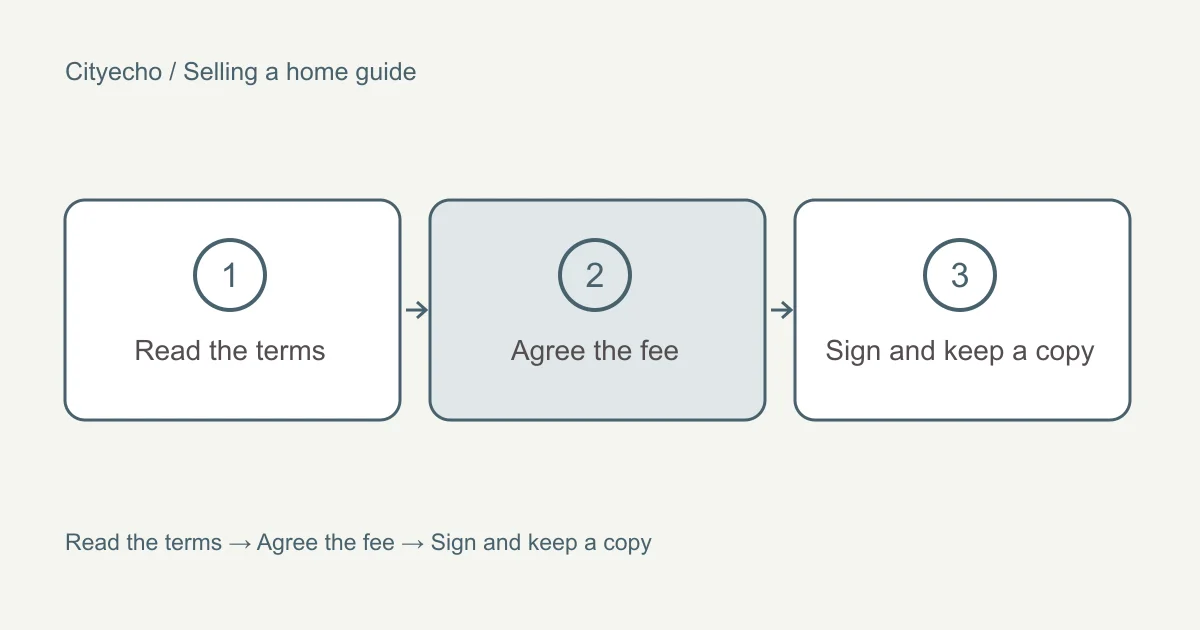
The listing agreement is the first document most sellers sign. It is a contract between you and a brokerage, and it sets the rules for everything the brokerage does for you until the sale completes or the agreement ends. The licensee you meet works on behalf of that brokerage. The agreement decides what you will pay, for how long, and for which services.
This chapter is part of the selling a home guide. It explains what the law requires the agreement to contain, how the fee is worked out, how long the agreement lasts, and what the brokerage owes you. Read it before your listing appointment so that you can ask about each term while the document is still a draft.
When a written agreement is required
The Real Estate Services Rules are the provincial rules that govern licensees. Section 43 says a brokerage must have a written service agreement before it represents an owner in offering real estate for sale, unless the owner waives the requirement. The agreement must be signed by you and by an authorized signatory of the brokerage. It must also state all of its terms and conditions clearly.
You can waive the written agreement, but BCFSA's guideline on service agreements explains the risk. Without one, it is harder to prove which services the brokerage agreed to provide and what you agreed to pay. The same guideline says a client should understand every term, may take time before signing, and should never be pressured to sign. It also says a licensee may suggest legal advice where a term is hard to understand.
Section 44 of the Rules requires the brokerage to give you a copy immediately after the agreement is signed. BCFSA's page on listing your home notes that electronic signatures are valid on contracts in British Columbia when the signature is on the contract itself.
What the agreement must contain
Section 43 lists the minimum content. The table below sets out each item and a question to ask about it.
| Required item | Question to ask |
|---|---|
| Your name and the brokerage's licensee name | Is every owner on title named? |
| The address of the property | Does it match the legal description on title? |
| The date the agreement takes effect | Can marketing start before this date? |
| The date the agreement expires | What happens to a buyer who first saw the home before expiry? |
| A general description of the services | Which services are included, and which cost extra? |
| The remuneration and when it is payable | Is it payable on completion, or at another point? |
| The split with a cooperating brokerage, if any | How much goes to the buyer's brokerage, and how much stays? |
| Use and disclosure of personal information | Who will see your information, and for what purpose? |
The services description is often short, so check it with care. If you expect professional photographs, a floor plan, a measured floor area or open houses, ask whether the agreement or a written note records them. BCFSA's guideline says the licensee should learn what services you want before drafting, so that the agreement reflects your intentions.
How the fee is calculated
The fee is whatever you and the brokerage agree. BCFSA's consumer guide to disclosures says the commission is usually written as a percentage of the sale price, that part of it may be paid to the brokerage representing the buyer, and that the amount is fully negotiable. Ask how the percentage in your draft applies to the price. Then ask your licensee to work the fee out in dollars at two or three possible sale prices, so you can see how it changes.
GST is charged on top. BCFSA's list of costs that come with selling a home includes the GST on the commission and on your legal fees. A written estimate of your net proceeds should show the commission, the GST and your other costs as separate lines. The listing page suggests asking for that estimate before you settle on a price.
When an offer arrives, section 57 of the Rules requires your licensee to give you a disclosure of expected remuneration on a form approved by the regulator. It shows, in dollars, what you will pay your brokerage, what your brokerage will pay the buyer's brokerage, and what your brokerage keeps. If the price changes through a counter offer, the figures are recalculated. The reviewing offers chapter shows where this form fits when you compare offers, and the journal article on multiple offers covers the same step when several offers arrive at once.
Exclusive and multiple listings
BCFSA describes two types of listing contract. An exclusive listing gives one brokerage the sole right to sell your home. If you sell to a buyer you found yourself during the term, you still owe the agreed commission, unless that buyer was named as an exclusion in the agreement. If you already know a possible buyer, raise it before you sign.
A multiple listing is a form of exclusive listing. The difference is that the brokerage registers the home on the Multiple Listing Service, which makes it known to licensees who are members of the local real estate board. The brokerage agrees to share a set part of the commission with another member who finds a buyer. The listing media chapter covers what then appears online.
How long the agreement lasts
The Rules require a listing agreement to state the date it expires, and the length of the term is a matter for you and the brokerage. A short term gives you an earlier point to review the results. A longer term gives the brokerage more time to market the home. Pick a date that fits your own plans, such as the date you need to move.
Read any clause that deals with a sale after the agreement expires. Ask whether a commission becomes payable if a buyer who saw the home during the listing buys it later, how long that clause runs, and whether it still applies if you sign a new listing with a different brokerage.
The agreement can be changed while it runs. BCFSA's guideline says any change must be amended in writing and signed by all parties. A price reduction or a new expiry date is a change of this kind, and the pricing chapter explains how price reductions are handled.
Ending the agreement early
A listing agreement is a binding contract. BCFSA's answers to common questions state that you need the agreement of the other party to cancel the obligations the contract created, and that you may need legal advice if you cannot get that agreement. BCFSA also notes that it does not resolve commission disputes or adjudicate contract matters.
Before you sign, ask the brokerage how it handles a request to end a listing early. Ask whether any costs are payable if it agrees, and whether marketing costs already spent are charged back to you. Get the answers in writing. If a problem arises later, talk first to your licensee and then to the managing broker. A complaint about a licensee's conduct can go to BCFSA.
What the brokerage owes you
Section 30 of the Rules sets the duties a brokerage and its licensees owe a client. They must act in your best interests, follow your lawful instructions, act only within the authority you give, and keep your information confidential. They must disclose all known material information about the services and the property, and present all offers in a timely, objective and unbiased way. They must also advise you to get independent professional advice on matters outside their expertise.
BCFSA's page on agency and your licensee adds a general duty to act honestly and with reasonable care and skill. It explains that the duty of confidentiality continues after the relationship ends. It also explains the two brokerage models. Under designated agency, your information is kept confidential from other licensees at the brokerage. Under brokerage agency, every licensee at the brokerage is treated as your agent. Ask which model your brokerage uses.
When you start working with a licensee, you receive a form called the Disclosure of Representation in Trading Services. It sets out the duties you are owed and how to make a complaint. Keep it with your agreement.
Conflicts of interest in writing
Section 30 also requires the brokerage to take reasonable steps to avoid any conflict of interest. If a conflict does exist, the brokerage must disclose it promptly and fully, in writing. The disclosure must be separate from the listing agreement and separate from any contract of purchase and sale.
A conflict can arise in several ways. The same licensee may be asked to represent a buyer for your home, or a buyer may be represented by another licensee at the same brokerage. BCFSA explains that dual agency, where one licensee represents both sides, is allowed only in limited situations and only with the consent of both clients. The service agreements guideline adds that you cannot agree in advance how you will respond to a conflict that has not yet arisen.
If you receive a conflict disclosure, read it before you reply. Ask what options you have. These can include changing the agency relationship, not going ahead with a particular transaction, or ending the relationship and finding separate representation. Once the listing agreement is signed, the next step is to prepare what you will disclose about the home, which the seller disclosure chapter covers.