

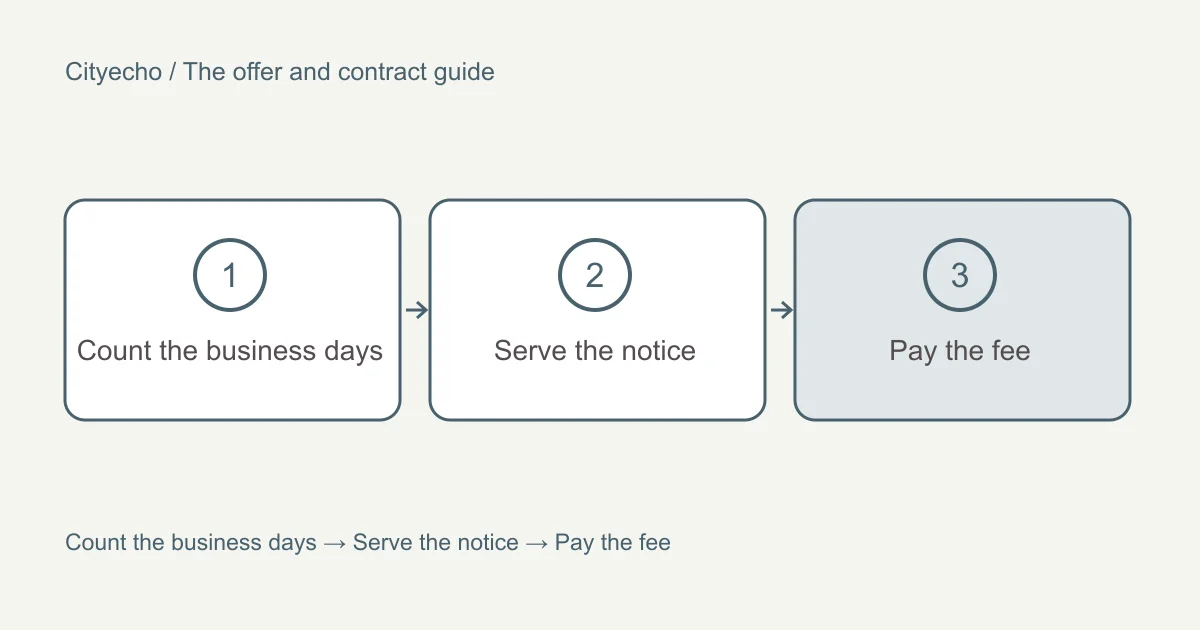
British Columbia gives a residential buyer a statutory right to walk away from the Contract of Purchase and Sale within 3 business days of acceptance, in exchange for a fee equal to 0.25% of the purchase price. The right is called the Home Buyer Rescission Period. It is sometimes called the cooling-off period. It is set by Property Law Act section 42 and B.C. Reg. 175/2022, and it cannot be waived. The offer and contract pillar sets out the whole process. This chapter covers the statutory source, the way business days are counted, how a buyer serves the notice, and how the right fits with the subject conditions a buyer may still write into the offer.
The right is a safety net, not a replacement for due diligence. A buyer who writes a firm offer in a competing-offer situation uses the window as a last-check escape. A buyer who writes subjects uses the window as a short backup for a problem that appears in the first 3 business days.
The statutory source
Property Law Act section 42, read on 5 October 2026, states a purchaser of residential real property may rescind the Contract of Purchase and Sale for the property by serving written notice of the rescission on the seller within the prescribed number of days after the date that the acceptance of the offer was signed. The section leaves the prescribed number of days to a regulation.
B.C. Reg. 175/2022, deposited on 21 July 2022 and amended on 14 November 2022, sets the detail. Section 4 of the regulation fixes the number of days at 3 business days. Section 6 sets the rescission fee at 0.25% of the purchase price for the residential real property set out in the contract. Section 7 states the right of rescission cannot be waived.
The right came into effect on 3 January 2023. A buyer who signed a Contract of Purchase and Sale on or after that date and whose property is covered has the right. A buyer who signed before that date did not. The right exists for every covered sale in British Columbia.
Which properties are covered
B.C. Reg. 175/2022 section 2, read on 5 October 2026, lists the covered property types. The list includes a detached house, a semi-detached house, a townhouse, an apartment in a multi-unit dwelling, a residential strata lot, a manufactured home affixed to land, and a cooperative interest. The common Lower Mainland property types all fall inside the list. A resale detached home in Coquitlam, a townhouse in Burke Mountain and a strata apartment in Port Coquitlam each carry the right.
Which sales are excluded
Section 3 of the regulation lists the exclusions. Residential property on leased land is excluded. A leasehold interest in residential property is excluded. Residential property sold at auction is excluded. Residential property sold under court order or under court supervision is excluded.
The auction exclusion matters for a buyer who signs at a live or online real estate auction. The court-order exclusion matters for a buyer who signs through a foreclosure or an estate sale that is being supervised by the Supreme Court. In each case the buyer protects themselves through subject conditions and through legal advice before signing, since the statutory rescission right does not apply.
A buyer who is unsure whether their sale falls into an exclusion asks the licensee and the lawyer or notary before signing. The subject conditions chapter covers how a buyer uses subjects when the Home Buyer Rescission Period is not available.
Counting the business days
Section 1 of the regulation defines a business day as a day other than a Saturday, a Sunday or a holiday. The holidays include the statutory holidays under the Interpretation Act and the Employment Standards Act. The practical result is that a long weekend or a holiday Monday extends the 3 business day window.
For an offer accepted on Monday the 7th, the business days are Tuesday the 8th, Wednesday the 9th and Thursday the 10th. The buyer may serve notice at any point from acceptance through to the end of Thursday the 10th. For an offer accepted on Friday the 4th, the business days are Monday the 7th, Tuesday the 8th and Wednesday the 9th, with the weekend not counted.
For an offer accepted on the day before a long weekend, the business day count skips the weekend and the holiday Monday. A buyer gains time to think when a long weekend falls inside the window. The licensee notes the exact deadline in the file and the buyer keeps the date on their calendar.
Serving the rescission notice
Section 5 of the regulation sets the methods of service. The written notice may be served on the seller or the seller's licensee by registered mail, by email, by fax, or by personal delivery. The notice must identify the Contract of Purchase and Sale by date, name the parties and state that the buyer is exercising the right of rescission under Property Law Act section 42.
Service by email is the common method. The buyer or the buyer's licensee sends the notice to the seller's licensee at the email address on file. The seller's licensee acknowledges receipt and informs the seller. The brokerage records the notice and the time of service.
The BC Financial Services Authority publishes a Home Buyer Rescission Period consumer resource, read on 5 October 2026, that includes a template notice. The Province's own Home Buyer Rescission Period page, read on the same date, is the primary consumer resource.
Paying the rescission fee
Section 6 of the regulation sets the fee at 0.25% of the purchase price. The buyer pays promptly after serving the rescission notice. The seller is entitled to the fee as compensation for the time the property was off the market.
The arithmetic is straight. On a $900,000 purchase the fee is $2,250. On a $1,100,000 purchase the fee is $2,750. On a $1,650,000 purchase the fee is $4,125. The fee is calculated on the full purchase price written on the contract, not on the deposit amount, and the buyer pays even if the deposit has not yet been collected by the brokerage.
A buyer who did not pay the deposit before rescinding still owes the fee. A buyer who paid the deposit before rescinding gets the deposit back under the Real Estate Services Act section 28 trust rules once the parties agree the fee has been paid. The deposits and trust accounts chapter covers the brokerage's role in releasing the deposit.
Rescission beside subject conditions
The subjects and the rescission period are two separate protections. A subject condition is a contract term. The rescission period is a statutory right. A buyer may use both, use one, or use neither in combination with a different protection.
A buyer who writes a subject-to-financing offer and a subject-to-inspection offer uses the subjects as the primary escape. The lender takes a week to decide on the mortgage, the inspector takes a day to inspect and write a report, and the buyer reviews both before the subject removal deadline. The rescission window plays a smaller role, since the buyer already has one to three weeks of protection through the subjects.
A buyer who writes a firm offer in a competing-offer situation does not have subject conditions to fall back on. The rescission window becomes the last-check mechanism. The buyer prepares as much as possible before the offer, so the 3 business days are enough to confirm the big decisions.
The subject conditions chapter covers the drafting choices. The multiple offers and bidding chapter covers the context in which a firm offer is often used. Our subject-free offers article in the journal covers the risks and the preparation involved.
When a buyer should and should not use the right
A buyer should use the right when a new fact changes the view of the property or when the finances or life circumstances change between acceptance and the deadline. A home inspection report that reveals a serious defect, a lender who declines the mortgage, a change in employment, a conversation with a lawyer that reveals a title problem, or a family emergency that changes the plan are each reasons a buyer uses the window.
A buyer should not use the right as a bargaining tactic. The fee is 0.25% of the purchase price and is paid to the seller. On a $1 million purchase the fee is $2,500. A rescinded offer followed by a new, lower offer is likely to be refused by the seller, since the seller already has a signed contract they can enforce. The right is a safety net, not a renegotiation tool.
A buyer who has already removed subjects on a longer timeline cannot usually also use the rescission period, since the 3 business days run from acceptance, not from subject removal. A buyer who signs on 1 October 2026 and removes subjects on 15 October 2026 passed the rescission window on 4 October 2026. The right is a short, early window.
The developer presale right is different
A buyer who signs a Contract of Purchase and Sale directly with a developer on a new strata unit uses a different statutory right. The Real Estate Development Marketing Act gives a presale buyer a 7 day rescission period, with no fee, after the buyer receives the disclosure statement and the signed contract. The 7 day right is longer and more generous than the Home Buyer Rescission Period.
A resale strata unit falls under the Property Law Act section 42 right, not the Real Estate Development Marketing Act. A buyer who buys a new unit from a developer uses the Real Estate Development Marketing Act. A buyer who buys the same unit from the first owner on resale uses Property Law Act section 42.
The applicable right depends on who the seller is and whether the unit is sold through a disclosure statement. The licensee and the lawyer or notary confirm which right applies before signing. The GST on new homes chapter in the costs and taxes guide covers related new-home tax rules that affect a presale buyer.
Use this chapter with your lawyer
A real estate licensee registered with BC Financial Services Authority discusses the window with a buyer and prepares the notice if the buyer decides to rescind. A British Columbia lawyer or notary advises on whether to use the right, since the decision has legal consequences. This chapter organises the rules. The next chapter covers assignments of contract. Our subject-free offers article in the journal covers the preparation a buyer completes before writing an offer that relies on the rescission window.