

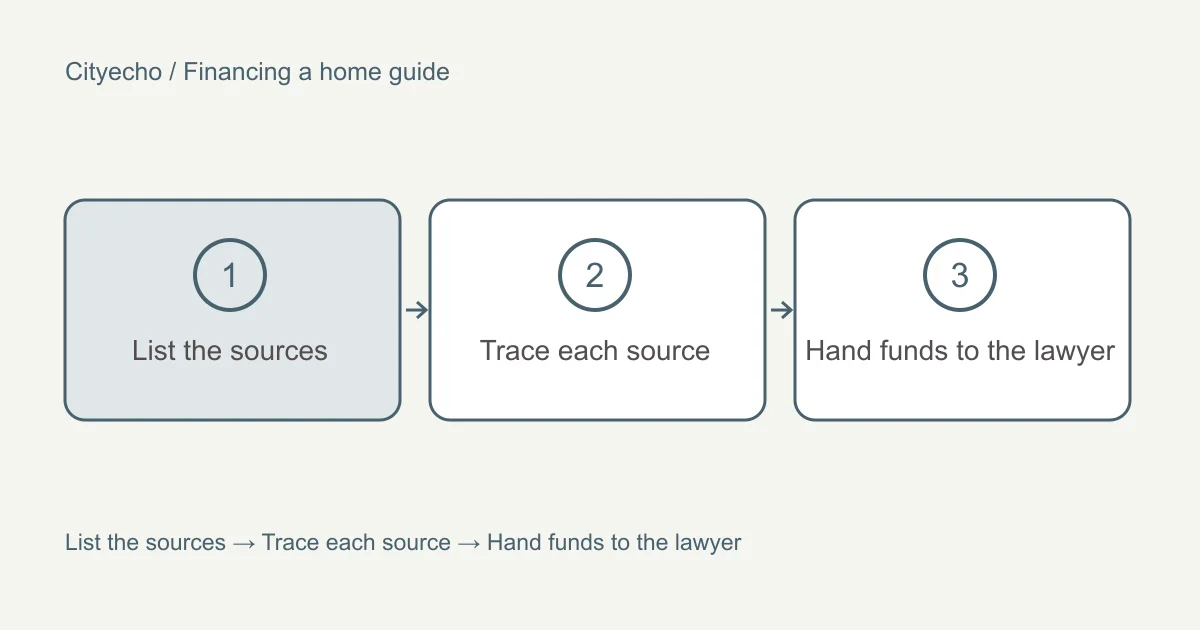
A mortgage covers most of the price. Your own money covers the rest, plus the one-time closing costs. The pieces come from several sources: savings, the Home Buyers' Plan, the First Home Savings Account, gifts from family, borrowed funds in some cases, and the equity from a sale when a buyer is also selling. Each source has a paper trail the lender wants to see, and each has rules under the Canada Revenue Agency or CMHC. This chapter walks through each one.
The financing hub pillar sets out the whole process. The mortgage application chapter covers the lender's conditional approval that includes the down payment source. The costs and taxes guide covers the one-time costs that sit alongside the down payment on completion day.
What has to be in the lawyer or notary's hands
Your lawyer or notary runs the completion. A few days before completion, they produce a statement of adjustments naming the exact amount of cash to deliver to the firm's trust account. The amount is the price, plus property transfer tax, plus Land Title and Survey Authority fees, plus legal and notary fees, plus adjustments for property tax and utilities, less the deposit already paid and less the mortgage advanced by the lender. The legal and registration costs chapter covers the itemisation.
The transfer is usually by bank draft or wire. Lawyers and notaries typically will not accept personal cheques for the full amount, because the funds have to clear by completion. Confirm the firm's acceptable payment methods and timing before completion week.
Minimum down payment and own-funds rule
CMHC's general requirements page, read on 5 October 2026, sets the minimum down payment at 5% of the price for homes up to $500,000, with 5% on the first $500,000 and 10% on the portion between $500,000 and $1,500,000. Homes priced above $1,500,000 are not insurable, which means the buyer puts at least 20% down. The down payment at a given price is covered in detail in the mortgage qualifying chapter in the costs guide.
The lender names the own-funds rule. CMHC's page lists traditional down payment sources as savings, the sale of another property, a gift from an immediate family member, and funds from an RRSP under the Home Buyers' Plan. Non-traditional sources on an insured mortgage include borrowed funds, with stricter conditions.
Savings and the paper trail
For a buyer whose down payment comes from accumulated savings, the Financial Consumer Agency of Canada's preapproval page, read on 5 October 2026, lists proof of the funds among the documents the lender collects. Lenders usually ask for 90 days of statements on each account that holds the funds, so recent large deposits can be traced.
A one-time deposit without a traced origin can delay the file. If a lump sum landed in the account recently, prepare a letter and a document trail: a sale of a car with a copy of the transfer, a withdrawal from another account with a statement showing the matching withdrawal, a gift with a signed gift letter and the giver's bank statement. The 90-day window gives the lender a complete picture of how the money arrived.
The Home Buyers' Plan
The Canada Revenue Agency's Home Buyers' Plan page, read on 5 October 2026, lets a first-time buyer withdraw up to $60,000 from an RRSP to buy or build a qualifying home, without the withdrawal being taxed. The funds must have been in the RRSP for at least 90 days before the withdrawal. A couple who both qualify as first-time buyers can withdraw up to $120,000 together.
Repayment follows a 15-year schedule. For a first withdrawal made between 1 January 2026 and 31 December 2028, the repayment start has been deferred so the 15-year clock begins in the fifth year following the year of the first withdrawal. A withdrawal made in 2026 under this rule starts repayment in 2031. For earlier withdrawals, repayment starts in the second year after the withdrawal.
Repayments are made through RRSP contributions designated to the plan on the tax return each year. A payment less than the annual minimum is added to the taxpayer's income for that year.
The First Home Savings Account
The Canada Revenue Agency's FHSA page, read on 5 October 2026, is a registered account for first-time buyers that combines a tax deduction on contributions with a tax-free qualifying withdrawal to buy a first home. The annual contribution limit is $8,000. The lifetime contribution limit is $40,000. Contribution room not used in a year carries forward on the agency's rules.
The agency's withdrawals page, read on 5 October 2026, defines a qualifying withdrawal: the buyer must have a written agreement to buy or build the home with an acquisition or construction completion date before 1 October of the year following the withdrawal, must occupy or intend to occupy the home as a principal residence within one year, and must maintain Canadian residency from the first qualifying withdrawal until the home is acquired. The withdrawal is not included in income and does not need to be repaid.
The FHSA can be used together with the Home Buyers' Plan on the same qualifying home, per the FHSA page, as long as both sets of rules are met.
Gifted and borrowed down payments
CMHC's general requirements page, read on 5 October 2026, lists a gift from an immediate family member among the traditional sources. The paper trail usually includes a signed gift letter stating the funds are a gift with no repayment expected, a copy of the giver's bank statement showing the funds leaving their account, and a copy of the receiving account statement showing the deposit cleared. Each lender has its own gift letter template; use the lender's wording to avoid a resubmission.
Non-traditional sources on an insured mortgage include borrowed funds, such as a personal loan or a line of credit. The borrowed amount is counted against the borrower's total debt service ratio, which can reduce the mortgage the lender will fund. Not every lender participates in programmes that allow borrowed down payments. A broker familiar with the specific programmes can match the file to a participating lender.
Bridge financing when a sale and a purchase overlap
A buyer who is also selling an existing home sometimes closes the new purchase before the sale. Bridge financing is a short-term loan from the mortgage lender that covers the gap. The lender advances the equity from the pending sale and takes repayment on the sale completion. Interest is charged daily, often at the lender's prime rate plus a margin.
A bridge requires a firm sale: a signed contract on the existing home with the subject conditions removed. Lenders usually cap the bridge at 90 days, sometimes longer by exception. The borrower pays the carrying costs on both loans until the sale closes. Our journal article on bridge financing walks through the mechanics and the typical cost on a Lower Mainland deal.
A sample completion cash list
| Line | Who it goes to | When |
|---|---|---|
| Deposit paid at offer | Brokerage trust account | At offer acceptance or soon after |
| Down payment balance | Lawyer or notary trust | A day or two before completion |
| Property transfer tax | Lawyer or notary pays to the province | Completion |
| Land Title and Survey Authority fees | Lawyer or notary pays to LTSA | Completion |
| Legal and notary fees | Lawyer or notary firm | Completion |
| Adjustments for property tax and utilities | Lawyer or notary pays to seller's side | Completion |
| Home insurance first premium | Insurer | In place by completion |
Who counts as a first-time buyer for the tax rules
The Canada Revenue Agency sets the first-time buyer definition for each programme separately. For the Home Buyers' Plan, a first-time buyer is a buyer who did not occupy a home they owned as a principal residence during the four calendar years before the withdrawal, with narrower rules for a buyer with a disability or buying for one. For the FHSA, the account holder must not have owned a home they lived in during the current year or any of the four preceding calendar years, individually or through a spouse or common-law partner.
The two rules overlap for most buyers but not for every one. A buyer who sold their first home three years ago is a first-time buyer under neither programme until the four-year window has passed. A buyer whose spouse owns a home may qualify for the Home Buyers' Plan but not the FHSA, since the FHSA treats a spouse's ownership as the buyer's own. The first-time buyer exemptions chapter in the costs guide covers the parallel definition under provincial property transfer tax, which uses its own test.
Use this hub with your lender, your lawyer or notary, and your real estate professional. The after funding chapter covers life inside the mortgage once completion has happened and the loan is in your name.