

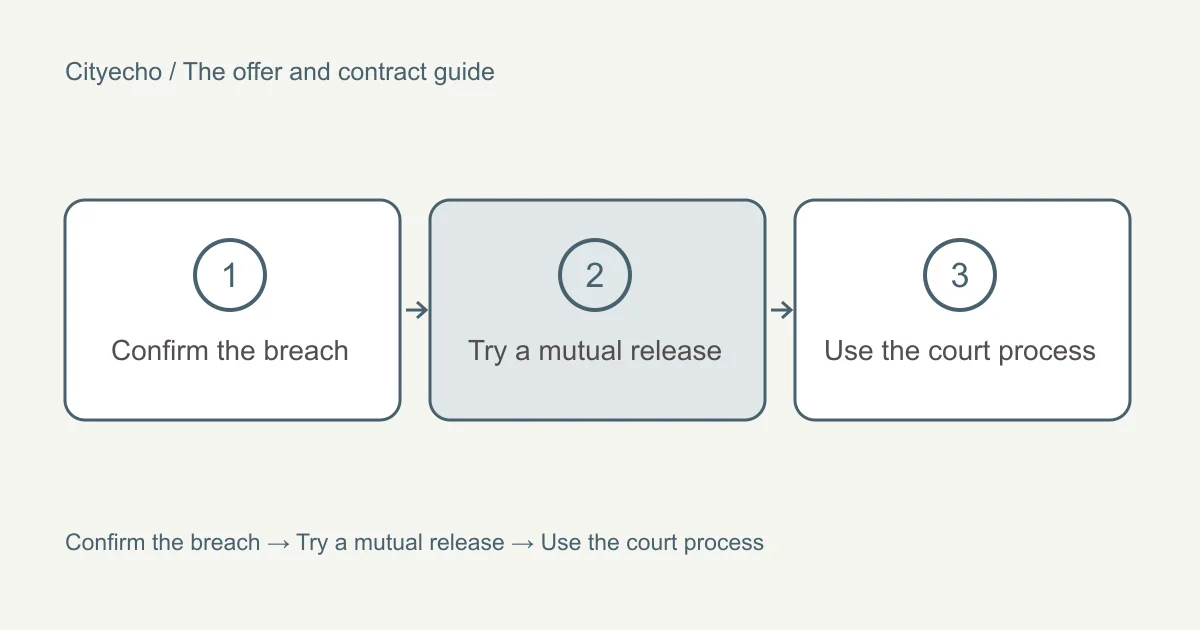
Not every Contract of Purchase and Sale reaches completion. A deal collapses when a subject is not removed by the deadline, a buyer refuses to complete after subjects are removed, a seller fails to deliver clear title on completion day, or one side becomes unable to perform between acceptance and the completion date. The deposit then becomes the first item the parties fight over, and the measure of damages beyond the deposit becomes the second. The offer and contract pillar sets out the whole process. This chapter covers what the Real Estate Services Act, the Law and Equity Act and the Property Law Act each say about a collapsed deal, how a mutual release ends most disputes without court, and what the Supreme Court of British Columbia decides when a release cannot be reached.
A collapsed deal is a stressful event for both parties. The buyer who intended to move in has lost the home. The seller who intended to sell has lost the sale and may be bridging two mortgages. The licensees watch the file carefully, the managing brokers document each step, and the lawyers prepare for the possibility of court. Most files reach a signed release within days of the breach, since the alternative is cost and delay for both sides.
The breach: who is in default and when
A buyer is in default when the contract is firm and the buyer fails to perform. The usual defaults are refusing to complete on completion day, failing to pay the balance of the price, and refusing to proceed after subjects are removed. The seller may still be in a position to require performance under the Property Law Act and the common law of contract, or treat the contract as repudiated and sue for damages.
A seller is in default when the seller refuses to deliver clear title, fails to remove a charge the seller agreed to remove, or refuses to complete on the completion date. The buyer may still require performance by asking the Supreme Court for specific performance, or treat the contract as repudiated and sue for damages. The buyer's deposit returns in full when the seller is the party in default.
Each party's licensee advises on the position. The managing broker is told under the Real Estate Services Rules B.C. Reg. 209/2021, which require the licensee to escalate when a deposit is at risk or a deal is at risk of failing. The lawyer or notary each party has retained for completion steps in once the risk of litigation appears.
The deposit path on a collapsed deal
The deposit sits in the brokerage trust account under the Real Estate Services Act section 28, which treats the brokerage as a stakeholder. The deposits and trust accounts chapter covers the trust rules in detail. On a collapsed deal the brokerage cannot release the money to one party without the other party's written consent, a court order or a direction in the contract that applies.
The Contract of Purchase and Sale sometimes includes a clause directing the deposit on specific events. For example, "if the buyer fails to remove the subjects by the deadline, the deposit is returned to the buyer". If the clause applies, the brokerage releases the money under the contract's own direction. If the clause does not apply, the brokerage waits for a mutual release or a court order.
A mutual release is the fastest and cheapest path. The parties negotiate who gets the deposit, usually with each party represented by a lawyer, and sign a short written release. The release names the contract, states each party releases the other, and directs the brokerage how to pay the deposit. The brokerage then releases the money and closes the file.
The Supreme Court interpleader under section 33
If a mutual release cannot be reached, the brokerage uses the Real Estate Services Act section 33, read on 5 October 2026. The section states that if, after a reasonable time, it appears to the brokerage there are adverse claimants to the money held in trust, the brokerage may apply to the Supreme Court for an order for payment of the money into court. The court holds the money and decides who it belongs to.
The interpleader application has three parts. The brokerage files a petition and serves it on the buyer and the seller. The parties file their claims. The court directs the brokerage to pay the money into court, which releases the brokerage from the stakeholder duty. The court then hears the dispute between the buyer and the seller and awards the money to one side, both sides on a split, or to a third person.
The brokerage's costs of the interpleader may be awarded out of the deposit by the court. Each party's own lawyer fees are not usually paid out of the deposit, since those are the parties' own costs of litigation. The court assigns costs based on who the court finds was at fault in the collapse.
Law and Equity Act section 24 relief
A buyer who defaults may lose the deposit under the contract's terms. In narrow cases, the court relieves against the forfeiture. Law and Equity Act section 24, read on 5 October 2026, states the court may relieve against all penalties and forfeitures, and in granting the relief may impose any terms as to costs, expenses, damages, compensations and all other matters that the court thinks fit.
The provision gives the court discretion. The court considers the size of the deposit relative to the contract price, the actual loss the seller suffered, the good faith of the buyer and whether the forfeiture would be grossly disproportionate to the breach. A deposit of 2% of the price may stand on a straight default. A deposit of 20% of the price may be partially returned if the seller resold without loss and the court finds the full forfeiture would be unconscionable.
The leading BC cases on relief against forfeiture of a deposit are decided by the Supreme Court and the Court of Appeal and are referenced on CanLII, the free Canadian case law resource. A buyer or seller facing a deposit dispute asks a lawyer who litigates real estate disputes to advise on the current state of the case law and the odds in the court. The regulation sets the framework. The judge decides.
The measure of damages beyond the deposit
A seller's damages often extend beyond the deposit. The common measure is the difference between the contract price and the resale price on the next sale. If a seller contracted with buyer A at $1.3 million, buyer A defaulted, and the seller resold to buyer B at $1.2 million, the loss is $100,000 before the deposit is applied.
A seller may also claim carrying costs for the extra time the home was on the market: the mortgage interest, the property tax, the strata fees for a strata property, the insurance and the utilities. The seller may claim the extra commission paid on the second listing. Legal fees to pursue the first buyer are sometimes awarded, depending on how the court exercises its discretion on costs.
The seller must act reasonably to resell the home. The common law of mitigation requires a plaintiff to take reasonable steps to minimise the loss. A seller who delays the resale for months without a good reason and then claims a larger drop in price may face a court finding that the extra loss was the seller's own doing. The licensee's advice on marketing and pricing after a default matters, since the seller may need to show the resale was handled competently.
A buyer in default may argue the actual loss is less than the deposit, which is where Law and Equity Act section 24 comes in. If the seller resold at a higher price than the contract and had no out-of-pocket loss, the buyer may argue the deposit should be returned in part. The court weighs the parties' positions and decides.
Specific performance: the buyer's remedy
If the seller refuses to complete, the buyer may ask the Supreme Court of British Columbia to order specific performance of the Contract of Purchase and Sale. Specific performance is an equitable remedy that forces the defaulting party to perform the contract, in this case to deliver the title to the buyer.
The historical view treated land as inherently unique, which supported specific performance in most cases. The Supreme Court of Canada in Semelhago v. Paramadevan narrowed that view, holding the buyer must show the property has qualities that make damages inadequate. In practice a residential buyer who wants a specific home for its location, its layout, its view or its proximity to a school or workplace, and who cannot find a comparable home on the market, has a plausible case for specific performance.
A buyer pursuing specific performance files a lawsuit in the Supreme Court. The buyer may also file a Certificate of Pending Litigation on the title to prevent the seller selling to someone else while the lawsuit runs. The buyer's lawyer handles the step. Our specific performance context in the collapsed deals discussion is beyond the scope of this chapter, and a buyer in that position retains a litigation lawyer promptly with the full contract and the breach documents.
Written releases and the limitation period
A written mutual release ends the Contract of Purchase and Sale and extinguishes further claims between the parties, subject to the terms of the release itself. A short, well-drafted release is a lawyer's job on each side. The parties agree on the deposit, the costs each side absorbs and any assumptions about future conduct, for example that neither will sue the other for damages beyond the amount directed in the release.
The Limitation Act sets a limitation period of two years from the date the party knew, or ought to have known, that a claim had arisen. A buyer or seller who delays beyond two years may lose the right to sue even if the deposit dispute is unresolved in the brokerage's trust account. The brokerage, meanwhile, may file an interpleader application under section 33 to clear the trust ledger if the parties remain inactive.
Use this chapter with your lawyer
A real estate licensee registered with BC Financial Services Authority runs the file through the breach and the mutual release step. A British Columbia lawyer who litigates real estate disputes handles the court steps. This chapter organises the questions a party asks at each stage. The deposits and trust accounts chapter covers the trust rules on the money. The subject conditions chapter covers the step most often linked to a collapse, which is a subject removal missed by a short margin. Our bridge financing article in the journal covers the funding step that a seller may face when a deal collapses and the resale sits for weeks.