

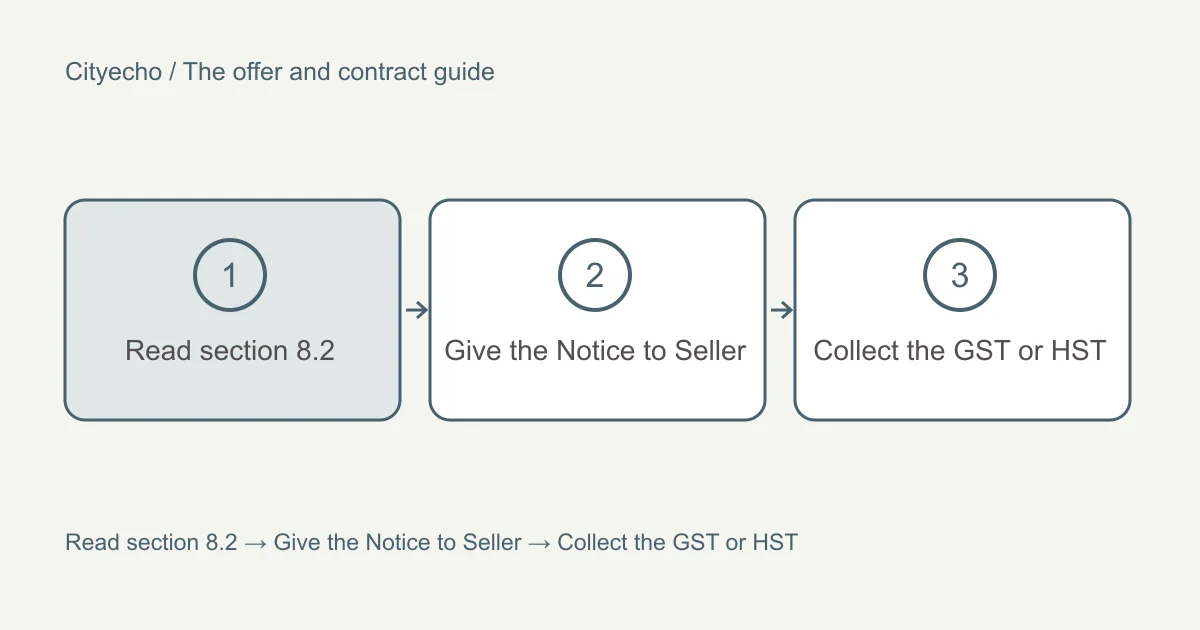
An assignment of a Contract of Purchase and Sale is a transfer of the buyer's rights under the original contract to a new buyer before completion. The step is more common on new-build presales than on resales, and is tightly regulated in British Columbia by the Real Estate Services Regulation section 8.2. A separate federal rule under the Excise Tax Act applies GST or HST to every assignment of new or substantially renovated residential housing. The offer and contract pillar sets out the whole process. This chapter covers the two standard assignment terms a licensee must include, the Notice to Seller Regarding Assignment Terms when the standard terms are left out, and the federal tax rule a buyer or seller addresses before signing.
An assignment is not a loophole. The regulator and the Canada Revenue Agency each watch the step, and the lawyer or notary registers the completion to the assignee only after the paper trail is in order. A buyer who intends to assign and a seller who may be asked to consent each read section 8.2 and the GST/HST rule before the first offer is signed.
The Real Estate Services Regulation section 8.2 standard terms
The Real Estate Services Regulation section 8.2(3), read on 5 October 2026, states that a contract for the sale of residential property prepared by a licensee must include the following terms, except as provided in subsection (4): "this contract must not be assigned without the written consent of the seller", and "the seller is entitled to any profit resulting from an assignment of the contract by the buyer or any subsequent assignee".
The two terms protect the seller. The first term gives the seller a veto on an assignment. The seller may refuse consent, consent on conditions, or consent on terms the parties negotiate. The second term claims the profit on an assignment for the seller. If the first buyer flipped the contract for $50,000 more than the original price, the second term directs that profit to the seller rather than the first buyer.
The standard terms are the default. Section 8.2(4) states the terms are not required if the licensee is told in writing to leave them out. The buyer or the seller may make this request, with the practical effect that the contract may be assigned without consent and the first buyer may keep any profit. The decision has to be made in writing to the licensee, and the licensee's file records it.
The Notice to Seller Regarding Assignment Terms
When the standard terms are left out, section 8.2(6) of the regulation requires the licensee to give the seller a Notice to Seller Regarding Assignment Terms. The notice must be in a form approved by the superintendent of real estate at BC Financial Services Authority, must be given when the contract is presented to the seller for signing, must be separate from the contract itself, and must advise the seller to obtain independent professional advice before signing.
The notice is the seller's warning that this is not a standard contract. A seller who signs without the standard terms gives up the right to profit on an assignment and the right to approve the new buyer. A seller advised by a lawyer in advance may still sign. A seller who did not see the notice has a complaint under section 8.2(6) and the regulator may investigate.
For a buyer who intends to assign, the Notice to Seller is a required step before the seller signs. The buyer's licensee prepares the notice, the seller receives it with the Contract of Purchase and Sale, and the signed notice is kept with the brokerage's file. The licensee cannot skip the step, since the regulation makes the delivery mandatory.
The common assignment path in the Lower Mainland
A typical presale assignment in Burke Mountain or along the Coquitlam Town Centre skytrain corridor follows a pattern. The original buyer signs a Contract of Purchase and Sale with the developer two years before completion, pays a deposit over three or four tranches, and chooses to assign the contract six months before completion rather than complete the purchase themselves.
The original buyer finds an assignee through a licensee or a presale assignment platform. The parties agree on the assignment price, which is often the original price plus a markup for the increase in market value since the original signing. The assignment agreement names the deposits already paid to the developer, the markup and the completion date on the original contract.
The developer's consent is required if the standard section 8.2 terms are in the original contract. On many developer presales, the developer builds its own assignment approval process into the contract and may charge an assignment fee for processing. The developer's lawyer reviews the assignee's identity and financial strength before giving consent, since the developer wants a reliable buyer at completion.
The federal GST/HST question is addressed next. The assignor collects the tax from the assignee on the taxable portion of the assignment price and remits it to the Canada Revenue Agency. The lawyer or notary completing the transaction confirms the tax has been collected before releasing the funds.
The federal GST/HST rule on new-build assignments
The Canada Revenue Agency GST/HST Info Sheet GI-120, read on 5 October 2026, is the authoritative federal guide to GST or HST on an assignment of a new or substantially renovated residential housing contract. The sheet states that effective 7 May 2022, all assignment sales in respect of newly constructed or substantially renovated residential housing are taxable for GST or HST purposes.
The amendment to the Excise Tax Act applies to every assignment agreement entered into after 6 May 2022, regardless of the identity of the assignor. Before the amendment, an assignment by an individual who did not acquire the property as a commercial activity was often not taxable. After the amendment, the individual status of the assignor does not matter. The sale is taxable.
GI-120 explains that the consideration for the taxable assignment sale is the assignment price minus any amount attributable to the deposit that was paid by the assignor to the builder and that is passed on to the assignee under the assignment, as long as the deposit amount is identified separately in the assignment. The deposit refund portion is not subject to GST. The remaining assignment profit is the taxable base.
The assignor is the person responsible for collecting and remitting the tax. The assignor charges the GST or HST on the taxable portion and files it with the Canada Revenue Agency on the next return. The federal rule applies even on a British Columbia sale, since GST is federal. HST does not apply in British Columbia, since the province did not harmonise.
When the assignment is of a resale home
The federal rule applies to newly constructed or substantially renovated residential housing. A resale home that is not a new build is not taxable for GST purposes on an assignment. If a buyer signs a Contract of Purchase and Sale on a resale detached home in Coquitlam and later assigns the contract before completion, the Canada Revenue Agency rule does not apply.
The provincial Real Estate Services Regulation section 8.2 still applies to the assignment of a resale contract. The two standard terms are in the contract unless the parties told the licensee to leave them out. The Notice to Seller is required if the standard terms were left out. The seller still has to consent to the assignment under the first standard term.
The practical result is that a resale assignment is a provincial-rules-only question. A new-build assignment is both a provincial-rules question and a federal-tax question. A buyer or seller on a new-build assignment uses a lawyer who understands both sets of rules.
BCFSA's role and the Assignments Guidelines
The BC Financial Services Authority publishes an Assignments Guidelines document for licensees. The Assignments Guidelines page, read on 5 October 2026, is the regulator's practice resource. The guidelines cover the licensee's duty to use the standard assignment terms, the content of the Notice to Seller, record-keeping, and the way the licensee handles the trust money on an assignment.
A licensee who omits the standard terms without a written instruction, or who omits the Notice to Seller when the standard terms are left out, is in breach of section 8.2. BCFSA may investigate and discipline. For a buyer or a seller, the practical result is that a BC licensee follows the regulation's steps, so the paperwork is in order when the lawyer or notary reaches the completion.
Novation versus assignment
A conventional assignment transfers the first buyer's rights under the contract to the second buyer but leaves the first buyer liable to the seller if the second buyer defaults on completion. The seller may still pursue the first buyer for the balance of the price and damages. A novation is a different instrument that releases the first buyer from the original contract and substitutes the second buyer in their place.
Novation requires a three-party agreement signed by the seller, the original buyer and the new buyer. The seller gives up any right to pursue the original buyer in exchange for the second buyer's full assumption of the contract. The lawyer drafts a novation when the parties want full substitution, which is a stronger form of transfer than an assignment.
A buyer assigning a Contract of Purchase and Sale asks the lawyer whether the assignment agreement is a novation or a conventional assignment. The two have different consequences on completion day and on any later litigation.
The brokerage trust accounting on an assignment
When an assignment happens, the deposit the first buyer paid to the developer or to the brokerage moves with the contract to the second buyer's account. The brokerage records the transfer on its trust ledger and the Real Estate Services Act section 28 continues to apply: the brokerage holds the money as a stakeholder.
The second buyer's additional funds, including the markup on the assignment price and the GST or HST on the taxable portion, flow through the parties' lawyers and the brokerage records them on the file. The deposits and trust accounts chapter covers the trust rules on a standard sale, and the same rules apply with the assignment-specific adjustments.
Use this chapter with your licensee and your lawyer
A licensee registered with BC Financial Services Authority prepares the Contract of Purchase and Sale with or without the standard assignment terms, gives the Notice to Seller when the standard terms are left out, and documents the trust money on the assignment. A British Columbia lawyer or notary advises on the GST or HST rule, on whether to use a novation and on the title registration path on completion. The next chapter covers when a deal collapses. Our assignment clauses article in the journal covers the common assignment addenda in the Lower Mainland. The GST on new homes chapter in the costs and taxes guide covers the GST rules a buyer meets on completion of a new build.