

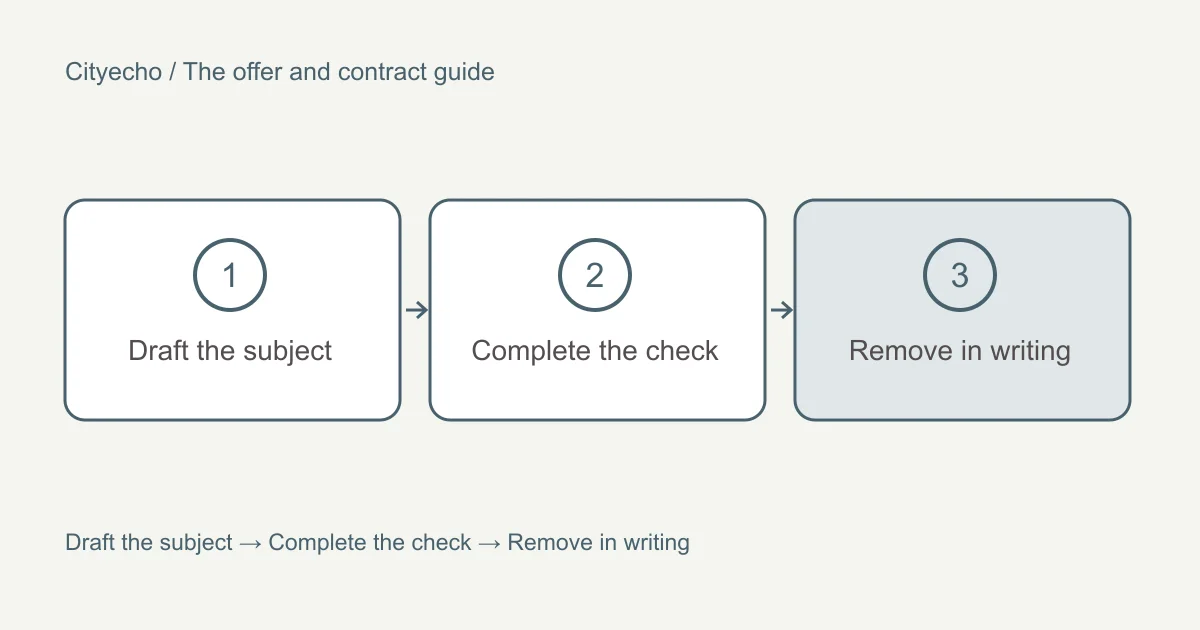
A subject condition is a contract term that lets the buyer or the seller cancel the Contract of Purchase and Sale if a stated requirement is not met by a stated date. The subjects buy the parties time to run the checks and the applications that cannot fit between the first viewing and the acceptance. The offer and contract pillar sets out the whole process. This chapter covers the common buyer subjects, the drafting language that fulfils versus the language that waives, and the Law and Equity Act section 24 relief a court may grant when a party misses a deadline by a short margin.
A well-drafted subject names the party responsible for the check, the test the party applies, the deadline and the method of notice. A badly drafted subject is a frequent source of disputes. The clause "subject to the buyer being satisfied with the home" gives one party a right no outside party can test. Rewriting the same clause as "subject to the buyer approving a home inspection report prepared by a licensed home inspector" names an outside party, a document and a party-controlled approval test. The second is the drafting pattern a BC licensee uses.
Financing, inspection, strata: the three common buyer subjects
Subject to financing protects the buyer from the lender refusing to fund the mortgage. The clause names the amount, the term and the date. The buyer applies to the lender after acceptance, provides income and down payment documents, and, if the lender approves, removes the subject in writing on the deadline. The mortgage application chapter in the financing a home guide covers the lender's review and the appraisal step inside the subject period.
Subject to inspection protects the buyer from a serious defect the viewing did not reveal. The clause names the inspector, the date and the buyer's approval test. A licensed home inspector in British Columbia must be licensed by Consumer Protection BC and provide a written report. The buyer attends the inspection, reviews the report with the inspector and decides whether to approve. If the report flags a serious problem, the buyer may remove on an amended price, remove with a repair holdback, or let the subject lapse and end the contract.
Subject to strata documents applies to a strata property. The buyer orders the strata documents through the seller or the licensee, reviews minutes, the depreciation report, the engagement letter for any pending levy and the Form B. The subject gives the buyer time to read, question and decide. The strata review chapter in the home buying guide covers the documents in detail. The contingency reserve fund article in the journal covers the reserve fund and special levies a strata buyer studies.
Other subjects a BC buyer uses
Subject to insurance confirms the buyer can get property insurance on the home. Insurers decline some older homes, homes with knob-and-tube wiring, polybutylene plumbing or an unresolved claims history. The clause gives the buyer a window to call an insurance broker, get a bindable quote and remove the subject. The home insurance article in the journal covers the step.
Subject to review of title lets the buyer see the Form A on title and the charges registered against the property before the contract becomes firm. The lawyer or notary runs the search and sends a report to the buyer. If a charge the seller did not disclose appears, for example a Statutory Right of Way across the backyard, the buyer may negotiate or walk away. The title search chapter in the due diligence guide covers the Form A, the charges and the steps a lawyer takes.
Subject to the sale of the buyer's current property is often called a subject-to-sale clause. The seller carries risk during the period, since the first contract depends on the buyer's own sale completing. Most sellers in the Lower Mainland accept a subject-to-sale clause only with a time clause that lets the seller continue to market.
Subject to municipal approval applies when the buyer intends to use the property in a way the current zoning does not permit, for example adding a secondary suite that needs a permit. The clause names the municipality, the approval sought and the deadline. The buildable lot chapter in the land and zoning guide covers the kinds of approvals that affect what a buyer can build.
Removing a subject in writing
A subject is removed by a short written document, signed by the party the subject protects, and delivered to the other party's licensee before the deadline. The removal names each subject by number or by subject matter and states the subject is removed. The brokerage records the removal in the file.
A removal must be in writing. A verbal removal, a text message or a licensee's note is not enough on its own. The BCFSA offers knowledge base page, read on 5 October 2026, treats subject removal as a contract step the licensee presents in writing to each party. The brokerage keeps a signed copy and the lawyer or notary refers to it when preparing the completion documents.
Many offers in the Lower Mainland split the deposit between an initial amount on acceptance and the balance on subject removal. The removal document names the balance due and the brokerage receives the payment on the deadline. If the balance does not arrive, the subject is not removed and the contract may end.
Waiver versus fulfilment
Removing a subject by fulfilment means the test the subject set has been met. The buyer got the financing, approved the inspection report or reviewed the strata documents without objection. Fulfilment confirms the contract is firm because the subject's purpose has been served.
Removing a subject by waiver means the buyer gives up the right the subject gave them without the condition being met. A buyer who waives a financing subject goes firm without a lender's written approval and takes on the risk the mortgage does not come through on completion. A buyer who waives an inspection subject goes firm without a passed inspection and accepts the risk of a hidden defect.
The language on the removal document matters when a later dispute asks whether the buyer accepted a known defect. If the inspection report flagged a leaking roof and the buyer removed by waiver without an amended price, the seller can argue the buyer accepted the roof condition and is not entitled to a credit on completion. If the buyer and seller instead amend the price by a holdback, the amendment records the agreed position and the removal confirms it.
The time clause on a subject-to-sale offer
A time clause lets a seller continue to market the property after accepting a subject-to-sale offer. The clause names a notice period, usually 48 or 72 hours. If the seller receives a second acceptable offer, the seller gives the first buyer written notice to remove the subject-to-sale clause within the stated period. If the first buyer cannot remove, the first contract ends and the second buyer's contract becomes binding.
The time clause transfers the sale risk away from the seller. The first buyer must be ready to bridge, firm up without their own sale complete, or step aside. The second buyer waits in a position with no guarantee their offer will be reached, since the first buyer may still remove. The licensee drafts the time clause with the exact hours, the method of notice and the first buyer's response window named.
The Law and Equity Act section 24 relief
A missed subject removal deadline ends the contract. In narrow cases, the Supreme Court of British Columbia relieves against the forfeiture under the Law and Equity Act. Section 24, read on 5 October 2026, states the court may relieve against all penalties and forfeitures, and in granting the relief may impose any terms as to costs, expenses, damages, compensations and all other matters that the court thinks fit.
The provision gives the court discretion. In practice it is used when the breach is minor, the party in breach acted in good faith, and granting relief does not prejudice the other party. A buyer who missed a deadline by a day because of a lender email delay, with the full subject substance already in hand, has a stronger case than a buyer who missed by a week while shopping for a better lender.
The faster path is a written extension signed before the deadline. If a subject is about to lapse and the lender or inspector has not finished, the buyer's licensee presents an extension amendment to the seller's licensee. The seller decides whether to extend. An extension signed in advance keeps the contract alive without a court application. The collapsed deals chapter covers the court route if the parties disagree.
Subjects, the rescission period and firm offers
A buyer with a complete set of subjects does not need the Home Buyer Rescission Period as the primary escape route. The subject gives a longer window, usually one to three weeks, and names an outside party's decision. The rescission period gives a 3 business day window after acceptance and requires a rescission fee.
A buyer who writes a firm offer in a competing-offer situation uses the rescission period as a last-check window. The province's Home Buyer Rescission Period consumer page, read on 5 October 2026, is the regulator's consumer resource. The Home Buyer Rescission Period chapter covers the statutory rules, the fee and how the business days are counted. Our subject-free offers article in the journal covers the risks of writing a firm offer and the way a buyer prepares to use the rescission window if needed.
Use this chapter with your licensee and your lawyer
A licensee registered with BC Financial Services Authority drafts each subject, keeps the deadlines in the file and runs the removal step. A British Columbia lawyer or notary reviews the title and the funds after subjects are removed. This chapter names the common subjects and the law that governs them. The next chapter covers deposits and trust accounts. The home inspection chapter in the due diligence guide covers the inspector a buyer hires inside the inspection subject period.