

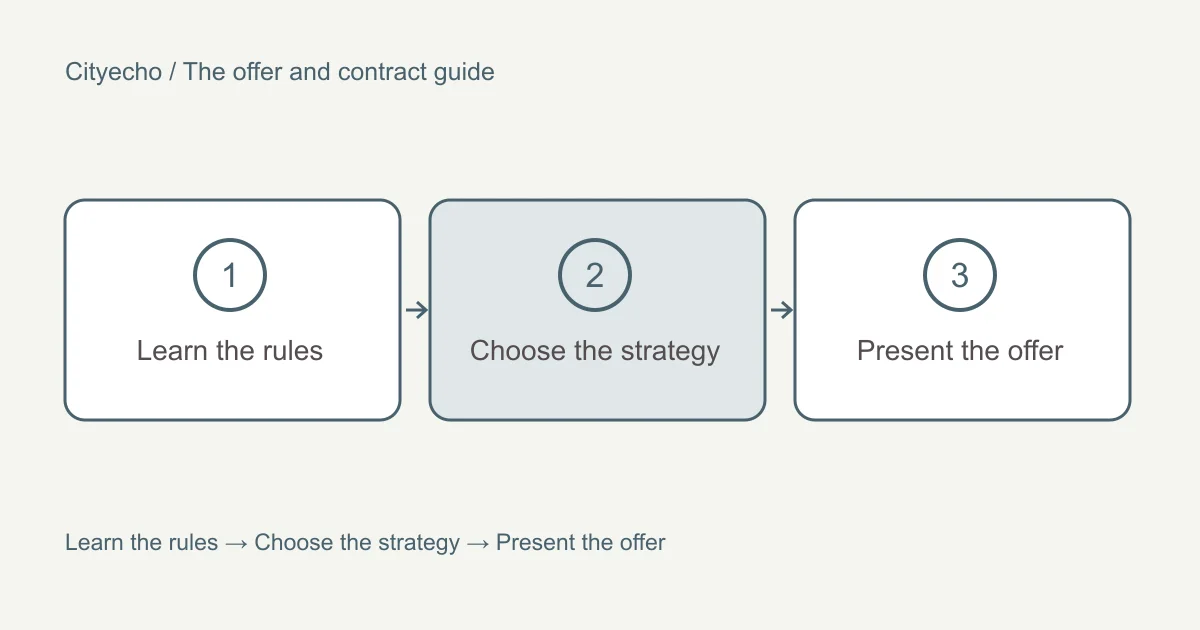
A competing-offer situation changes the way a buyer and seller think about the Contract of Purchase and Sale. The seller reviews two or more offers side by side. Each buyer writes their offer without knowing what the others wrote. The deal depends on the terms a buyer chooses on price, deposit, subjects and dates, and on the disclosure rules that govern what the licensees can share. The offer and contract pillar sets out the whole process. This chapter covers the practice rules under BC Financial Services Authority's offers knowledge base, the common strategies, and the mistakes a buyer avoids in a bidding scenario in Coquitlam and Port Coquitlam.
The regulator's goal is simple. Each buyer gets a fair shot and the seller's own choice is informed. The licensee is a conduit, not a dealer who sets up a side auction. A buyer who knows the rules reads the step for what it is and makes decisions that match their own risk tolerance.
The disclosure rules under BCFSA
The BC Financial Services Authority offers knowledge base page, read on 5 October 2026, is the regulator's practice guidance on how a licensee handles a competing-offer scenario. The core rules work together: a listing licensee may tell each buyer how many offers are in play, must not share the content or dollar amount of one buyer's offer with another, and acts on the seller's written instructions on the process.
A buyer who asks the listing licensee for the number of competing offers is entitled to a straight answer. A buyer who asks for the price another buyer offered is not. A seller's licensee who shares the dollar amount or the subjects on a competing offer without written authorisation breaches the regulator's rules and exposes the file to a BCFSA investigation.
A buyer may authorise the listing licensee to share the terms of their own offer with other buyers. Some buyers choose this to signal strength. The authorisation is in writing and the listing licensee follows it. A buyer who does not authorise sharing keeps the terms confidential and competes on the strength of their own paper.
Sealed-bid or open process
A sealed-bid process is a competing-offer step where each buyer submits a sealed, written offer by a stated deadline. The seller opens all offers at once and chooses. The listing licensee does not share one offer's terms with another and does not run a round-by-round auction. The sealed-bid process is the common pattern in the Lower Mainland on a property that attracts multiple offers.
The seller may instead run a two-stage process. In the first stage each buyer submits an offer. In the second stage the seller invites one or more buyers to improve their offer, usually by increasing price, raising the deposit or reducing subjects. The second-stage invitations are run under the listing licensee's handling, with the Real Estate Services Act section 28 trust rules still governing any deposits already paid.
The two-stage process favours the seller when the market is tight. The sealed-bid process favours a buyer who makes a strong first offer. The seller chooses the process in advance and the listing licensee communicates it to each buyer.
Price, deposit, subjects and dates: the four levers
A buyer in a competing-offer situation has four main levers to pull. Price is the first and most obvious. A buyer may bid the asking price, below the asking price with a reason, or above the asking price if the market is tight. The listing licensee may indicate the seller's expectation but cannot share another buyer's price.
Deposit is the second lever. A larger initial deposit on acceptance signals cash in hand. On a $1.2 million purchase, a $120,000 deposit on acceptance is a stronger signal than a $30,000 deposit. The deposits and trust accounts chapter covers how the deposit sits in a brokerage trust account and the stakeholder rule under the Real Estate Services Act section 28.
Subjects are the third lever. Fewer subjects, or subjects with tighter deadlines, make the offer firmer from the seller's point of view. A buyer who completes the inspection, review of strata documents and lender preapproval before writing the offer may drop subjects and present a firm offer with a short Home Buyer Rescission Period as the only remaining escape. The subject conditions chapter covers which subjects a buyer may safely drop and which they should keep.
Dates are the fourth lever. A seller selling to move up a street in Coquitlam has moving plans. A buyer who matches the seller's preferred completion date and offers flexible possession makes the offer easier to accept. The three dates on the Contract of Purchase and Sale, completion, possession and adjustment, each give the buyer room to accommodate the seller.
Escalation clauses, bump clauses and preemptive offers
An escalation clause ties the buyer's price to the highest competing offer, plus a stated increment, up to a ceiling. For example, "the buyer will pay $1,000 more than any other bona fide offer, up to a maximum of $1,300,000". The clause requires the seller to demonstrate the competing offer, usually by showing a signed Contract of Purchase and Sale. BCFSA's rules against sharing the content of one offer with another buyer complicate the use of an escalation clause. Many sellers in the Lower Mainland refuse to consider them because of the disclosure questions they create.
A bump clause, also called a time clause, is the seller's tool rather than the buyer's. The subject conditions chapter covers the time clause a seller adds to a subject-to-sale offer. In a straight competing-offer situation without a subject-to-sale offer in the mix, a bump clause is not usually used.
A preemptive offer, also called a bully offer, is an offer presented before the stated offer deadline. The seller may accept it immediately, breaking the planned competing-offer process, or hold firm to the deadline. The listing licensee follows the seller's instructions. A buyer who presents a strong preemptive offer with a short acceptance window puts pressure on the seller to decide ahead of the deadline.
The backup offer
A backup offer is a signed Contract of Purchase and Sale accepted by the seller to become operative only if the first contract collapses. The backup names the first contract, the trigger that activates the backup, and the backup's own expiry date. The second buyer is bound to the seller until the trigger fires or the backup expires.
A backup offer gives the second buyer a queue position without a guarantee. If the first buyer removes subjects and completes, the backup never activates and the second buyer's deposit returns on the backup's expiry. If the first buyer walks away during the subject period, the backup becomes the operative contract and the backup buyer's own subject period begins.
A seller gains a safety net from a backup offer. If the first deal fails, the backup contract exists and the seller does not have to re-list. The backup buyer's deposit sits in the brokerage trust account under the Real Estate Services Act section 28 until the trigger or the expiry resolves the backup. Our multiple offers from the seller's side article in the journal covers the seller's choices on backup offers in the Coquitlam market.
The Home Buyer Rescission Period and firm offers
A firm offer is an offer with no subject conditions. It is binding on the seller immediately on acceptance and firm on the buyer when the Home Buyer Rescission Period expires. Property Law Act section 42, read on 5 October 2026, and B.C. Reg. 175/2022 section 4 together give the buyer 3 business days to rescind the contract after acceptance was signed, with a rescission fee of 0.25% of the purchase price under section 6 of the regulation.
In a competing-offer situation the firm offer is the strongest paper. The seller knows the buyer is committed to the price and the deposit, and has given up every subject. A buyer who writes a firm offer should have completed the inspection, review of strata documents and lender preapproval first. The rescission window is a last-check escape, not a substitute for pre-offer due diligence.
The Home Buyer Rescission Period chapter covers the mechanics of the right. Our subject-free offers article in the journal covers the risks of writing a firm offer in a bidding situation and the preparation a buyer completes before taking that path.
Writing a personal letter to the seller
In a tight competing-offer scenario, some buyers add a short personal letter to their offer. The letter introduces the buyer, names the reason the buyer wants the home and avoids any statement that could introduce a protected characteristic the seller is forbidden to consider under the Human Rights Code. BCFSA's offers guidance treats the letter as supplemental to the written offer, not as part of the contract.
A well-written letter does not include a photograph of the buyer, references to the buyer's race, religion, national origin, family status, sexual orientation or disability, or any content that could expose the seller or the licensees to a human-rights complaint. A buyer who wants to use a letter asks the buyer's licensee to review it before presentation.
A letter does not change the paper. The seller still weighs price, deposit, subjects and dates. A letter can tip a tie between two similar offers and does nothing when the dollar gap is wide.
Use this chapter with your licensee
A licensee registered with BC Financial Services Authority prepares the offer and runs the step under the regulator's practice rules. The buyer sets the price, the deposit and the subjects after a conversation about the risk each lever carries. This chapter organises the questions a buyer brings to that conversation. The next chapter covers the Home Buyer Rescission Period. The pricing a home chapter in the selling guide covers how a seller sets a price knowing a competing-offer situation may follow. The showings and open houses chapter in the selling guide covers the step a seller runs before offers arrive.