

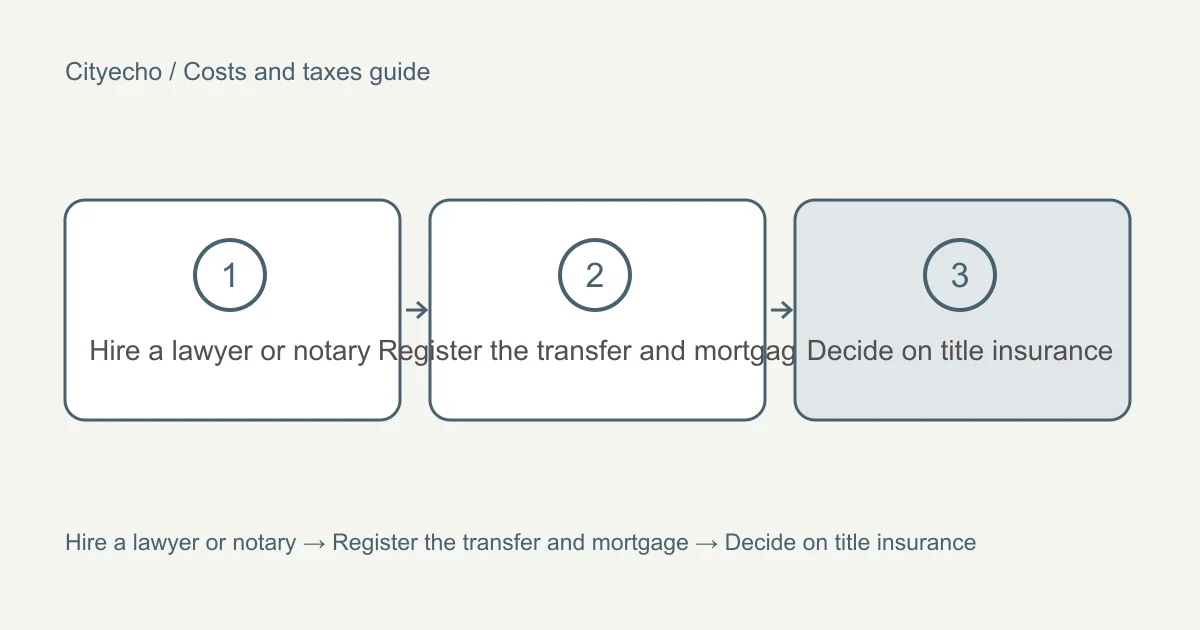
Every home sale in British Columbia is completed by registering documents at the Land Title Office. A lawyer or notary prepares those documents, handles the money in trust, and registers the result. The fees involved are smaller than the taxes in this guide, but they arrive on the same day and they must be paid in cash.
This chapter belongs to the costs and taxes guide. It covers the professional's role, the government registration fees, and title insurance. The transfer tax that your lawyer or notary pays for you is covered in the property transfer tax chapter, and the money flow on completion day is covered in the deposits and adjustments chapter.
What a lawyer or notary does on a purchase
BCFSA's page on completing your purchase says it is normal practice for a buyer to engage a lawyer or notary public to prepare the documents that transfer legal ownership. It lists the work they do to protect the buyer's interests.
They search the title in the land title register to find anyone other than the seller with a legal right to the home, and any registered easements or restrictive covenants. They prepare the transfer documents and the property transfer tax return. They make sure the seller's old mortgage is discharged where required, and that your new mortgage is registered. They confirm that the seller has paid what the seller owes. They prepare the statement of adjustments, arrange for you to sign, deliver the final amount to the seller, and register you as the owner.
A title search can turn up questions that affect how you can use the land. Our journal article on title search charges explains common entries such as easements and covenants. The due diligence guide explains how those entries fit into a wider review of a property before you remove your conditions.
Lawyers and notaries
Both lawyers and notaries handle home purchases in B.C. The Notaries Act, section 18, allows a notary in good standing to draw documents relating to property that are to be registered or filed in a public registry. A land transfer and a mortgage are both documents of that type.
If your purchase involves a complex issue, such as a dispute over a boundary or an unusual term in the contract, ask the professional at the start whether it falls within the work they can do. Ask for a written quote that lists their fee, their expected disbursements and the taxes on both.
What a lawyer or notary does on a sale
BCFSA's page on completing your sale says both the buyer and the seller usually engage a lawyer or notary. On the seller's side they search the title, prepare the transfer documents, make sure the seller's mortgage is discharged, confirm the seller's payments are made, and receive the money from the buyer's side.
BCFSA's page on what costs come with selling a home lists the seller's legal costs. They are the legal fees to discharge any existing mortgage and the legal or notary fees for the title transfer, with GST on those fees. The same list includes the commission and any mortgage prepayment penalty. The selling a home guide covers the seller's side in more detail.
Land title registration fees
The Land Title and Survey Authority (LTSA) charges a fee for each document registered. Its fee page showed the customer fee list as at 1 April 2026. The table lists the fees that come up most often in a home sale.
| Service | Fee as at 1 April 2026 |
|---|---|
| Register a transfer of title | $83.82 |
| Register a charge, such as a mortgage | $83.82 each |
| Cancel a charge, such as discharging a mortgage | $33.53 |
| Title search | $11.06 |
| State of title certificate | $16.76 |
| Document or plan order | $17.78 |
| Filing a transparency declaration | $10.61 |
For a buyer with one new mortgage, the two registrations add up to $167.64. A seller who pays off a mortgage pays $33.53 to register its discharge. These are government fees paid through your lawyer or notary. Ask them to list each one on their account so you can check it against the LTSA's published list.
The LTSA says registration fees are exempt from GST and PST. Searches ordered or applications filed through an LTSA account also carry a service charge, and a document signed with an electronic signature carries a separate electronic signing fee. GST applies to those two charges. Your lawyer or notary passes them on as disbursements.
The land owner transparency filing
The LTSA's fee list includes charges under the Land Owner Transparency Act. As at 1 April 2026, filing a transparency declaration cost $10.61 and filing a transparency report cost $60.15. Whether your transfer needs a report depends on who is buying and how the property is held, for example through a corporation or a trust. Ask your lawyer or notary which filing applies to you.
Title insurance as a separate product
Title insurance is an insurance policy, sold by an insurer, that may pay for certain losses linked to ownership of the property. It is optional. CMHC's worksheet to estimate the total cost of a home purchase lists title insurance among the up-front costs a buyer may pay, next to legal fees and the land registration fee.
The Financial Consumer Agency of Canada's page on real estate fraud suggests two steps for protection. One is a land title search, which shows the owner's name and any registered mortgages or liens. The other is to consider buying title insurance to protect yourself against losses from title fraud. The search is a record. The policy is a promise by an insurer, limited by its terms.
Before you buy a policy, ask for the wording. Ask what it covers, what it excludes, whether it protects you, your lender or both, and whether it replaces any other step your lender would otherwise require. Our journal article on survey certificates and title insurance compares the two and the questions each one answers.
What to give your lawyer or notary
Contact your lawyer or notary as soon as your offer is accepted, and before you remove any conditions if you can. Send them the full contract, including every addendum and any counter-offer. Send your lender's name and the contact for your mortgage, so the lender can send its instructions. Give them your insurance agent's details. The home insurance chapter explains why lenders look for cover and what an insurer will ask.
They will also ask for identification for each buyer and details of how you will hold title, for example as joint tenants or tenants in common. Each choice has different legal effects, so ask them to explain both before you decide. If a first-time buyer exemption or another exemption may apply, tell them early, since the claim goes on the tax return they prepare.
Timing on and before completion day
BCFSA lists arranging for you to sign the transfer documents among the tasks your lawyer or notary carries out. Ask them early when that appointment will be, what you must bring, and whether each buyer must attend in person. At the appointment you sign the transfer, the tax return and the mortgage documents, and you provide the balance of your funds. Ask them how and when they need the money, and how long a bank transfer takes to reach their trust account. Funds that arrive after the deadline they give you can hold up registration and the payment to the seller.
On completion day, your lawyer or notary registers the documents at the Land Title Office and delivers the purchase money to the seller's side. BCFSA's pages describe this as delivering the final amount due to the seller and making sure you are registered as the owner. Your lender's mortgage money is part of that amount, so ask your lawyer or notary when the lender will send it to them. Ask your real estate professional how the keys will be handed over on the possession date set in your contract, since that date can differ from the completion date.
Adding the costs to your budget
The Financial Consumer Agency of Canada's buying a home page tells buyers to be ready to spend between 1.5% and 4% of the purchase price on one-time closing costs. Its examples include inspection fees, legal fees, property tax adjustments and title insurance. In B.C., property transfer tax is part of that total, and on the $1,500,000 example in the transfer tax chapter it comes to $28,000.
Ask two or three lawyers or notaries for written quotes early, before you write an offer. Compare what each quote includes: the fee for the purchase, the fee for the mortgage, the disbursements, the LTSA charges and the taxes. Then carry the chosen figure into your completion budget, together with the transfer tax and your down payment.