

The deposit is the first money a buyer commits on a residential purchase. It sits in a brokerage trust account from acceptance to completion, under rules set by the Real Estate Services Act and the Real Estate Services Rules. If the deal completes, the deposit forms part of the purchase price. If the deal collapses, the deposit becomes the first item the parties fight over. The offer and contract pillar sets out the whole process. This chapter covers the trust account rules, the way the brokerage records each movement of money, and the court interpleader path when the parties disagree on who gets the deposit. The deposits and adjustments chapter in the costs and taxes guide covers the completion-day accounting that applies the deposit to the balance due.
A buyer who understands the trust rules knows what the brokerage can and cannot do with the money. The brokerage is not the seller's agent for this purpose and not the buyer's agent. The brokerage is a neutral stakeholder with a specific statutory duty.
The trust account rules under the Real Estate Services Act
The Real Estate Services Act section 26, read on 5 October 2026, requires a brokerage to maintain, in accordance with the rules, one or more interest-bearing trust accounts with one or more savings institutions in British Columbia. The trust accounts are separate from the brokerage's own operating accounts, and the brokerage must not use the money for its own purposes.
Section 28, read on the same date, states that if the brokerage holds the money in a brokerage trust account, then despite any rule of law to the contrary, the brokerage holds that money as a stakeholder and not as agent for one of the parties to the trade in real estate. The stakeholder duty is central. A listing licensee cannot pay the deposit to the seller before completion. A buyer's licensee cannot pay the deposit back to the buyer without the seller's written release or a court order.
The Real Estate Services Rules, B.C. Reg. 209/2021, read on 5 October 2026, set out the operational detail. The rules name the trust accounting standards, the notifications a managing broker must receive when a deposit is not received or a cheque is dishonoured, and the mechanics of trust account withdrawals on completion.
The deposit path from acceptance to completion
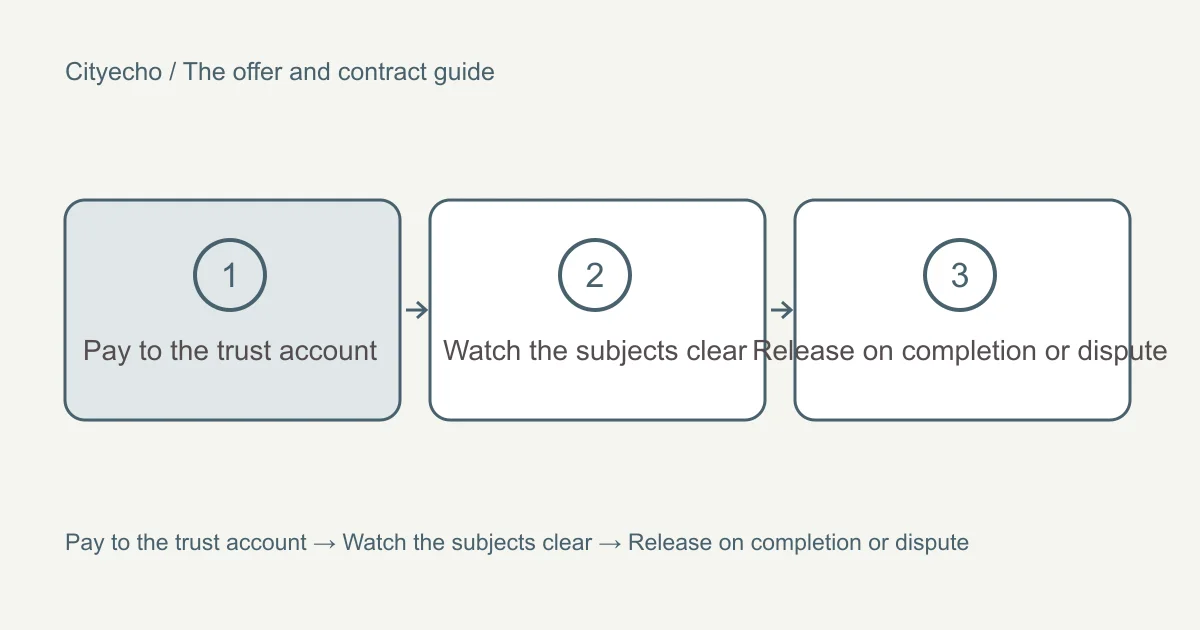
A typical sale in Coquitlam or Port Coquitlam follows a simple sequence. The buyer and seller sign the Contract of Purchase and Sale. The contract names the deposit amount, the brokerage that holds it and the dates. Within one or two business days of acceptance the buyer provides the initial deposit, often by bank draft or certified cheque to the holding brokerage. The brokerage records the deposit on its trust ledger and issues a receipt.
If the deposit is split, the balance arrives on subject removal, named in the subject removal document. The brokerage records the balance and issues a second receipt. The full deposit now sits in the trust account for the period between subject removal and completion.
On completion day, the lawyer or notary requests the deposit from the brokerage. The brokerage releases the money to the seller's lawyer, who applies it as part of the purchase price on the statement of adjustments. The buyer pays the balance of the price, the lawyer registers the Form A transfer at the Land Title and Survey Authority, and the possession date follows under the contract.
When the deposit becomes a dispute
A deposit dispute starts when the parties disagree on who the money belongs to. The common patterns are a buyer who refuses to complete after subjects are removed, a buyer whose financing fails inside the subject period without a timely written notice, a seller who refuses to deliver clear title on completion day, and a dispute over whether a subject was removed in time.
Each party may have a position. The seller argues the deposit is forfeited because the buyer breached the contract. The buyer argues the deposit is returnable because the contract ended by its own terms or because the Law and Equity Act section 24, read on 5 October 2026, grants relief against forfeiture. The brokerage cannot decide. The brokerage holds the money and waits for either a signed mutual release or a court order.
A signed mutual release is a short document the two parties sign to end the contract and direct the brokerage how to pay the deposit. The parties may split the deposit, agree the full amount goes to one side, or amend the contract to allow the deal to proceed. A release signed by both parties avoids a court application and the cost of a lawyer running one.
Interpleader under Real Estate Services Act section 33
When a release cannot be reached, the brokerage uses section 33 of the Act, read on 5 October 2026. The section states that if, after a reasonable time, it appears to the brokerage there are adverse claimants to the money held in trust, the brokerage may apply to the Supreme Court for an order for payment of the money into court. The court then decides who the money belongs to under the contract and the law.
An interpleader application has three steps. The brokerage files the application and serves it on the buyer and the seller. The parties file their claims to the deposit. The court directs the brokerage to pay the money into court, which releases the brokerage from the stakeholder duty. The court then hears the dispute and awards the money to one side, both sides on a split, or to a third person named in the contract.
The brokerage's own costs of the interpleader application may be awarded out of the deposit. Each party's lawyer fees are separate and depend on who the court finds was at fault. The collapsed deals chapter covers the measure of damages the seller may claim beyond the deposit when a buyer defaults.
BCFSA's role and the Deposits Guidelines
The BC Financial Services Authority publishes a Deposits Guidelines document for licensees. The Deposits Guidelines page, read on 5 October 2026, is the regulator's practice resource. The guidelines describe the licensee's duty to secure the deposit without delay after acceptance, to deposit the funds into the brokerage trust account without delay after receipt, to issue a receipt and to record every movement on the trust ledger.
BCFSA investigates licensees for trust account breaches. A missed deadline on depositing a buyer's cheque, a payment to the brokerage's own account by mistake, or a release of trust money without the required signatures are each conduct that invites discipline. For a buyer or seller, the practical result is that a BC licensee treats trust money with care. The regulator and the brokerage's managing broker both watch the file.
Deposit timing in multiple-offer situations
In a competing-offer scenario, the deposit size and timing are part of the offer strength. A buyer who writes 10% of the purchase price on acceptance signals cash in hand and commitment. A buyer who writes 5% split between acceptance and subject removal signals a standard offer. A buyer who writes 2% at acceptance only signals a weaker position on cash flow.
The multiple offers and bidding chapter covers the strategy around deposit size. A larger initial deposit on acceptance commits the buyer in a way that competes against the rescission period, since a 3 business day rescission under Property Law Act section 42 still carries a 0.25% rescission fee. The money the buyer walks away from after rescinding depends on the fee calculated on the full price, not on the deposit amount.
Reading the trust ledger on your file
Every brokerage keeps a trust ledger for each trade. The ledger records the receipt of each deposit, the date, the amount, the source and the running balance. A buyer or seller may ask the brokerage for a copy of the ledger entries relevant to their trade. The managing broker signs off on the ledger each month.
For a buyer, two lines on the ledger confirm the deposit is in trust: the receipt of the initial deposit on or around acceptance, and the receipt of the balance on subject removal. If a line is missing or the amount is wrong, raise the question with the buyer's licensee without delay. The managing broker addresses discrepancies under the brokerage's internal procedure and reports to BCFSA when the shortfall involves a licensee's conduct.
Use this chapter with your lawyer and your licensee
The brokerage holds the deposit under statutory rules. The lawyer or notary applies the deposit at completion. If the deal collapses, the signed mutual release or the Supreme Court order releases the money. This chapter organises the questions a buyer or seller asks before the trust path is tested. The next chapter covers multiple offers and bidding. The presale deposit schedules article in the journal covers the longer deposit timeline on a new build. The subjects chapter covers how the deposit returns when a subject is not removed in writing by its deadline.