

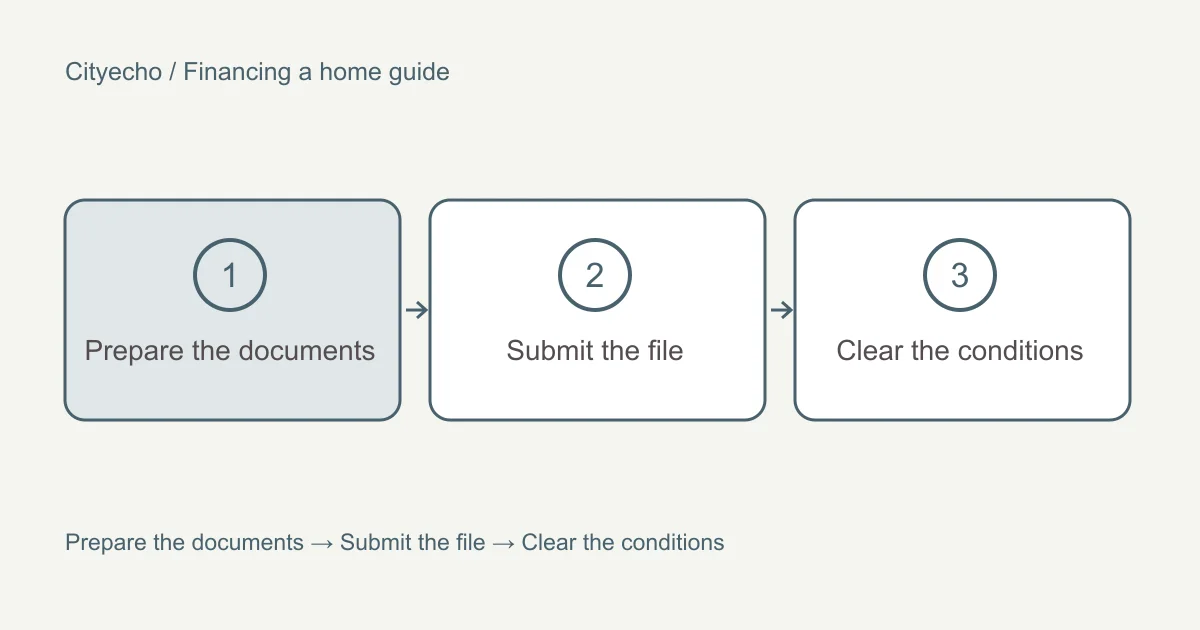
A mortgage application has three visible stages: a preapproval that tests the borrower, an approval that tests the property, and a funding step on completion day. Each stage has its own documents, its own deadlines and its own ways to be refused. This chapter walks through each one with the Financial Consumer Agency of Canada's rules attached.
The financing hub pillar sets out the full process. The brokers and lenders chapter covers which professional arranges the loan. The appraisal chapter covers the lender's property review that sits inside this process.
Prepare the file before the first call
Your file is the record a lender uses to decide the loan. The Financial Consumer Agency of Canada's preapproval page, read on 5 October 2026, lists identification, proof of employment such as pay stubs or Canada Revenue Agency notices of assessment for the self-employed, proof you can pay the down payment and closing costs, and information about assets and debts.
Gather each document before the first conversation. For a salaried borrower, that is a letter of employment confirming position, salary and length of service, the two most recent pay stubs, the two most recent notices of assessment, and account statements showing the down payment and reserves. For a self-employed borrower, the lender wants two years of personal and business tax returns, two years of notices of assessment, and bank statements for both personal and business accounts.
The agency's preparing to get a mortgage page, read on 5 October 2026, suggests ordering a copy of your own credit report before applying, so any errors are corrected before the lender pulls the file. A single error on an old account can lower the score by enough to push a borderline file into a higher rate.
The preapproval tests the borrower
A preapproval is the lender's assessment of what the borrower can carry, given the stress test, debt service ratios and credit history. The Office of the Superintendent of Financial Institutions' qualifying rate page, read on 5 October 2026, sets the qualifying rate at the greater of the contract rate plus 2% or 5.25%. CMHC's general requirements page, read on 5 October 2026, applies the same test to insured loans and caps the gross debt service ratio at 39% and the total debt service ratio at 44% of gross household income.
The preapproval produces a maximum loan amount and often a rate hold. The Financial Consumer Agency of Canada's preapproval page states the process does not guarantee approval and a lender could refuse a mortgage even after a preapproval. Treat the maximum as an upper boundary, not a target: buying at the maximum leaves no room for a payment increase at renewal.
Use the preapproval before you shortlist houses. Our preapproval article in the journal shows what a typical lender looks at and the common reasons a file is reduced from the online estimator's number.
The approval tests the house
Once an offer is accepted, the lender tests the specific property. A conditional approval names the conditions that still have to clear before funding. Common conditions include an acceptable appraisal, confirmation of the down payment source, home insurance in place by funding, a lawyer or notary engagement, strata documents on a strata property, and sometimes a current tax statement.
The lender orders the appraisal and reads the result. The appraisal chapter covers what happens when the value comes in below the price. For a condo or townhouse, the lender may require the strata's current depreciation report, bylaws, insurance certificate and recent minutes. Our journal article on reading a strata depreciation report covers what the lender looks at in that document.
A conditional approval is not funding. The commitment letter is a contract between the lender and the borrower, naming the terms, the rate, the amortization, the fees and the deadlines. Read every line against the terms quoted during the application.
The subject to financing clause
In a BC resale contract, a subject to financing clause gives the buyer a stated period, usually one to three weeks, to confirm the lender's commitment. Discuss the length with your real estate professional. A one-week condition suits a buyer with a thorough preapproval and an appraisal that can be ordered quickly. A longer condition suits a self-employed buyer, a non-conforming property, or a presale assignment.
Removing a subject to financing clause before the lender has issued the commitment letter is a serious risk. If the lender then refuses, the deposit is at risk and the contract becomes unconditional. Discuss the removal with your real estate professional and your lawyer or notary before giving notice. Our journal article on bridge financing covers the condition structure buyers use when a sale and a purchase overlap.
The rescission period, under BC Financial Services Authority as read on 5 October 2026, is a separate three-business-day right that applies to covered residential sales regardless of the subject conditions. The 0.25% fee is paid to the seller if the right is exercised.
The commitment letter and its conditions
A lender's commitment letter is the written contract that follows an approval. It names the loan amount, the rate, the term, the amortization, the schedule of advances if any, the prepayment privileges, the fees payable, the renewal rules and the conditions precedent to funding. Each condition has to be met with a specific document the lender names, often with wording the lender provides.
Common conditions in a BC resale commitment include:
- Appraisal at or above the purchase price
- Confirmation of down payment and closing cost source from the borrower's own accounts
- Fire insurance in place by funding, with the lender named as loss payee
- Lawyer or notary engagement letter and firm's trust account details
- Current property tax certificate or recent tax notice
- Strata documents on a strata property
- No new debt or change of employment since the application
Clear each condition early. The closing funds chapter covers the documents that trace the down payment to its source. Our journal article on home insurance before completion covers the insurance condition in detail.
The funding step
The lender funds the mortgage on completion day, through your lawyer or notary. The lawyer or notary registers the mortgage against title at the Land Title and Survey Authority, delivers the loan funds plus your down payment to the seller's lawyer or notary, and provides a statement of adjustments. The legal and registration costs chapter covers the Land Title and Survey Authority fees and the lawyer or notary's role.
The interest adjustment date on your mortgage contract sets the day interest starts to accrue, which is sometimes the same as the completion date and sometimes a day or two later. The first regular payment follows the schedule in the contract. The after funding chapter covers the first payment, the renewal letter at the end of the term and the choice at renewal.
Keep the file steady
| Change | Effect on the file | Action |
|---|---|---|
| New car loan or credit card | Lowers borrowing capacity under the total debt service ratio | Tell the lender in writing before applying |
| Job change | Lender may require probationary period to end | Confirm timing with the lender before accepting the role |
| Late payment on an existing account | Lowers the credit score | Pay the account, provide a letter if explanation is needed |
| Change of down payment source | Documentation restarts under the new source | Tell the lender early and provide the new paper trail |
| Change of property | Appraisal and insurance restart | New commitment letter, possibly new rate |
Shortfalls, reductions and declines
A conditional approval can be reduced before funding. The lender re-checks income, employment and debts in the week before funding, usually with a verbal confirmation to the employer and a soft credit pull. A reduction in gross household income, a new debt the lender spots on the credit report, or a drop in the account the down payment comes from can lower the approved amount. If the reduced loan is still enough to cover the deal, the file proceeds with the new terms. If it is not, the buyer has to either put more cash in, renegotiate the price, or trigger the subject to financing clause.
A full decline is less common past the commitment stage but it happens. The common causes are an appraisal below the price with a gap that cannot be closed, a title defect the lender's lawyer cannot clear, insurance the buyer cannot obtain, or a change in the buyer's employment status past the point the lender can underwrite. Treat the commitment deadline as the real decision point for the subject condition, not the first conditional approval.
Use this hub with your lender or broker. BC Financial Services Authority publishes the licensing register. The choosing a mortgage chapter and the rate hold chapter carry the questions you take into the application conversation.