

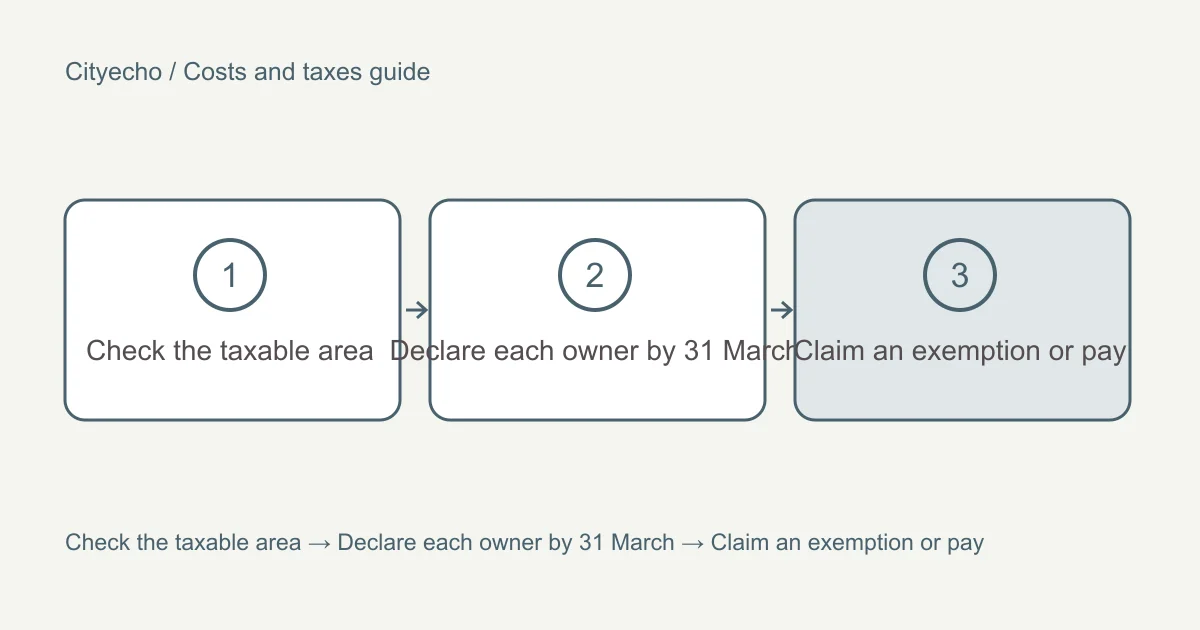
British Columbia's speculation and vacancy tax is an annual provincial tax on residential property in certain areas. It depends on how the owner uses the home, the owner's residency status, and where the owner earns and reports income. An owner who lives in the home as a principal residence may qualify for an exemption, but every owner in a taxable area must declare each year to claim it.
This chapter is part of the costs and taxes guide. It explains where the tax applies, the rates, the yearly declaration and the main exemptions. It also covers the federal Underused Housing Tax, which was a separate tax. The one-time 20% transfer tax on foreign buyers is explained in the property transfer tax chapter.
Where the tax applies
The province publishes a list of taxable areas, last updated on 8 December 2025. Under the Metro Vancouver Regional District it names the City of Coquitlam and the City of Port Coquitlam. It also names nearby Port Moody, Pitt Meadows, Anmore and Belcarra, together with Burnaby, Vancouver, Surrey and other member municipalities.
So the tax applies in both cities this guide covers. If you own residential property in Coquitlam or Port Coquitlam, you must declare. Outside Metro Vancouver, the list covers parts of the Capital Regional District and a set of named cities, districts, towns and villages. Areas not on the list, and some excluded lands, are outside the tax.
The province lists these exclusions inside taxable areas. Reserve lands, treaty lands and lands of self-governing Indigenous Nations are not part of the taxable areas. Islands reachable only by air or water are also excluded, except Vancouver Island. If your home is on reserve or treaty land, ask the province whether it falls inside the taxable area. Otherwise, plan to declare.
Rates for 2026 and 2027
The province's rate page, updated on 3 July 2026, sets the rate as a percentage of the property's assessed value. The rate depends on who the owner is.
| Tax year | Canadian citizens and permanent residents who are not untaxed worldwide earners | Foreign owners and untaxed worldwide earners |
|---|---|---|
| 2019 to 2025 | 0.5% | 2% |
| 2026 | 1% | 3% |
| 2027 | 1% | 4% |
The province describes an untaxed worldwide earner as a category of taxpayer that includes members of a satellite family. Its terms and definitions page sets out the full test. The rates for 2026 apply to how the home is used during 2026 and are declared in 2027.
The tax is based on ownership on 31 December each year. Where there are several owners, the tax is split by ownership share. On a hypothetical home assessed at $1,500,000 with no exemption, a 1% rate gives $15,000 for the year, and a 3% rate gives $45,000.
The yearly declaration
The province's page on how the tax works sets out the timeline. Declaration letters arrive between mid-January and mid-February. You declare by 31 March how you used the property in the previous year. If tax is owed, it is due on the first business day of July, and a 10% penalty plus interest applies to any balance after that date.
The declaration page, updated on 4 June 2026, says each owner on title must declare separately, even when the other owner is a spouse or relative. The letter goes to the mailing address held by BC Assessment. The province says the fastest way to declare is online, using the letter, your social insurance number and your date of birth. You can also declare by phone.
A buyer's first declaration comes in the year after the purchase year. If you complete a purchase in 2026, you will receive a letter in early 2027 asking how you used the home in 2026. Make sure BC Assessment has your mailing address so the letter reaches you.
The main exemptions for individuals
The province's exemptions page for individuals, updated 28 July 2026, lists the options. The one most owners use is the principal residence exemption. It applies to an owner who is a Canadian citizen or permanent resident, a B.C. resident for income tax purposes, and not an untaxed worldwide earner. An owner with several homes can claim it only on the home they lived in for the longest period in the year.
A home rented to a tenant can be exempt. The province says an owner may be exempt if a tenant, including a family member or other non-arm's length tenant, occupies the home for at least six months of the calendar year and the tenancy requirements are met. Read those requirements and the province's examples before you declare.
The year you buy has its own exemption. A newly bought property is exempt for that year if you paid property transfer tax or were exempt from it under listed programs, including the first-time home buyers' and newly built home exemptions. The province's example makes clear that in the following year you must claim a different exemption or pay the tax.
Other exemptions cover separation, the death of an owner, a home that cannot be lived in, and several other situations. Our journal article on the speculation and vacancy tax gives examples for common cases.
What a buyer should do in the first year
Start with the mailing address. The province sends declaration letters to the address BC Assessment holds for you, and it receives address updates from BC Assessment each week. After completion, confirm with BC Assessment that your name and address are correct, so that the letter reaches you in early 2027 for a 2026 purchase.
Keep records that show how you used the home. The province says that in some cases an owner may be asked for documents to confirm a property is their principal residence. A driver's licence, a tax return, utility accounts and a tenancy agreement are the kinds of records that show where you lived and who lived in the home.
Speak with every co-owner before the deadline. Each owner declares separately and can claim a different exemption. If one owner lives in the home and another lives elsewhere, the province's own example shows the first claiming the principal residence exemption and the second claiming a tenancy exemption for a family member.
Mistakes can be fixed. The declaration page says you have up to three years to submit or correct a declaration for a tax year, and the province has discretion to accept late declarations up to six years later. Correct an error as soon as you find it, because interest and penalties can apply to tax that should have been paid.
The federal Underused Housing Tax
The Canada Revenue Agency's Underused Housing Tax page describes it as an annual federal 1% tax on the ownership of vacant or underused housing, which took effect on 1 January 2022. It generally applied to foreign national owners, and in some cases to Canadian partners, trustees and corporations. The agency says provincial and municipal vacancy taxes are separate, and that an exemption from one does not exempt you from another.
Budget 2025 proposed to end it. The Budget 2025 tax measures say that no Underused Housing Tax would be payable, and no return would be required, for the 2025 and later calendar years. All requirements for 2022 to 2024 continue, including penalties and interest for late filing or payment.
The agency's Excise and GST/HST News No. 121 says those amendments are in Bill C-15. Parliament's record of Bill C-15, the Budget 2025 Implementation Act, No. 1, shows that it received Royal Assent on 26 March 2026. If you owned a home in Canada in 2022, 2023 or 2024 as a foreign national, or through a partnership, trust or corporation, ask a tax professional whether a return for those years is still outstanding.
Where each tax applies and where it does not
The three vacancy-related taxes that buyers hear about are separate, and each has its own rules.
| Tax | Who sets it | Applies to a Coquitlam or Port Coquitlam home |
|---|---|---|
| Speculation and vacancy tax | Province of British Columbia | Yes: both cities are listed taxable areas |
| Empty homes tax | City of Vancouver | A City of Vancouver tax, separate from the provincial tax |
| Underused Housing Tax | Government of Canada | Obligations remain for 2022 to 2024; none for 2025 and later |
The province's declaration page names Vancouver's empty homes tax, the federal tax and the home owner grant as separate from the speculation and vacancy tax. The home owner grant has its own application, explained in the annual property tax chapter.
If you plan to sell a home soon after buying it, other taxes can apply to the profit. The tax when you sell chapter covers the B.C. home flipping tax and the federal rules on short holding periods.