

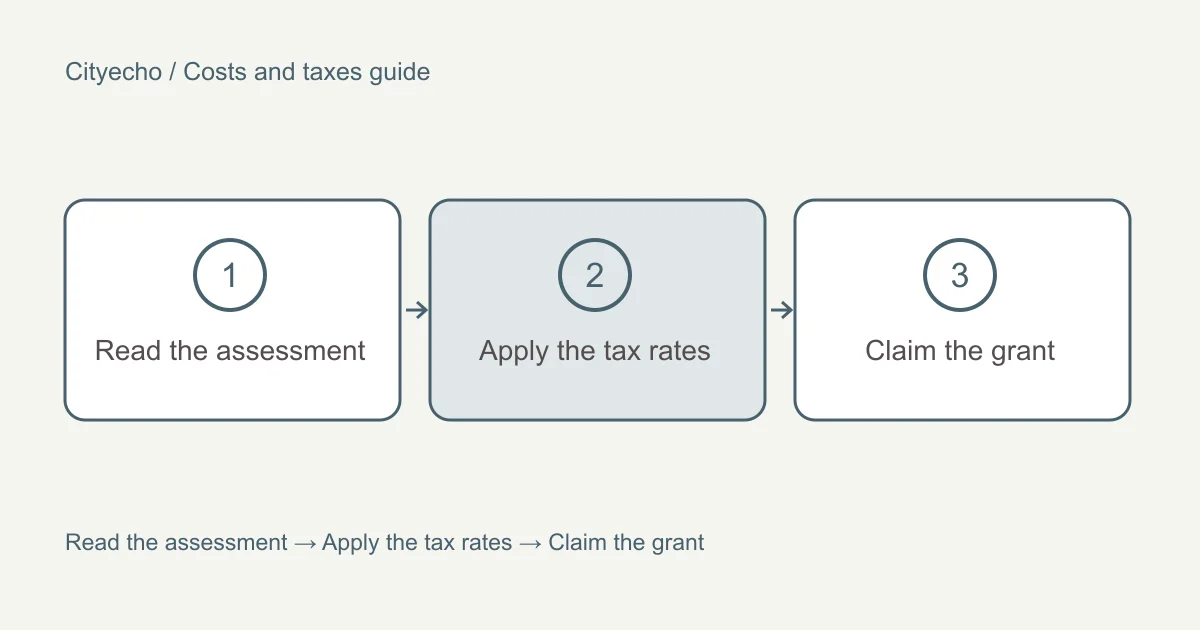
Annual property tax is the cost that stays after completion. The city sends a bill each year, and the amount depends on your assessed value and on the tax rates set by the city and other government bodies. The province then reduces the bill through the home owner grant if you qualify and claim it. This chapter explains each piece for Coquitlam and Port Coquitlam.
It belongs to the costs and taxes guide. The property tax for the year you buy is shared between you and the seller on completion day, as the deposits and adjustments chapter explains. A lender also counts property tax when it works out whether you qualify, which the mortgage qualifying chapter covers.
How a tax bill is built
A property tax bill multiplies your assessed value by a set of tax rates. Each rate is expressed per $1,000 of assessed value. The assessed value comes from BC Assessment. The rates come from the city and from the other bodies whose levies appear on the bill.
Coquitlam's property tax page says the city collects part of the bill on behalf of other government agencies, including the Province of B.C., TransLink, Metro Vancouver and BC Assessment. Port Coquitlam's property tax page says its bill includes municipal taxes and levies for schools, the BC Assessment Authority, the Greater Vancouver Regional District, TransLink and the Municipal Finance Authority.
Coquitlam explains how its own rate is set on its assessment and tax rate questions page. The city first sets its budget. Once BC Assessment provides the values, the city sets a rate that raises the amount the budget needs from each class of property. When assessed values rise across the city, the city adjusts the rate so that it still raises only the budgeted amount. What changes your bill is how your value moved compared with the average for your property class, together with any budget increase.
Coquitlam's 2026 residential rates
Coquitlam publishes a summary of 2026 tax rates. The residential figures, per $1,000 of assessed value, are below.
| Levy | 2026 residential rate per $1,000 |
|---|---|
| Municipal services | $2.1993 |
| Drainage | $0.0763 |
| School (local) | $1.1248 |
| BC Assessment Authority | $0.0381 |
| Metro Vancouver Regional District | $0.0547 |
| Municipal Finance Authority | $0.0002 |
| TransLink | $0.3586 |
| Total | $3.8520 |
On a hypothetical assessed value of $1,500,000, the 2026 bill before any grant is $5,778.00. The same summary lists an additional school tax on qualifying residential properties: $2 per $1,000 on the part of assessed value between $3,000,000 and $4,000,000, and $4 per $1,000 on the part above $4,000,000.
Port Coquitlam publishes its own 2026 property tax information, linked from its tax page. Use that document for a home in Port Coquitlam, since each city sets its own municipal rate.
Due dates and penalties in 2026
Both cities set 2 July 2026 as the due date for 2026 property taxes. Coquitlam says the payment covers 1 January to 31 December 2026. In both cities a 5% penalty applied to unpaid current taxes after 2 July 2026, and a further 5% applied to any balance after 15 September 2026. Port Coquitlam says it has no authority to waive these penalties because they are set by provincial law.
Port Coquitlam mails tax bills at the end of May and asks new owners who have not received one by the last week of May to contact the tax office. It also says owners must pay and claim the grant by the due date whether or not a bill arrived. If you complete a purchase in spring, check with the city that your name and mailing address are on file. Coquitlam says mailing address changes are made through BC Assessment.
Utility charges are billed separately
Water, sewer and garbage are billed apart from property tax. Coquitlam's utility fee page set the 2026 charges for a single-family dwelling at $713 for water and $661 for sewer. The garbage fee depends on cart size: $287 for a small cart, $379 for a medium cart and $534 for a large cart. That gives a 2026 total of $1,661, $1,753 or $1,908. Payment was due on 31 March 2026.
Port Coquitlam's utility bills page set 2026 annual rates for a single residential dwelling unit at $646 for water and $648 for sewer. Its bills were due on 31 March 2026. Port Coquitlam bills solid waste fees on the annual property tax notice. Both cities add charges for a secondary suite.
Paying ahead with a prepayment plan
Both cities offer a way to pay next year's tax in monthly amounts. Coquitlam's tax and utilities calendar says withdrawals for the tax prepayment plan and the utility instalment plan start on 1 August for the following tax year. The final tax prepayment withdrawal is on 1 May, and the final utility withdrawal is on 1 January. Port Coquitlam's tax page links to its own prepayment plan with pre-authorized withdrawals.
A plan spreads the cost across the year. You still claim the home owner grant with the province each year. When you buy a home, ask the city what happens to any plan the seller had and how to start a plan in your own name once the sale has completed. Check your first bill against any amount you have prepaid.
The home owner grant
The province's home owner grant page, updated 22 September 2026, says the grant reduces the property tax you pay on your principal residence. It states that the regular grant is $570 effective 1 January 2027. A higher additional grant is available to seniors, veterans, persons with a disability and some others.
To qualify you must be the registered owner, a Canadian citizen or permanent resident, live in B.C., and occupy the home as your principal residence. The assessed value must be within the threshold, which was $2,075,000 for 2026. Above that value the grant is reduced by $5 for each $1,000, and the regular grant is $0 above $2,189,000. You must pay at least $350 in property tax before the regular grant applies.
If you bought during the year, you can claim if the previous owner did not claim for that year, you have not claimed on another home that year, and you are living in the home when you apply. The province's application page says you must apply every year. It suggests applying after your tax notice arrives and before the due date, because a late claim counts as late payment of that part of the tax. Claims are accepted until 31 December of the tax year, and the province audits them for up to seven years.
The property tax deferment program
The province's deferment program is a loan. When you are approved, the Ministry of Finance pays your property taxes after the due date and registers a lien on your title. Interest is charged; for taxes deferred for 2026 and later years, the province says interest compounds.
The eligibility page, updated 20 March 2026, describes two programs. The regular program is for owners aged 55 or older in the current year, surviving spouses and persons with disabilities. The families with children program is for parents, stepparents and others who financially support a child. The home must be your principal residence, and you must have lived in B.C. for at least a year.
Equity is the main limit. The regular program requires minimum equity of 25% of the assessed value, and the families program requires 15%. You must also have paid all earlier years' taxes, utility fees, penalties and interest. The province's repayment page says the loan must be repaid in full before you sell, refinance or subdivide the property, or add or remove an owner on title, with exceptions for a spouse and a deceased owner. If you are buying a home whose title shows a deferment lien, ask your lawyer how it will be paid off and removed at completion.
How the assessed value relates to a market price
BC Assessment's key dates explain the timing. The assessment is based on market value on 1 July, and on the physical condition and permitted use of the property on 31 October. Notices are mailed by 31 December, and they are used for the following year's tax.
BC Assessment's page on market value and assessment says it looks at the same features a buyer would, such as size, age, condition and location, together with recent sales. It notes that its value can differ from a bank or private appraisal because its value is fixed at 1 July of the previous year. Our journal article on BC Assessment and market value explains why the two numbers move apart.
If you disagree with an assessment, contact BC Assessment first. The written complaint deadline for a Property Assessment Review Panel is 31 January. A homeowner who is not a Canadian citizen or permanent resident, or who leaves the home empty, should also read the speculation and vacancy tax chapter, because that tax is also calculated on the assessed value.