

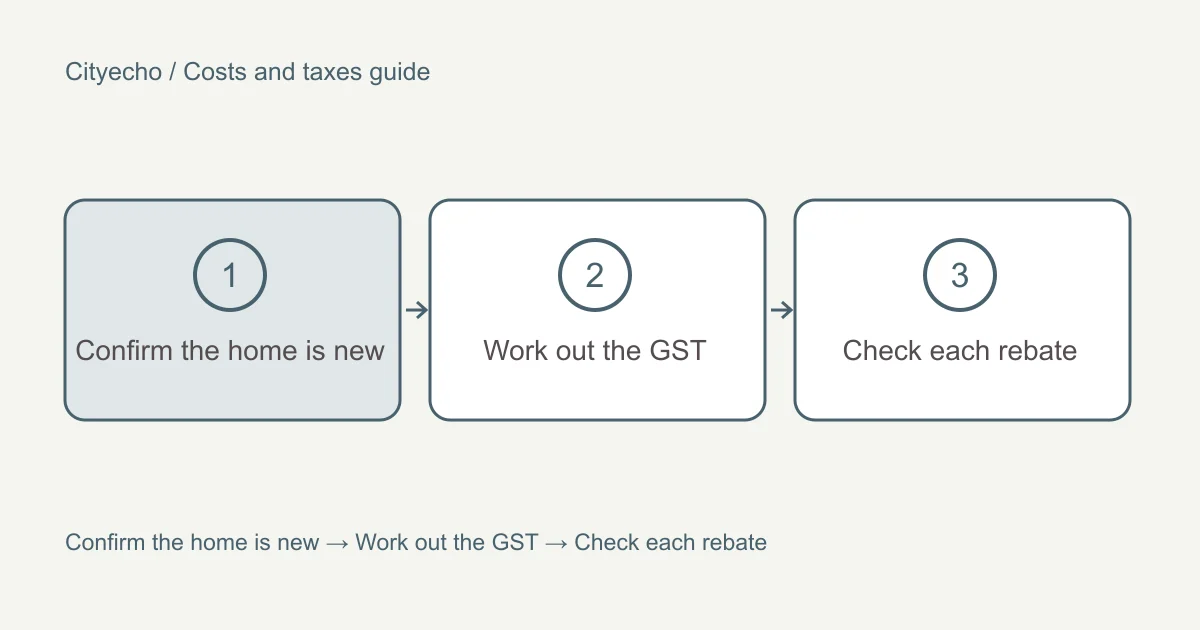
Federal sales tax applies to most newly built homes and to homes that have been substantially renovated. In British Columbia that tax is the Goods and Services Tax, or GST. For a buyer of a new house, the GST is often the second-largest tax after property transfer tax, and two federal rebates can reduce it.
This chapter belongs to the costs and taxes guide. The provincial exemption for newly built homes is a separate program under property transfer tax, and it is explained in the first-time and new home exemptions chapter. You can qualify for the provincial exemption, a federal rebate, both, or neither. Treat each as its own line in your budget.
Which homes carry GST
GST applies when you buy a newly built home from a builder, or a home that a builder has substantially renovated. The Canada Revenue Agency's new housing rebate page covers houses bought from a builder, owner-built houses, and new homes on leased land. The rebates described in this chapter apply only to new and substantially renovated homes. For any other purchase, ask your lawyer or notary to confirm whether GST applies to that sale.
A substantial renovation has a strict meaning. The agency's first-time rebate overview says that generally 90% or more of the interior of the existing home must be removed or replaced. Only livable space counts toward that test, including finished basements and attics. Garages and crawl spaces are left out. A kitchen update or a new bathroom on its own covers far less than 90% of the interior.
The rate and who collects it
The Canada Revenue Agency's provincial rates table, read on 30 September 2026, lists British Columbia at 5% GST. The same table shows that B.C. does not take part in the harmonized sales tax, which combines federal and provincial sales tax in some other provinces.
The builder collects the GST from the buyer at completion and sends it to the agency. The tax is part of the money you need on completion day, together with property transfer tax and legal costs. On a hypothetical new home priced at $1,250,000 before tax, 5% GST is $62,500.
Read your contract to see whether the price includes GST or adds it on top. The wording decides how much cash you bring on completion day. On the hypothetical $1,250,000 home, the difference is $62,500 before any rebate. Ask your lawyer to explain the wording before you sign, or before any subject removal date.
The two federal rebates
Two federal rebates can return part of the GST on a new home that you will live in as your primary place of residence. The regular GST new housing rebate has existed for many years and has low price limits. The first-time home buyers' GST rebate is newer and covers much higher prices. Where both apply, the agency describes the first-time rebate as a top-up to the regular one.
| Rebate | Maximum | Full rebate at | No rebate at |
|---|---|---|---|
| GST new housing rebate | 36% of the GST, up to $6,300 | $350,000 or less | $450,000 or more |
| First-time home buyers' GST rebate | 100% of the GST, up to $50,000 | $1,000,000 or less | $1,500,000 or more |
These figures come from Guide RC4028 and the agency's first-time rebate pages, as they read on 30 September 2026. Between the lower and upper limits, each rebate is reduced in proportion to the price.
The regular new housing rebate
Guide RC4028 sets out the regular rebate. For a house bought from a builder, you must buy the house and land under one written agreement. You must intend, when you sign, to use the house as your or your relation's primary place of residence. The price, plus any price you paid for a taxable assignment, must be less than $450,000 before tax.
The rebate is 36% of the GST paid, up to $6,300. The full amount applies at a value of $350,000 or less. It shrinks between $350,000 and $450,000, and it disappears at $450,000. Check the actual price against that limit before you include this rebate in a budget.
The first-time home buyers' GST rebate
The agency's eligibility page sets out who can apply. You must be at least 18 and a Canadian citizen or permanent resident. In the calendar year you take ownership, and in the four calendar years before it, you cannot have lived as your primary residence in a home that you or your spouse or common-law partner owned. Neither of you can have received this rebate before.
The dates also matter. For a house and land bought from the same builder, the agreement must be signed on or after 20 March 2025 and before 2031. Construction must begin before 2031 and be substantially completed before 2036. Ownership must pass to you before 2036. You must be the first person to live in the home after it is completed.
The value rule is generous compared with the regular rebate. On a home valued at $1,000,000 or less, the rebate can return all the GST, up to $50,000. The agency's example is a $1,250,000 home, halfway between $1,000,000 and $1,500,000, which receives half the maximum, or $25,000. On the hypothetical $1,250,000 home above, that leaves $37,500 of GST to pay if every condition is met.
The rebate follows the federal definition of a first-time buyer, which differs from the provincial one. A buyer who owned a home seven years ago and has rented since may qualify for the federal rebate while failing the provincial property transfer tax rule, which looks at ownership at any time. Check both sets of rules separately.
How the rebate is paid
Guide RC4028 describes two routes. The builder may pay or credit the rebate to you by reducing the amount you owe at completion. In that case you and the builder sign the rebate application, and the builder sends it to the agency. If the builder does not credit the rebate, you file directly with the agency. The guide says you generally have up to two years from the day ownership passes to you to do so.
Keep a copy of your statement of adjustments. The guide lists it among the documents the agency may ask for, including any assignment documents. The deposits and adjustments chapter explains what that statement shows. Our journal article on GST for new construction homes walks through the numbers for a purchase from a builder.
Assignments of presale contracts
An assignment happens when the first buyer of a presale home transfers their contract to a new buyer before completion. The Canada Revenue Agency's GI-120 info sheet carries a notice that since 7 May 2022 all assignment sales of newly built or substantially renovated housing are taxable for GST.
This creates two taxable sales. The new buyer can owe GST to the original builder on the home, and GST to the first buyer on the price of the assignment. The info sheet gives an example in which the first buyer paid a $10,000 deposit and assigned the contract for $15,000. The GST applies to the full $15,000, including the part that recovers the deposit. A fee that the builder charges for approving an assignment is also generally taxable.
Only one new housing rebate application can be made for each new home. The info sheet explains that a buyer who paid GST to both the builder and the first buyer may prefer to apply directly to the agency, so that both amounts are counted. Guide RC4028 adds that the first-time home buyers' rebate is not available where the original agreement was signed before 20 March 2025 and was later assigned or amended.
The seller of an assignment faces its own taxes. B.C.'s home flipping tax applies to profit on presale assignments held for less than 730 days, as the tax when you sell chapter explains. Our journal article on assignment clauses covers the contract terms that decide whether a builder will consent. Ask a lawyer to review any assignment before you sign it.
Questions to ask before you sign
Put the GST questions in writing to the builder and to your lawyer before you commit. Ask whether the price includes GST or adds it on top. Ask whether the builder will credit the first-time rebate or the regular rebate at completion, and what the builder needs from you to do so. Ask what happens to the price if you turn out not to qualify for a rebate that the builder has already deducted.
Ask your lender the same questions from its side. A lender works from the price in the contract and the cash you must bring. If a rebate falls away, the cash you need at completion rises by the amount of that rebate. Keep a note of every answer with its date. The mortgage qualifying chapter explains what a lender checks before it advances funds.