

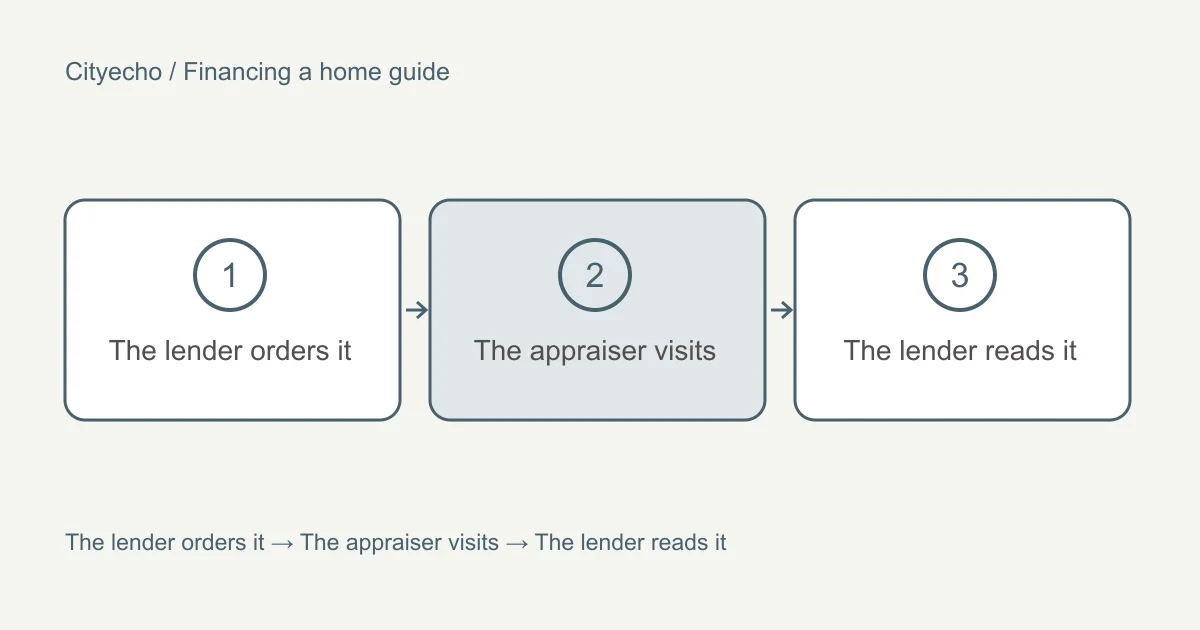
A lender funds a mortgage against the property. The appraisal is how the lender confirms the property is worth the loan. In most Canadian purchase files, the lender orders an on-site appraisal from a professional on its approved roster, reads the report, and sizes the loan against the appraised value. If the appraised value is below the offer price, the lender's loan amount reflects the lower number, not the price the buyer agreed. This chapter walks through each stage with primary sources attached.
The financing hub pillar sets out the full process. The application chapter places the appraisal inside the lender's conditional approval. The home inspection chapter in the due diligence guide covers the separate physical-condition report the buyer orders for themselves.
Who orders the appraisal and why
The appraisal is for the lender's security file, not the buyer's negotiation. The mortgage is a loan secured against the property, and the lender's recovery in a default sale depends on the property being worth the loan. The lender decides whether an appraisal is required, which appraiser to use from its approved list, and what date it must be effective. The Financial Consumer Agency of Canada's preapproval page, read on 5 October 2026, confirms that a lender may refuse a mortgage if the property does not meet certain standards.
CMHC's general requirements page, read on 5 October 2026, confirms the appraisal as part of the lender's eligibility assessment for insured loans. The appraisal result sets the loan-to-value ratio that determines the maximum loan and whether default insurance is required.
A buyer can order an independent appraisal for a second opinion, due diligence on a non-conforming property, or support for a renegotiation. That report is a document the buyer uses with the seller, not something the lender funds against unless the appraiser is on the lender's roster and the report is written for the lender.
Who pays and how much
In most files, the borrower pays the appraisal fee. Fees range from $350 to $600 on a standard detached single-family house in the Lower Mainland, higher for a rural property, an acreage, a multi-unit building, or a specialty property. On some files the lender covers the fee as part of its offer, inside a cash-back product or as an incentive on a strong borrower profile.
Ask each lender in writing whether it pays the fee or expects the borrower to pay. Monoline lenders, which fund through brokers, often pay the fee as part of the offer. Big banks sometimes cover it in a specific product and sometimes not. The answer belongs in the comparison spreadsheet the brokers and lenders chapter describes.
Who the appraiser is
A residential appraiser working on a Canadian lender's file typically holds the Canadian Residential Appraiser designation from the Appraisal Institute of Canada. The designations page, read on 5 October 2026, lists the requirements: university-level education, supervised experience and continuing professional development. Appraisers for higher-value, non-conforming or commercial properties hold the Accredited Appraiser Canadian Institute designation.
The lender picks the appraiser from its approved list. The buyer does not interview the appraiser, choose the appraisal company, or negotiate the fee. The lender's approved list exists so the appraiser's independence from the parties is preserved and the report meets the lender's underwriting standards.
What happens on the visit
The appraiser contacts the listing side to schedule the visit, usually inside a week of the lender's order. On the visit, the appraiser measures the home, records the number and type of rooms, notes the condition of major systems, photographs the interior and exterior, and asks about recent updates. The visit typically takes 30 to 60 minutes on a standard house, longer on a larger or non-standard property.
The appraiser then prepares a written report. The sales comparison approach, standard for a residential appraisal, selects three to six recent sales of similar homes in the same market area and adjusts the sold price of each for differences in size, age, condition, lot, parking and views. The adjusted figures produce a range, and the appraiser selects a value inside that range as the estimate of market value as of the date of inspection.
The appraisal is a professional opinion, not a guarantee. Two qualified appraisers reviewing the same property can produce different values inside a reasonable range. On a market with few recent comparable sales, the range is wider.
When the number is lower than the price
The lender reads the report and uses the appraised value as the base for the loan-to-value ratio. If the appraised value is below the offer price, the lender funds against the appraised value, not the price. The gap between the price and the appraised value has to be paid in cash by the buyer, or the deal has to be renegotiated.
Three ways to handle a shortfall:
- Put more cash in. The buyer adds the difference to the down payment. The loan is funded on the appraised value and the deal closes at the agreed price. This works when the buyer has reserves beyond the planned down payment and closing costs.
- Renegotiate the price. The buyer asks the seller to reduce the price to the appraised value, or to meet somewhere between. The seller is not required to agree. On a soft market the request often succeeds; on a competitive market it often does not.
- Walk away. If the buyer's offer carries a subject to financing clause and the condition is still active, the buyer can notify the seller that the condition is not met and the deposit is returned. On a condition-removed offer, walking away risks the deposit and other remedies.
Discuss the exact wording of the subject to financing condition with your real estate professional before an appraisal is ordered. The application chapter covers the condition structure and the deadlines inside which these choices have to be made.
BC Assessment, lender appraisal and listing price
| Figure | Purpose | Who sets it | Date it reflects |
|---|---|---|---|
| BC Assessment value | Property tax base | BC Assessment | 1 July of the previous year |
| Appraised value | Lender security | Appraiser on lender's roster | Date of inspection |
| Listing price | Seller's asking position | Seller with agent | Date of listing |
| Offer price | Negotiated contract | Buyer and seller | Date of offer acceptance |
A BC Assessment value is a mass-produced estimate set as of 1 July of the previous year, published by BC Assessment. Each year's roll is used by cities for property tax billing. A lender does not fund against the assessment, because the assessment is a mass estimate from a date in the past, not an individual appraisal of the current market. Our journal article on BC Assessment versus market value covers the difference in detail.
Appraisals on a strata property
On a strata property, the appraiser inspects the unit and may ask the strata manager for the depreciation report, the current insurance certificate, the bylaws and recent minutes. The appraiser also uses sales of similar units in the same building or complex as the primary comparables, since location and shared amenities are near identical to the subject.
A strata property with a large upcoming special levy, deferred maintenance in the depreciation report, or a recent fire-code order can be reflected in the appraisal. The strata review chapter in the home buying guide covers the documents a buyer reviews. The lender's appraisal is one more reader of the same documents.
Timing in the subject period
The appraisal usually fits inside the subject to financing period. The lender orders it once the file is in underwriting, the appraiser contacts the listing side to schedule, visits the house, and files the report within one to five business days of the visit on a standard file. A rural property, an acreage, or a property with few recent comparable sales can take longer. The appraiser may need the listing agent to confirm access, the seller to be absent during the visit, and the strata manager to provide documents on a strata property.
Build the appraisal timeline into the subject condition. A one-week subject to financing clause can be tight when the lender is slow to send the file to the appraiser, when the appraiser is booking a week out, or when the seller delays access. Discuss realistic timelines with your real estate professional before writing a short condition, and consider a two-week window to absorb the common delays. A buyer who shortens the condition for competitive reasons on a strong preapproval accepts the risk that the appraisal arrives after the deadline, which can force an early removal of the condition without the lender's final result.
Use this hub with your lender, your real estate professional and your lawyer or notary. The application chapter covers the conditions that follow the appraisal, and the closing funds chapter covers the cash the buyer puts in when a shortfall closes the deal at the agreed price.