

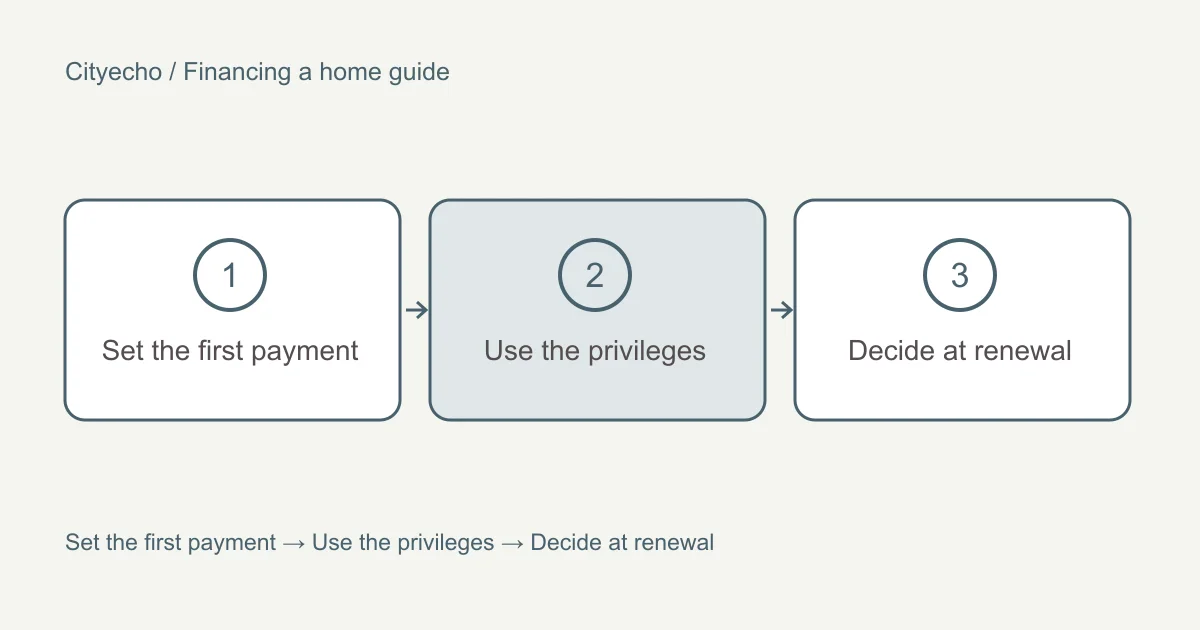
A funded mortgage is a schedule and a set of rules. The schedule names the day interest starts to run, the frequency of payments, and the day each payment is drawn. The rules name the use of prepayment privileges, the renewal letter at the end of the term and the choice between staying with the lender and switching. This chapter walks through each stage with the Financial Consumer Agency of Canada's rules attached.
The financing hub pillar sets out the whole process. The application chapter covers the step before funding. The prepayment penalties page is the primary source for the breakage calculation referenced throughout this chapter.
The interest adjustment date and the first payment
A mortgage contract names an interest adjustment date. This is the day the lender starts counting interest on the loan, and the day the amortization schedule begins. The interest adjustment date can be the same as the completion date, or a day or two later. On a completion date in the middle of a month, the lender sometimes aligns the interest adjustment date to the next first-of-month, so the regular payment schedule falls on a clean day.
The first regular payment follows the payment schedule the contract names, usually one payment period after the interest adjustment date. A monthly schedule with an interest adjustment date of 1 November, for example, produces the first regular payment on 1 December. A biweekly schedule produces the first payment two weeks later. Check the contract for the exact date.
Between the completion date and the interest adjustment date, interest accrues on the loan. The lender collects this interest at funding, as part of the funds drawn down. The amount is small but it is real; your lawyer or notary records it on the statement of adjustments.
Payment frequency and amortization
The Financial Consumer Agency of Canada's mortgage calculator, read on 5 October 2026, lists weekly, biweekly, semi-monthly and monthly payment schedules, each with an accelerated option. The accelerated biweekly schedule charges a payment equal to half the monthly payment, taken every two weeks. Over a year, that is 26 payments against 12 monthly payments, which equals 13 monthly payments annually rather than 12. The extra one goes to principal.
The agency's terms and amortization page, read on 5 October 2026, shows the amortization effect clearly: a $300,000 mortgage at 4% costs $63,919 in interest on a 10-year amortization and $173,418 in interest on a 25-year amortization. An accelerated biweekly schedule on a 25-year amortization usually shortens the real repayment period by three to four years, with the matching reduction in total interest.
Choose a frequency that matches your payroll. A borrower paid every two weeks finds the biweekly schedule simpler to budget than a monthly schedule. A borrower paid once a month finds the monthly schedule easier. The accelerated option is a choice separate from the frequency, and each lender has its own rules for making the change later.
Using prepayment privileges
A closed mortgage limits the extra you can pay toward the loan each year without a penalty. The Financial Consumer Agency of Canada's prepayment penalties page, read on 5 October 2026, lists the two common privileges: a lump sum of a stated percentage of the original balance each year, and the right to increase the regular payment by the same percentage. The percentages run from 10% to 20% at most lenders. The contract names the exact numbers.
Three ways to use the privileges effectively:
- One lump sum per year, on the anniversary date. For a lender that permits only an anniversary lump sum, time the deposit to the day. A payment on the wrong day may be refused or recorded as a scheduled payment rather than a prepayment.
- A payment increase, kept in place. Raising the regular payment by the privilege percentage once, and keeping the increase in place, is a long-running saving. The lender adds the extra to principal every pay period for the rest of the term.
- A combined push. On a windfall, use both privileges in the same year, up to each one's limit. A 20% lump sum plus a 20% payment increase on a $500,000 mortgage can take months off the amortization in a single year.
Record each prepayment with the lender and keep the confirmation. At renewal, a borrower with a long record of prepayments has evidence to support a competitive rate offer.
The renewal letter
The Financial Consumer Agency of Canada's renewing your mortgage page, read on 5 October 2026, states federally regulated lenders must send the renewal statement at least 21 days before the term ends. The statement names the remaining balance, the interest rate, the payment frequency, the term options available for renewal, and any applicable fees. Credit unions follow provincial renewal rules.
Read every line. The quoted rate is a starting point, not the final price. The agency's page is explicit: shop around and present competing offers to the current lender, which often results in a discounted rate better than the one in the letter. A borrower who takes the first offered rate without comparison usually pays more over the next term.
Start the comparison four months before the term ends. The current lender's early-lock window often opens then, and a broker can collect competing offers in that time.
Switching lenders at renewal
Switching to a new lender at renewal avoids a prepayment penalty, because the old term has ended. The costs that remain are the discharge fee from the old lender, usually no charge up to around $400 under the Financial Consumer Agency of Canada's discharge page, read on 5 October 2026, a legal cost for the new registration, often $400 to $2,500, a new appraisal in some cases, and a new application.
The renewing page notes that an existing mortgage with insurance may carry its insurance certificate across to the new lender in some cases, which avoids a new insurance premium. Ask the current lender for the insurance certificate number before applying with a new lender. If the switch requires a larger loan or a longer amortization, a new premium may apply.
A collateral charge mortgage adds work to a switch. The collateral charge has to be discharged and the new lender has to register a new charge, which usually produces a higher legal cost.
Breaking a mortgage before renewal
Breaking a closed mortgage before the term ends triggers a prepayment penalty. The Financial Consumer Agency of Canada's prepayment penalties page lists two methods: three months of interest on the remaining balance, or the interest rate differential, with the lender charging the higher of the two. The agency's own example on a $200,000 balance with 36 months remaining shows a penalty of $12,000 under the interest rate differential method against $3,000 under the three-month method.
The agency recommends four ways to reduce the penalty: maximise the yearly prepayment privileges in the lead-up, wait until the term ends, port the mortgage to a new home, and shop around at renewal. For a buyer who is selling a home and buying a new one, porting the existing mortgage is often the right answer, since it avoids the penalty and keeps the current rate.
Payment and renewal checklist
| Milestone | What you do |
|---|---|
| Interest adjustment date | Note the date in your calendar |
| Each anniversary | Review prepayment privileges, use what fits the budget |
| Four months before term end | Request competing offers from broker and other lenders |
| 21 days before term end | Read the renewal statement, present competing offers |
| At renewal | Sign a new term or switch lenders |
| On a sale | Discuss porting with the lender early |
Keeping records inside the term
A mortgage lives for 25 or 30 years in most Canadian households, but the contract renews several times during that period. Each renewal is an opportunity to reduce the rate, change the amortization, or move to a different lender, and the quality of the decision at renewal depends on the record kept during the term.
Keep three records in one folder, physical or digital. First, every prepayment confirmation from the lender, dated and with the running balance. Second, a copy of each annual mortgage statement, which shows the balance, the interest paid in the year, and the principal paid. Third, the original mortgage contract and any amendments, so the terms are available on short notice at renewal.
A borrower who presents a lender with a clean record of on-time payments and used prepayment privileges, alongside a competing offer from another lender, has the strongest case for a discounted renewal rate. The Financial Consumer Agency of Canada's renewing your mortgage page describes competing offers as the usual lever on renewal pricing, and the lever is only usable when the record supports the request.
Use this hub with your lender or broker, your lawyer or notary and your real estate professional. The choosing a mortgage chapter and the rate hold chapter cover the product choice that returns at every renewal.