

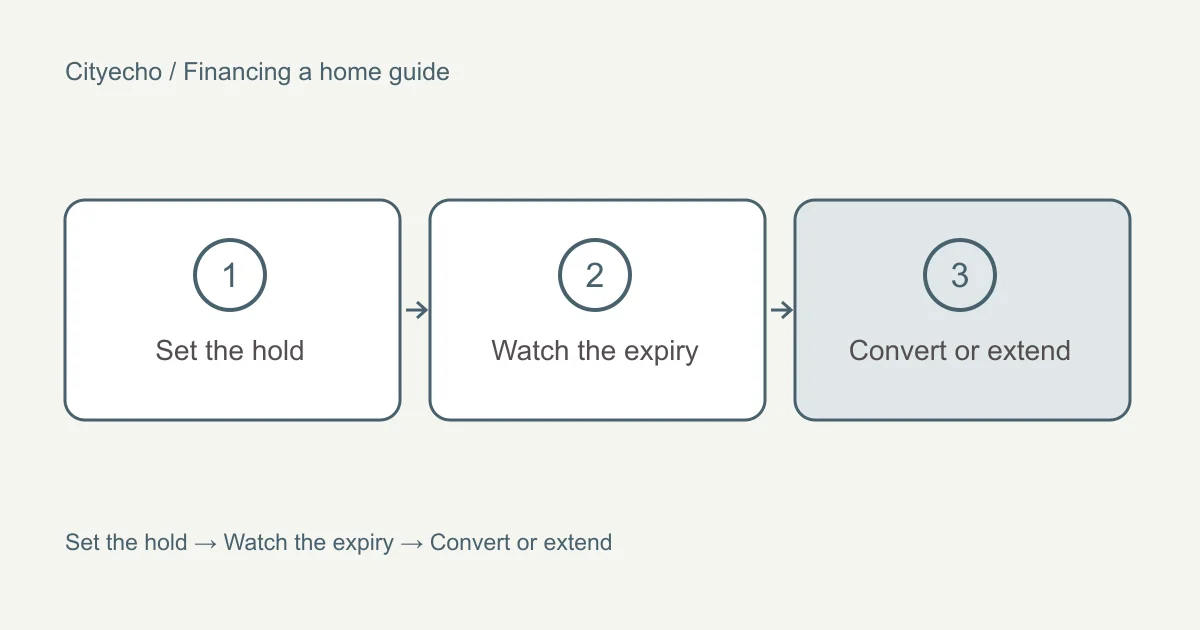
A rate hold is a lender's commitment to honour a quoted rate for a set period. For a buyer who has not yet found a house, a rate hold acts as insurance against rising rates during the search. For a buyer in the middle of a long closing, it protects the budget while the lawyer or notary prepares for completion day. This chapter covers the mechanics of the hold, the point of expiry, the conversion rules inside a term and the early-lock window at renewal. Each rule is sourced to the Financial Consumer Agency of Canada.
The financing hub pillar sets out the whole process. The application chapter covers the stage at which the rate hold is set. The after funding chapter covers the renewal letter that triggers the next hold decision.
How long a rate hold lasts
The Financial Consumer Agency of Canada's preapproval page, read on 5 October 2026, puts the typical rate hold at 60 to 130 days, depending on the lender. Some lenders quote 90 days as a default; others go to 120 or 130 days on request. A new build with a long closing date can carry a longer hold, often with a condition that the construction completes by a stated outside date.
The hold applies to a specific product: the term and amortization quoted at the hold date. Changing either on signing can change the rate. If you ask for a 25-year amortization at the hold and then switch to a 30-year amortization on signing, the lender may reprice the loan at the 30-year rate for the current market, which can be higher.
Keep the expiry date on your calendar next to the condition dates in your offer. A rate hold that expires between acceptance and completion can push the loan onto a different rate at the worst possible time.
What the hold does and does not do
A rate hold freezes the rate for the hold period on a quoted amount, assuming the file as quoted. It does not approve a specific house, and it does not fund a loan on its own. The Financial Consumer Agency of Canada's preapproval page states the process does not guarantee approval and a lender could refuse a mortgage even after a preapproval. The lender tests the specific property, usually through an appraisal and a review of the title, strata documents on a strata property, and the insurance on a fire-insured property.
A buyer should treat the preapproval and its rate hold as a working estimate. Shortlisting a house inside the hold's loan maximum keeps the budget disciplined. Shortlisting outside the maximum means a new application and a new hold at the current rate on acceptance.
Rate drops during a hold
The Financial Consumer Agency of Canada's preapproval page, read on 5 October 2026, suggests asking the lender whether you automatically receive the lowest rate if interest rates go down during the hold. Not every lender does this. Three common responses:
- Automatic repricing. The lender resets the hold at the lower rate without a request, within set rules.
- Request-based repricing. The lender lowers the rate once, on request, before signing the commitment letter.
- No repricing. The lender honours the original rate until expiry and leaves the borrower to shop a competing offer.
The lender's rule belongs in the comparison spreadsheet. The brokers and lenders chapter covers how to collect this answer from each lender in writing.
Converting a variable rate to a fixed rate
Most Canadian lenders allow a conversion from a variable rate to a fixed rate at any point during the term. The fixed rate is the lender's current rate for a term equal to or longer than the time left on the original term. The conversion is a one-way move: once converted to fixed, the mortgage stays fixed for the rest of the term, and converting back requires breaking the contract.
Three things to confirm with your lender before converting:
- The exact rate on offer, and the term available on it
- Whether the lender adjusts the regular payment or holds it steady on conversion
- Whether the prepayment privileges stay the same under the new product
Conversion does not usually trigger a prepayment penalty, because the loan is not being paid down or ended. The fixed rate at the moment of conversion is higher than the variable rate at that moment, so the monthly payment usually rises. Convert when payment certainty matters more than the current cost advantage.
Breaking a fixed-rate mortgage to switch to variable
Converting the other way, from fixed to variable, requires breaking the mortgage. The Financial Consumer Agency of Canada's prepayment penalties page, read on 5 October 2026, confirms the penalty is the greater of three months of interest on the balance or the interest rate differential, and the differential method typically applies when the contract is less than five years old. The agency's own example on a $200,000 balance with 36 months remaining shows a penalty of $12,000 under the differential method against $3,000 under the three-month method.
For a borrower with a short period left, the three-month method sometimes produces a penalty the lower variable rate can offset. For a borrower early in the term, the differential method rarely does. Ask the lender for a precise penalty quote in writing before deciding.
The early-lock window at renewal
The Financial Consumer Agency of Canada's renewing your mortgage page, read on 5 October 2026, states that federally regulated lenders must send the renewal statement at least 21 days before the term ends. Many lenders also open an early-lock window inside the final four or five months of the term. During the window, the borrower can lock a rate on the renewal before the current term actually expires.
An early-lock rate hold works like a preapproval rate hold: a commitment to honour the quoted rate if the borrower signs the renewal inside the window. For a borrower who expects rates to rise before renewal, the early lock is useful. For a borrower who expects rates to fall, the early lock may be at a higher rate than the one available on the day of renewal. Watch the market and the lender's rate sheet inside the window before signing.
Blended rates on a port or a top-up
A blended rate combines an existing rate with the current rate for an extended term or an additional advance, in a weighted average. A borrower porting a mortgage to a new home with a larger loan asks the lender to blend the existing rate on the existing balance with the current rate on the top-up, for a new combined contract. A borrower adding funds for a renovation does the same thing.
Each lender uses its own blending formula. Ask for the blended rate in writing before accepting the port or the top-up. A low blended rate can make the port better than breaking the contract and starting a new one, since blending avoids the prepayment penalty.
Common rate-hold outcomes
| Situation | Common outcome |
|---|---|
| Rate falls during hold | Lender's rule applies: auto, on request, or none |
| Rate rises during hold | Hold honoured, borrower funds at the lower held rate |
| Hold expires before closing | Lender extends at current market, or on quoted rate with a fee |
| File changes before funding | Lender reprices, may reduce approved amount |
| Property is non-conforming | Lender may decline the file after an appraisal |
| Variable rate rises during term | Payment increases on a variable payment product; balance drops slower on a fixed-payment variable |
When a presale closing collides with a rate hold
A presale contract with a long completion date is the file most exposed to rate-hold expiry. The buyer signs the sale contract today and closes in one or two years when the building is finished. A standard preapproval rate hold runs 60 to 130 days, which is a small fraction of the time to closing. Lenders handle this with specialised presale programmes that offer longer initial holds, usually 12 to 24 months, with a condition that the construction completes by a stated outside date.
The presale rate hold is not a free option. The borrower is tested at the hold date and tested again before funding, with current income, debts and credit. A borrower whose circumstances change between the hold and completion can find the file reduced or declined, even inside the hold. For a presale assignment, the rate hold is on the original contract and does not transfer to the assignee without a fresh application.
Discuss presale financing with a broker experienced in the lender programmes. Our journal article on the mortgage stress test covers the qualification rule the lender applies at both dates.
Use this hub with your lender or broker. The choosing a mortgage chapter covers the product choice behind the rate. The after funding chapter covers life inside the term and the next decision at renewal.