

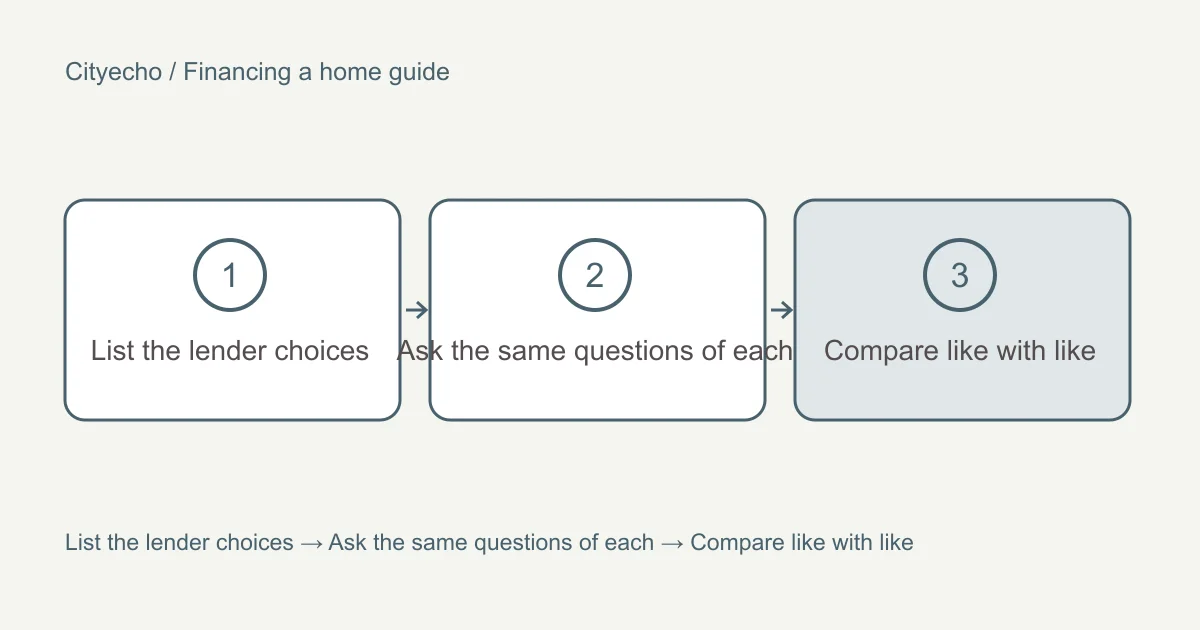
Shopping a mortgage involves two separate decisions: who arranges the loan and who funds it. In Canada most residential buyers reach a lender through a bank branch, a credit union branch, a mortgage broker, or a direct lender's online channel. Each path has duties, costs and a service model the buyer should understand before signing. This chapter walks through each one with the Financial Consumer Agency of Canada's and BC Financial Services Authority's rules attached.
The financing hub pillar sets out the full process. The product choices chapter covers what the lender is actually offering you. The application chapter covers the documents that follow a signed agreement.
Banks, credit unions, monolines and brokers
A chartered bank funds the loan from its own balance sheet and sells its own products through branches and brokers. A credit union is a member-owned provincial institution and funds loans the same way, with its own products. A monoline lender funds mortgages only, usually without branches, and reaches borrowers through brokers. A mortgage broker does not fund the loan: the broker shops your file to several lenders and arranges the loan with whichever lender approves the file on the best terms.
Each has a different regulator and a different cost base. The Office of the Superintendent of Financial Institutions' qualifying rate page, read on 5 October 2026, sets the stress test rule for federally regulated lenders at the greater of contract rate plus 2% or 5.25% on uninsured mortgages. Credit unions are provincially regulated and set their own stress test on uninsured loans. On insured loans, CMHC applies the same rule across all lenders.
How a broker is paid in British Columbia
In most prime residential files the lender pays the broker a finder's fee on funding. The borrower pays nothing extra for the broker's work. The fee is set as a share of the loan amount and depends on the lender's compensation table and the term the borrower chooses. The lender's cost is already priced into the product, which is why a broker's rate is often at or near the lender's best rate for a given term.
For non-prime files the picture is different. BC Financial Services Authority's conduct rules require a broker to disclose compensation and any conflict of interest in writing before arranging a loan. For a private lender, a credit-rebuild file, or an unusual property, the borrower may pay a direct fee to the broker, to the lender, or to both. Read the broker's agreement and the lender's commitment letter line by line before you sign.
The broker's licence number and the licensing register are published on BC Financial Services Authority's own site. Ask for both before signing an agreement. For comparison with the agency rules that cover a real estate professional, see BCFSA's agency guidelines, read on 5 October 2026.
Service model and specialisation
A bank branch gives you a known office and a known contact. For a prime file with a straightforward income and down payment, a branch representative can take the file end to end. The branch's product set is one lender's set, so the comparison stops there. For a borrower whose profile fits that lender's criteria, the branch is often the simplest path.
A broker usually works by phone, email and secure document portal. A broker who has worked on self-employed income, foreign income, newcomer files, inherited properties, co-ownership structures or multi-unit mortgages brings experience the branch may lack. The trade-off is that the broker's service model does not include a local branch for routine banking.
The questions that make an offer comparable
An offer with the lowest rate on a term is not the cheapest offer in every case. Prepayment privileges, portability, the renewal process and the type of charge the lender registers all move the lifetime cost. Ask every lender or broker the same list of questions in writing:
- Contract rate and term length
- Amortization available on this file
- Fixed, variable or hybrid, and the lender's variable-rate adjustment mechanism
- Open or closed, and the breakage penalty method on this product
- Prepayment privileges: lump sum percentage, payment increase, timing
- Portability window and top-up handling
- Charge type: standard or collateral
- Fees on breakage, discharge and switching at renewal
- Any cash-back offer and its clawback terms
Record each answer in the same spreadsheet. The application chapter and the rate hold chapter cover the application and lock-in stages that follow.
Read the commitment letter before you sign
A lender's commitment letter is the written offer that follows an approval. It names the rate, the term, the amortization, the conditions the borrower must still meet, the fees payable at funding and the date the commitment expires. The Financial Consumer Agency of Canada's choose a mortgage page, read on 5 October 2026, notes that lenders must disclose the full cost of borrowing on a mortgage, including fees that reduce the amount advanced to you.
Read every line of the commitment. A rate quoted on a phone call carries no legal weight: the commitment is the contract. Compare the commitment against the terms the broker or branch quoted during the application. Common differences include a higher rate after a credit score change, a shorter amortization than quoted, a different prepayment privilege, a cash-back product with a clawback period, or a condition that requires title insurance in place by funding.
If the commitment names a condition you cannot meet, go back to the lender or broker before accepting. A missed condition sometimes forces a last-minute switch of lender, which can trigger a new rate hold at a different rate. On a tight condition period inside a subject-to-financing offer, that switch can threaten the deal.
Keep your file current while you shop
A rate hold on a mortgage is a snapshot of your credit, income and debts at the day of the hold. Any change the lender notices before funding can affect the approval. The Financial Consumer Agency of Canada's preapproval page, read on 5 October 2026, lists a poor credit history as one reason a lender could refuse a mortgage even after a preapproval.
The common changes that affect a file are a new credit card or line of credit, a new car loan, a change of job, a drop in savings below the quoted down payment, or a late payment on an existing debt. For a self-employed borrower, a change of business structure or a late tax filing counts too. Keep your file steady between the preapproval and funding, and avoid taking on new debt even if a car dealership or furniture retailer offers interest-free terms before completion day.
Tell your lender or broker about any planned change in writing before it happens, so the file can be re-reviewed early. A proactive update is handled inside the office. A surprise discovered in the week before funding usually becomes a last-minute problem.
Documents to prepare before the first call
The Financial Consumer Agency of Canada's preapproval page, read on 5 October 2026, lists identification, proof of employment such as pay stubs or Canada Revenue Agency notices of assessment for the self-employed, proof you can pay the down payment and closing costs, and information about assets and debts. CMHC's general requirements page, read on 5 October 2026, confirms the same categories for insured files.
Prepare each document before the first conversation. A broker or branch who sees the full file at once can match it to the right lender faster. A broker who receives documents piecemeal often loses the first rate hold to a competing file. Our preapproval article in the journal describes what a lender typically asks for and why.
Match the professional to the file
| File type | Who usually fits |
|---|---|
| Salaried T4 income, standard property | Any bank, credit union or broker |
| Self-employed, two years of filed taxes | Broker experienced with alt-A lenders |
| Recent arrival in Canada, limited credit | Lender with a newcomer programme, usually a bank |
| Rental property or multi-unit | Broker with monoline access, or specialised lender |
| Credit rebuild | Broker working with B-lenders and private channels |
| Buying with family or an inheritance | Broker familiar with co-ownership structures, or a lawyer-informed branch |
For your own file, speak to a licensed mortgage professional. BC Financial Services Authority publishes the licensing register, and your lawyer or notary registers the loan on title once it is approved. The choosing a mortgage chapter and the application chapter carry the questions you take into that conversation.
A buyer who approaches more than one source rarely regrets the time. Treat the first offer as a starting point, write down the terms, and ask another lender or broker to beat it on the same term and amortization. The written comparison is the record that justifies the choice to future-you at renewal.