

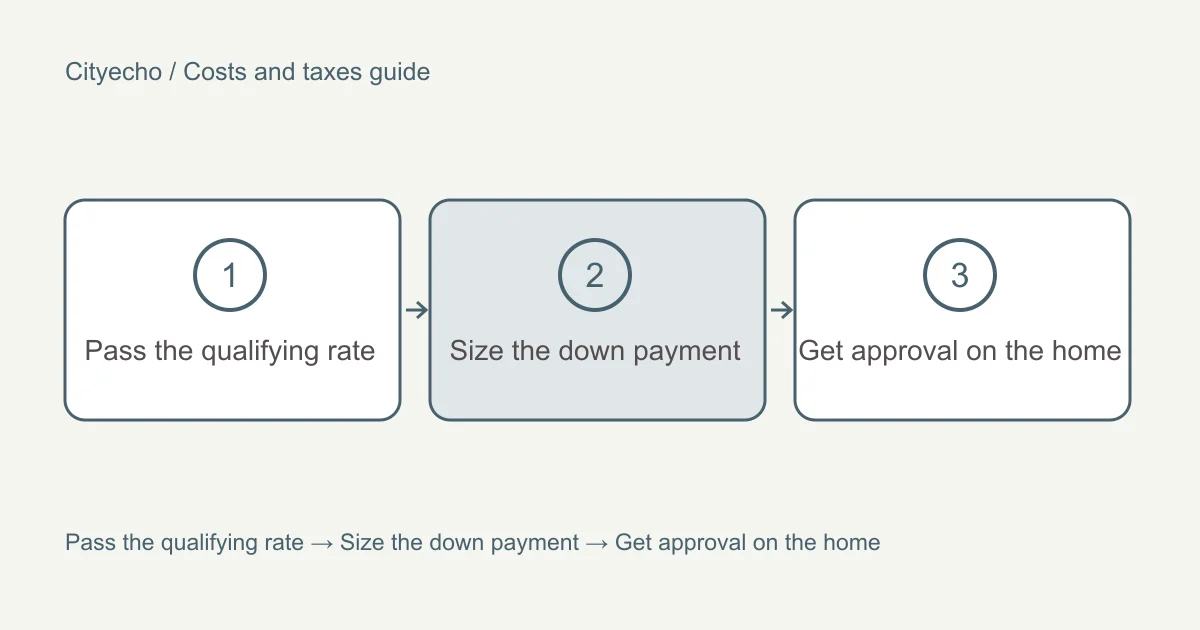
A mortgage decides how much you can offer and how much cash you need on completion day. Federal rules set the minimum down payment, the interest rate you must qualify at, and the price and amortization limits for insured loans. Lenders then apply their own policies on top. This chapter explains the federal pieces and the costs they create, so that you can ask a lender focused questions.
It is part of the costs and taxes guide. The figures come from the Office of the Superintendent of Financial Institutions (OSFI), the Financial Consumer Agency of Canada and Canada Mortgage and Housing Corporation (CMHC), as their pages read on 30 September 2026. A lender or mortgage broker decides whether you qualify. Nothing here is an approval or a promise of one.
The qualifying rate, or stress test
A lender must check that you could still make your payments if interest rates were higher than the rate you are offered. For uninsured mortgages, OSFI's minimum qualifying rate page sets that test as the greater of the contract rate plus 2%, or 5.25%. OSFI calls the 2% the buffer and the 5.25% the floor, and it reviews both at least once a year.
For insured mortgages, CMHC's purchase product page applies the same numbers. It says the debt ratios must be calculated at the greater of the contract rate plus 2% or 5.25%.
Two examples show how this works. If a lender offers you 4.49%, you must qualify at 6.49%. If it offers you 3.00%, the contract rate plus 2% is 5.00%, which is below the floor, so you must qualify at 5.25%. The test uses a higher payment than the one you will actually make, so the loan you qualify for is smaller than the payment alone suggests. Our journal article on the mortgage stress test walks through more examples.
OSFI's page adds one exception. It does not expect lenders to apply the test to an uninsured straight switch at renewal, where the borrower moves to another federally regulated lender without increasing the amount or the amortization.
Debt ratios
The qualifying rate feeds into two ratios. CMHC's purchase product sets a maximum gross debt service ratio of 39% and a total debt service ratio of 44%. The first ratio measures housing costs against gross household income. CMHC's consumer page on qualifying for mortgage loan insurance says housing costs include principal, interest, property taxes and heating, plus half of any condominium fees. The second ratio adds all your other debt payments, such as car loans and credit cards.
Annual property tax is part of the first ratio. That is one reason the annual property tax chapter matters before you buy. A home with a higher tax bill needs more income to qualify at the same price.
CMHC also lists a minimum credit score of 600 for at least one borrower on an insured loan. Lenders may set higher standards for their own products.
Minimum down payment
The Financial Consumer Agency of Canada's down payment page sets out the minimum down payment by price. The table uses the figures on that page as it read on 30 September 2026.
| Purchase price | Minimum down payment |
|---|---|
| $500,000 or less | 5% of the price |
| Above $500,000 and below $1,500,000 | 5% of the first $500,000, plus 10% of the part above $500,000 |
| $1,500,000 or more | 20% of the price |
On a hypothetical $1,200,000 home, the minimum is $25,000 on the first $500,000 plus $70,000 on the remaining $700,000, for a total of $95,000. The mortgage would then be $1,105,000 before any insurance premium. The agency notes that a lender may require a larger down payment from a self-employed borrower or a borrower with a poor credit history.
Mortgage default insurance and its premium
The agency says that with less than 20% down you will typically need mortgage loan insurance. This insurance protects the lender if the loan is not repaid. It gives the borrower no protection of their own. The agency names three insurers: CMHC, Sagen and Canada Guaranty. Your lender arranges it.
CMHC's premium schedule sets the premium as a percentage of the loan. It depends on the loan-to-value ratio, which is the loan divided by the value of the home.
| Loan as a share of value | Standard premium | Home Start premium |
|---|---|---|
| Above 80% up to 85% | 2.80% | 3.00% |
| Above 85% up to 90% | 3.10% | 3.30% |
| Above 90% up to 95% | 4.00% | 4.20% |
| Above 90% up to 95%, borrowed down payment | 4.50% | 4.70% |
On the $1,200,000 example, a $1,105,000 loan is 92.08% of the value. At CMHC's standard premium of 4.00%, the premium is $44,200. CMHC says the premium is a one-time charge that may be added to the loan. The agency notes that if you add it, you pay interest on it at your mortgage rate.
CMHC's page names Ontario, Quebec and Saskatchewan as the provinces that charge sales tax on the premium. British Columbia is not on that list.
Price and amortization limits
CMHC's purchase product requires the price, or the lending value, to be below $1,500,000 for a homeowner loan. At $1,500,000 or more, insured financing for the purchase is not available and the minimum down payment becomes 20%.
The standard maximum amortization for an insured purchase is 25 years. CMHC's Home Start product allows 30 years where the loan is above 80% of the value and either at least one borrower is a first-time buyer or the home is newly built and has not been lived in. CMHC defines a first-time buyer for this product as someone who has never bought a home in Canada, or who has not lived in a home they or their current partner owned in the current year or the four years before.
A longer amortization lowers each payment and raises the total interest over the life of the loan. The Home Start premium is also higher, as the table shows. For an uninsured mortgage, ask each lender what maximum amortization it offers.
A rate hold and an approval on the property
The agency's preapproval page explains what a preapproval is. A lender reviews your income, assets and debts, runs a credit check, and tells you the maximum it might lend. It may hold an interest rate for 60 to 130 days, depending on the lender. The agency states that this process does not guarantee approval. Our journal article on what lenders check at preapproval lists the documents to gather.
Approval on a specific home comes later, after you have an accepted offer. The lender now reviews the property as well as you. CMHC's cost worksheet lists an appraisal fee, where applicable, and a survey or certificate of location among the up-front costs of buying. Ask your lender whether it needs either one for this home, and who pays. The same worksheet lists property insurance, and the home insurance chapter explains why lenders look for it.
If the appraisal comes in below your price, ask the lender how it will size the loan. A smaller loan means more cash from you to complete. CMHC's insured product also requires a home that is suitable for full-time, year-round occupancy, so a home that fails that test cannot carry CMHC insurance. Keep your financing condition in the contract until the lender has confirmed approval on this home in writing, and ask your lawyer how the deadline works.
How the down payment changes the cost
The size of the down payment changes more than the loan. With the minimum $95,000 down on the $1,200,000 example, the loan is above 90% of the value and carries the highest standard premium, $44,200. With $240,000 down, which is 20%, the loan is $960,000. The agency says insurance is then typically not required, so there is no premium to add, unless the lender asks for insurance for another reason.
Between those two points, each premium band has its own rate. A buyer with 12% down on the same home would borrow $1,056,000, which is 88% of the value, and CMHC's standard premium for that band is 3.10%, or $32,736. Ask your lender to show the premium at two or three down payment levels before you decide how much cash to keep in reserve for closing costs and moving.
Costs to plan for from the mortgage
Bring these amounts into your budget next to the down payment. The insurance premium, if one applies, is usually added to the loan. An appraisal fee may be payable. Your lawyer or notary will charge for registering the mortgage, and the Land Title and Survey Authority charges a fee to register it, as the legal and registration costs chapter explains.
Ask each lender for its terms in writing, including the rate, the hold period, the prepayment rules and any fees. Compare those terms on the same loan amount and amortization. Your lender or mortgage broker is the person who decides whether you qualify; this chapter only helps you ask the right questions.