

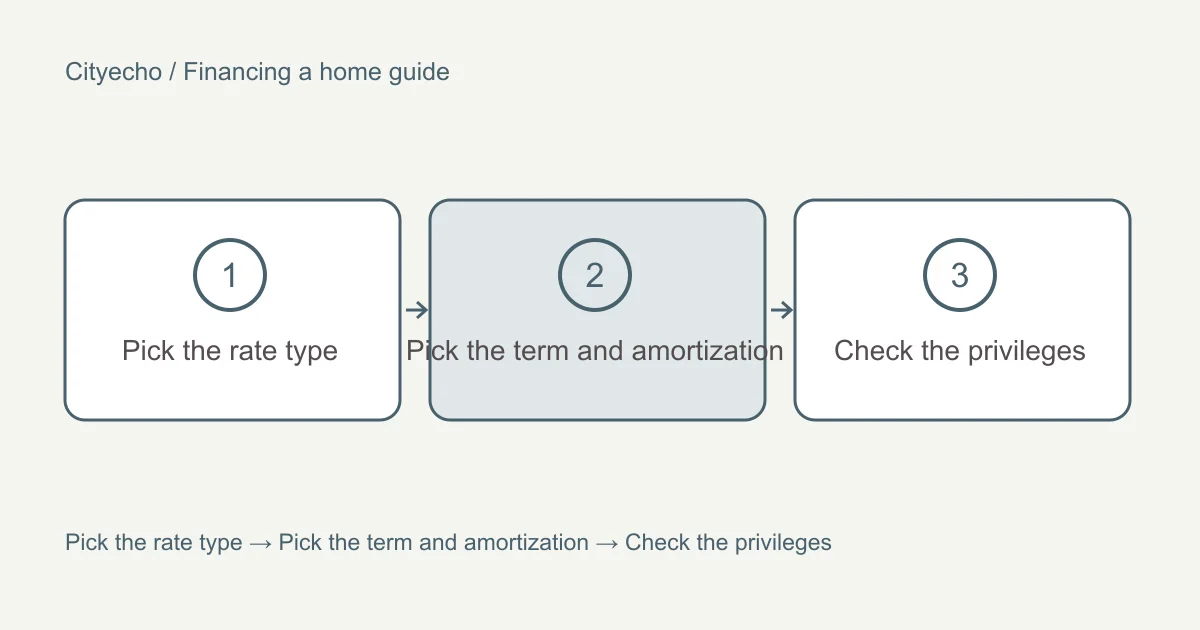
A Canadian mortgage is a set of choices made at once. The product you sign names a rate type, a term length, an amortization length, an open or closed condition, a schedule of prepayment privileges, a portability rule and the type of charge the lender registers on title. Each choice has a cost somewhere, either in the rate you pay today or in the flexibility you keep for later. This chapter runs through each one with the Financial Consumer Agency of Canada's definitions and sources attached.
The financing hub pillar sets out the whole process and names the sources. This chapter is the product layer. The application chapter covers what the lender then does with your file. The costs and taxes guide covers the mortgage default insurance premiums and other one-time costs on completion day.
Fixed or variable rate
The Financial Consumer Agency of Canada's choose a mortgage page, read on 5 October 2026, defines a fixed interest rate as a rate that stays the same for the entire term. It is usually higher than a variable rate for a similar term. A variable interest rate may increase or decrease during the term, and is typically lower than the fixed rate at the start.
A variable mortgage with fixed payments carries a quieter risk. The agency notes that when interest rates rise, more of each payment automatically goes toward interest costs. The payment does not change, but less of it reduces the balance. If rates rise far enough, the lender may increase the payment to keep the amortization on track. A variable mortgage with payments that move with the rate removes this hidden effect, because the payment itself reflects the current rate.
The right choice depends on how much payment movement your budget absorbs and how long you plan to hold the mortgage. A buyer close to the limit of what they can afford has less room for a payment increase. A buyer with a short holding period has less exposure to rate movement overall.
Open or closed
A closed mortgage has a lower rate than an open mortgage of the same term, because the lender knows the balance will remain outstanding except for the prepayment privileges in the contract. Paying the loan down past those privileges, or breaking the mortgage before the term ends, triggers a prepayment penalty.
An open mortgage charges a higher rate and lets you pay any amount at any time without a penalty. It suits a borrower whose plans may change inside the term, for example a buyer waiting for the sale of another property, a short-term bridge to a longer-term plan, or a buyer with a known inheritance or settlement about to arrive. The higher rate pays for the right to leave the loan at any time.
Most Canadian borrowers hold a closed mortgage. The lower rate accumulates to a larger saving than the fee for a planned prepayment during the term, in most cases. The right question is whether your plans fit the closed terms. If they do not, the open product may cost less overall than paying a penalty later.
Term length
The Financial Consumer Agency of Canada's terms and amortization page, read on 5 October 2026, describes the term as the length of time the mortgage contract is in effect, typically a few months to five years or longer. At the end of each term, you renew with the current lender or move the loan to another lender.
A short term, usually one to three years, lets you renew into a better rate sooner if rates fall. It also forces you to renew sooner if rates rise. A five-year term is the common Canadian choice: enough stability to plan a budget, enough flexibility to react to a changed life, and the longest term that typically avoids a longer-term interest penalty on breakage. Terms past five years exist and carry their own prepayment rules that the lender names in the contract.
Term length also changes the prepayment penalty on breakage. The Financial Consumer Agency of Canada notes the interest rate differential method typically applies when the contract is less than five years old. A seven-year term broken in year three is still inside the differential window, which can produce the larger penalty under the agency's two-method rule.
Amortization length
Amortization is the full time to pay the loan off at the current rate and payment. The Financial Consumer Agency of Canada's terms and amortization page, read on 5 October 2026, sets the maximum amortization at 30 years for first-time buyers or newly built homes with a down payment below 20%, and 25 years otherwise.
A longer amortization lowers each payment and raises the total interest paid over the life of the loan. The agency's own example on a $300,000 mortgage at 4% shows $63,919 in interest at a 10-year amortization and $173,418 in interest at a 25-year amortization. The agency warns that the extra interest on a longer amortization can add up to thousands or tens of thousands of dollars.
A borrower whose budget is comfortable at the shorter payment usually pays less total interest at a shorter amortization. A borrower who stretches to reach the house may pick a longer amortization and plan to use prepayment privileges each year as the budget allows.
Prepayment privileges and portability
Prepayment privileges are the extra you may put toward the loan each year without a penalty. Each lender names its own numbers. Common privileges are a 10% or 20% lump sum of the original balance each anniversary year, and the right to increase the regular payment by the same percentage. Some lenders allow the lump sum on any payment date, some only on the anniversary. Ask the lender for its exact rule in writing before signing.
Portability is the right to move the loan with its rate and terms to a new home within a time window the lender sets. For a buyer who may move inside the term, a portable mortgage removes the prepayment penalty if the port rules are met. Lenders differ on how long they allow between the sale and the new purchase, how they handle a larger loan, and whether they blend the old rate with a new rate for the top-up amount.
Insured, insurable and conventional
A mortgage above 80% of the price is insured, meaning the lender's loan is covered by default insurance paid by the borrower. CMHC's premium information page, read on 5 October 2026, sets the standard premium at 2.80% of the loan from 80% to 85% of value, 3.10% from 85% to 90% and 4.00% from 90% to 95%. The premium is a one-time charge that may be added to the loan.
A conventional mortgage has 20% or more down and does not carry default insurance. An insurable mortgage has 20% or more down but meets insurable criteria that let the lender buy portfolio insurance in the background. Insurable loans sometimes carry a lower rate than fully conventional loans, because the lender's cost of funds is lower. The borrower pays no insurance premium either way.
Charge type: standard or collateral
A standard charge registers the mortgage for the amount of the loan. A collateral charge registers the mortgage for an amount higher than the loan, so the lender can advance more credit later without a new registration. The Financial Consumer Agency of Canada notes collateral charges can secure multiple loans against the property.
At renewal, moving a loan held under a collateral charge to a new lender requires the collateral charge to be removed and a new charge registered, which is more work than switching a standard charge. Ask the lender which charge type it uses, which fees apply if you move the loan at renewal, and whether you can register the collateral charge for only the loan amount rather than a larger amount.
Decide the whole package together
| Choice | Trade-off |
|---|---|
| Fixed rate | Payment certainty, higher starting rate |
| Variable rate | Lower starting rate, payment exposure to changes |
| Closed term | Lower rate, capped prepayments, penalty on breakage |
| Open term | Higher rate, any-time repayment allowed |
| Short term | Flexibility, more frequent renewals |
| Longer term | Rate certainty for longer, bigger penalty on breakage |
| Short amortization | Less total interest, higher payment |
| Long amortization | Lower payment, more total interest |
| Portable | Avoid penalty on move, rules on top-up and timing |
| Collateral charge | Future advances without new registration, harder switch |
Walk each row with your lender or broker and the rule as it applies to your file. The brokers and lenders chapter covers how to compare offers from more than one source. The application chapter covers what the lender then does with the file.