

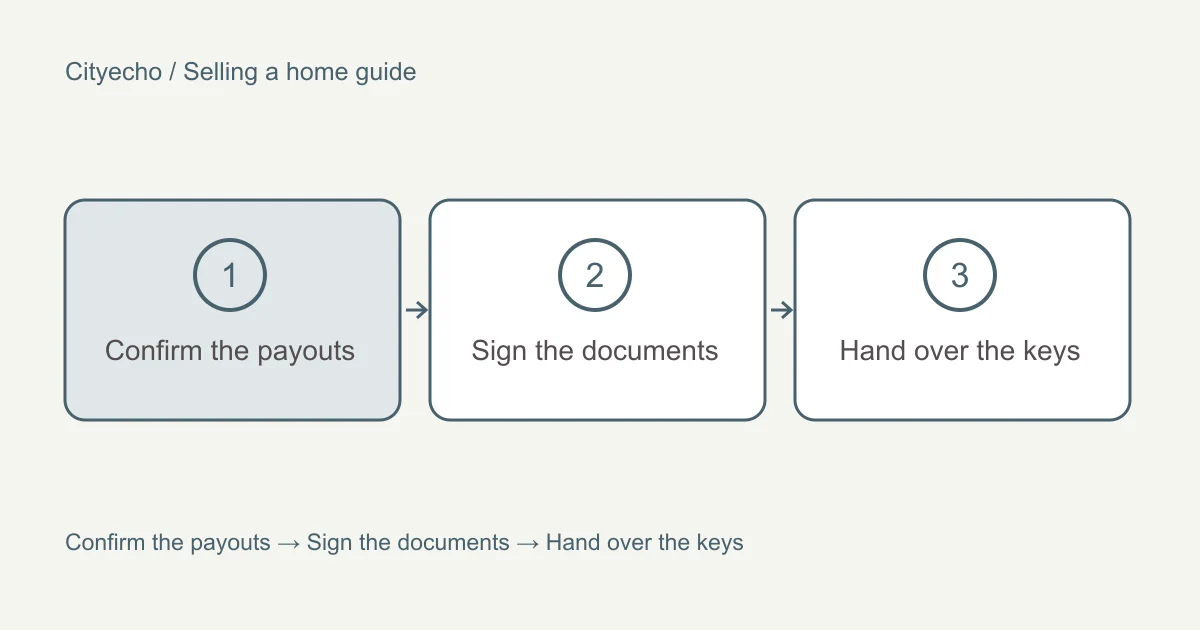
Completion is the day legal ownership of your home passes to the buyer in exchange for the purchase price. For a seller, it is also the day the money moves: the buyer's funds come in, your mortgage and costs are paid out, and the balance is paid to you. This chapter explains the money side of that day, the documents that record it, and the handover of the keys.
The chapter is part of the selling a home guide. It follows the chapter on the time after an offer is accepted, because completion can only happen once the sale is firm. For tax on the sale itself, read the tax when you sell chapter in the costs and taxes guide. For how the buyer's deposit is held and applied, read the deposits and adjustments chapter.
Completion and possession
BCFSA's page on completing your sale explains that the contract of purchase and sale states the completion day. On that day, legal ownership transfers from you to the buyer in exchange for the price. The possession date is the day the buyer can move in or take control of the home. BCFSA notes that completion and possession are not always on the same day.
Check both dates in your contract. Plan your move around the possession date. If you are also buying a home, line up the two sets of dates with your lawyer or notary and your lender, and ask what happens if one side is delayed. The journal article on bridge financing explains one way sellers cover a gap between buying and selling.
What your lawyer or notary does
Both you and the buyer usually hire a lawyer or notary. BCFSA lists the work your lawyer or notary does for you:
- Search the title at the Land Title and Survey Authority to find anyone else with legal rights to the home, and any registered easements or restrictive covenants.
- Prepare the documents that transfer ownership, including the Property Transfer Tax return.
- Make sure your old mortgage is properly discharged, if required.
- Confirm that all payments you are responsible for have been made.
- Prepare a statement of adjustments.
- Deliver the final amount due to you, and make sure the buyer is registered as the owner.
Contact your lawyer or notary as soon as the sale is firm. They will tell you what they need from you, such as identification, your mortgage details and any documents about the home. Book your signing appointment early, and confirm with them the date and what to bring.
The costs a seller pays
BCFSA's page on the costs that come with selling lists the fees and charges a seller should expect. The table sets them out with the source of each amount.
| Cost | Where the amount comes from |
|---|---|
| Commission to your brokerage | Your listing agreement |
| GST on the commission | Charged on the commission amount |
| Legal fees to discharge the mortgage | Your lawyer or notary's quote |
| Legal or notary fees for the title transfer | Your lawyer or notary's quote |
| GST on your legal fees | Charged on those fees |
| Mortgage prepayment penalty, if any | Your lender's payout statement |
| Your share of unpaid property taxes, plus any late penalty | The statement of adjustments |
The commission is shown in dollars on the disclosure of expected remuneration you received with the accepted offer. BCFSA's consumer guide to disclosures points out that this form covers commissions only. Other costs, such as lender penalties and legal fees, are not on it. BCFSA's page on listing your home suggests asking your licensee for an estimate of your net cash proceeds. Update that estimate once the sale is firm and the payout figures are known.
Paying out the mortgage
If you have a mortgage, it is paid from the sale proceeds. Your lawyer or notary asks your lender for a payout statement, pays the lender on completion, and deals with the discharge from title. BCFSA lists the legal fees for the discharge as a seller's cost.
The payout statement may include a prepayment penalty. The Financial Consumer Agency of Canada explains that a prepayment penalty is a fee a lender may charge when you pay back your whole mortgage before the end of its term, including when you sell your home. Lenders may also call it a prepayment charge or a breakage cost.
The Agency says the penalty is usually the higher of two amounts: three months' interest on what you still owe, or the interest rate differential. The lender usually uses the differential when your mortgage rate is higher than the current rate and you signed your contract less than five years ago. The Agency's own example uses a balance of $200,000 at 6%, with 36 months left and a current posted rate of 4%. Three months' interest is $3,000, the differential is $12,000, and the penalty is the higher amount, $12,000. An administration fee may be added.
Methods vary between lenders, so ask your lender for the actual amount. The Agency notes three ways to reduce or avoid a penalty. An open mortgage can be paid off without one. You may be able to port the mortgage to a new home. And using your yearly prepayment privileges before you sell lowers the balance the penalty is based on. Ask your lender about each one before you set the completion date.
Property taxes and the statement of adjustments
Property taxes are charged for the whole year, and the sale happens partway through it. The statement of adjustments shares the year's taxes between you and the buyer as of the adjustment date in the contract. BCFSA lists your share of the property taxes for the year, if they have not yet been paid, as a seller's cost, together with any penalty for late payment. If you have already paid the year's taxes, ask your lawyer or notary how the statement treats the part of the year after the adjustment date.
The statement of adjustments is the written account of the money in the sale. It starts with the purchase price and shows each credit and each deduction. Read it before you sign. Check the price, the deposit, the tax adjustment, the mortgage payout and each cost. Ask your lawyer or notary about any line you do not understand.
If the home is rented, the adjustments may also deal with the tenant. The province's page on selling a rental property explains that the owner at the time the tenant moves out is responsible for returning the security or pet damage deposit, which can make the buyer responsible for a deposit you hold. It suggests the buyer and seller deal with the transfer of these deposits in their contract or at closing.
If something is late on the day
Completion depends on several people acting on the same day: the buyer's lender, the buyer's lawyer or notary, your lawyer or notary, and your lender. If one of them is late, the money may arrive later than planned. Stay reachable by phone on completion day, and keep your lawyer or notary's contact details at hand.
Wait for your lawyer or notary to confirm that the sale has completed before you hand over the keys. Ask your licensee to coordinate the handover with the buyer's side once completion is confirmed. If the buyer asks for early access before completion, for example to measure rooms or move boxes, speak to your lawyer or notary first. Any access before possession is a change from the contract and should be agreed in writing.
If either side cannot complete on the agreed date, the contract and the law decide what follows. Get legal advice at once. Do not agree to a new date, or sign anything that changes the dates, until your lawyer or notary has explained what it means for you.
Keys and the handover
BCFSA's page ends with the simple picture of completion: you sign the documents, receive your money and hand over the keys. The keys go to the buyer for possession, on the possession date. Ask your licensee how keys will be passed to the buyer's side and at what time.
Gather everything the buyer will need. That list includes house keys, garage and gate openers, mailbox keys, and codes for alarms or smart locks. Leave manuals and warranties for appliances and systems that stay with the home. Leave the home in the condition the contract requires, with the included items in place and the excluded items removed.
Before you hand over the keys, cancel or transfer your utilities, internet and home insurance for the right date, and arrange mail forwarding. Keep a copy of the statement of adjustments, the transfer documents and your final payout records. Your accountant may need them when you file your tax return for the year of the sale.