

The list price is the number that starts the conversation with buyers. The final price is the one you and a buyer agree in a signed contract, and it may be higher or lower. This chapter explains how a list price is built from completed sales, what a market evaluation is, how it differs from an appraisal, why your assessed value is a separate number, and how a price reduction works.
The chapter is part of the selling a home guide. Pricing usually happens after the listing agreement is discussed and while the home is being prepared, because repairs and presentation can change which sales are fair comparisons. The journal article on pricing a home in a balanced market looks at one set of market conditions in more detail.
What buyers compare your home with
BCFSA's page on the costs that come with selling also gives pricing advice. It says buyers will base their offer price primarily on what similar properties in the area have sold for. It asks sellers to be realistic and to keep emotional attachment out of their pricing strategy. It notes that most sellers like their own design choices and may believe their home looks better than similar homes, and it warns against letting that opinion push the price up.
The same page asks sellers to think about the neighbourhood. Some buyers will pay more to be close to schools, shops and restaurants. Others prefer a quieter setting. Your home's location affects which buyers are interested and what they compare it with.
Building the price from completed sales
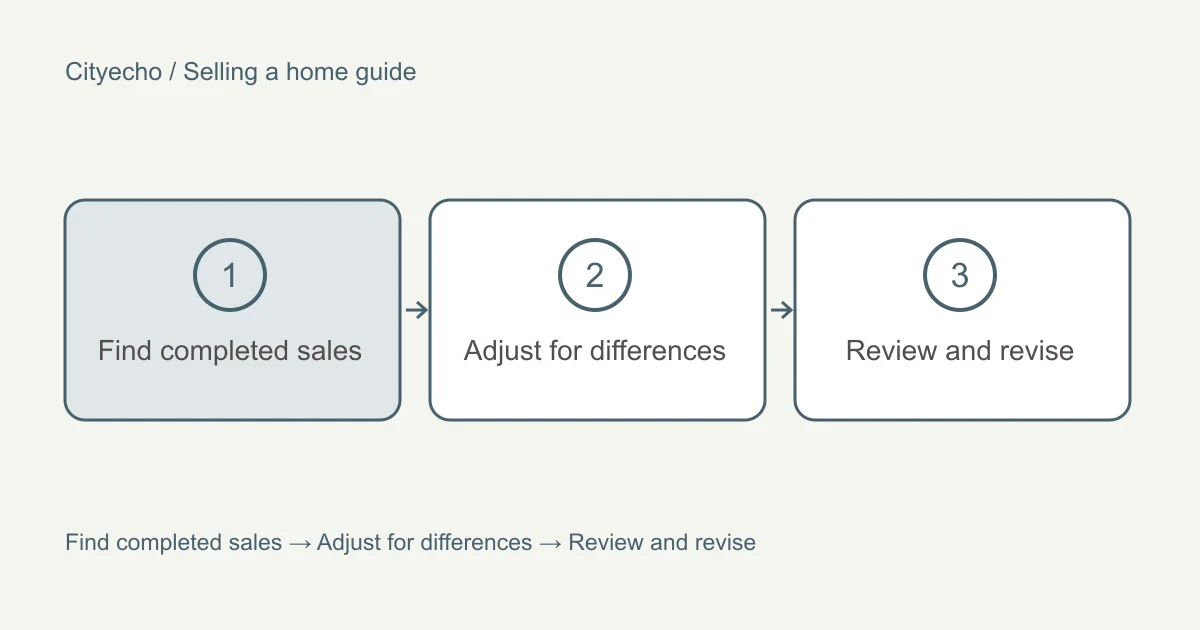
A completed sale shows the price a buyer actually paid. BCFSA explains that a licensee can use statistical data to show you what similar properties have recently sold for in your neighbourhood, and then adjust that value for your home's closeness to amenities and for upgrades the comparable homes lack. This method is the core of a list price.
Choose comparables that match your home as closely as you can. Look at location, lot size and shape, floor area, age, condition, the number of bedrooms and bathrooms, and features such as a suite or a garage. For each sale, note the date it completed. The market can move between that date and the day you list.
Then look at the differences. A comparable with a newer kitchen, a larger lot or a better street position will need an adjustment. Ask your licensee to explain each adjustment in writing. The result is a price range, and you choose where in the range to list.
Active listings and expired listings help as background. An active listing shows what a competing seller is asking. An expired listing shows a price that did not attract a buyer during that listing. Neither shows a price a buyer agreed to pay, so keep them separate from completed sales.
What a market evaluation is
A market evaluation is the written version of this work. Your licensee gathers recent sales, current listings and the relevant facts about your home, and suggests a price range. BCFSA's page on listing your home describes the licensee using market research, knowledge and expertise to help you set the list price.
Read the evaluation as evidence, and ask questions about it. Which sales were included, and which were left out? How old is each sale? How was the floor area of each home measured? Where did the adjustment figures come from? A clear evaluation shows its working, so you can follow the steps from the sales to the suggested range.
The same BCFSA page suggests asking for an estimate of your net cash proceeds before you settle on a price. That estimate starts from the suggested price and your current financing, and takes away the costs of selling. The completion day chapter explains each of those costs.
How an appraisal differs
An appraisal is a formal opinion of value prepared by an appraiser. BC Assessment's page refers to bank mortgage appraisals, which is one common use. A market evaluation and an appraisal can use similar evidence, but they have different purposes and are prepared by different people. The table shows the three numbers a seller is most likely to see.
| Number | Who prepares it | Date it reflects | What it is used for |
|---|---|---|---|
| Market evaluation | Your licensee | The date it is prepared | Choosing a list price |
| Appraisal | An appraiser, often hired for a lender | The date it is prepared | Lending and other formal decisions |
| Assessed value | BC Assessment | July 1 of the year before the notice | Sharing out property taxes |
The buyer's lender matters here. The Financial Consumer Agency of Canada explains that the approved mortgage amount depends on the value of the property and the buyer's down payment, and that the lender will check that the property meets its standards. If the lender's view of value is lower than the agreed price, the buyer may need more cash or may be unable to remove a financing condition. The chapter on the time after an offer is accepted covers that period.
Why your assessed value is a different number
BC Assessment explains that its value reflects the market value as of July 1 of the previous year. It says the number on an assessment notice may differ from a bank mortgage appraisal or a real estate appraisal for that reason, because a private appraisal can be done at any time. BC Assessment explains that market value assessment is used to share out the property tax burden between owners.
BC Assessment does look at many of the same facts a buyer would. It considers size, layout, age, finish, quality and condition, as well as location, views, neighbourhood and recent sales of similar properties. Even so, the date is fixed, and the market can change between that July 1 and the day you list. Work you did after the assessment may also be missing from it. The journal article on BC Assessment and market value goes through the difference in more detail.
Features that are hard to compare
Some features need extra care when you compare sales. A secondary suite is one example. Coquitlam's building permit questions list a permit as required to build a new secondary suite or to legalize an existing one, so a suite with a permit and a suite without one are different facts for a buyer. Ask your licensee to check whether each comparable suite had a permit, and see the preparing the home chapter for how to check your own.
Floor area is another. Two listings can report floor area measured in different ways, which makes a price per square foot unreliable unless the method is the same. The listing media and measurements chapter explains what to ask.
The lot can also change the comparison. On some streets, buyers include builders who value a house for its land and for what could be built there. If that is likely for your home, ask your licensee to look at recent sales to builders as well as sales to people who plan to live in the house. The selling to a builder chapter covers those sales.
How price reductions work
The list price is one of the terms you agree with the brokerage. BCFSA's guideline on service agreements says any change to the agreement must be amended in writing and signed by all parties. A price reduction follows the same process. Ask your licensee to prepare the written amendment, and treat the new price as settled only once every party has signed it.
Decide a reduction from evidence. Review the number of showings, the feedback from buyers' licensees, any new completed sales and any new competing listings since you listed. If new sales support a lower range, the reduction is a response to the market. If showings are steady and feedback is about something you can fix, such as presentation, a repair may help more than a new price.
Agree in advance when you will review the price. For example, you might meet after a set number of showings or after a set number of weeks. Having that date written down makes the review a planned step. The showings chapter explains how to collect useful feedback for that meeting.
The final price is set in the contract
The list price invites offers, and the final price is the one both sides sign. Section 30 of the Real Estate Services Rules requires your licensee to act in your best interests and to present all offers in a timely, objective and unbiased way. You decide which offer to accept. The price is only one term in an offer, and the reviewing offers chapter explains how to weigh it against the deposit, subjects and dates.