

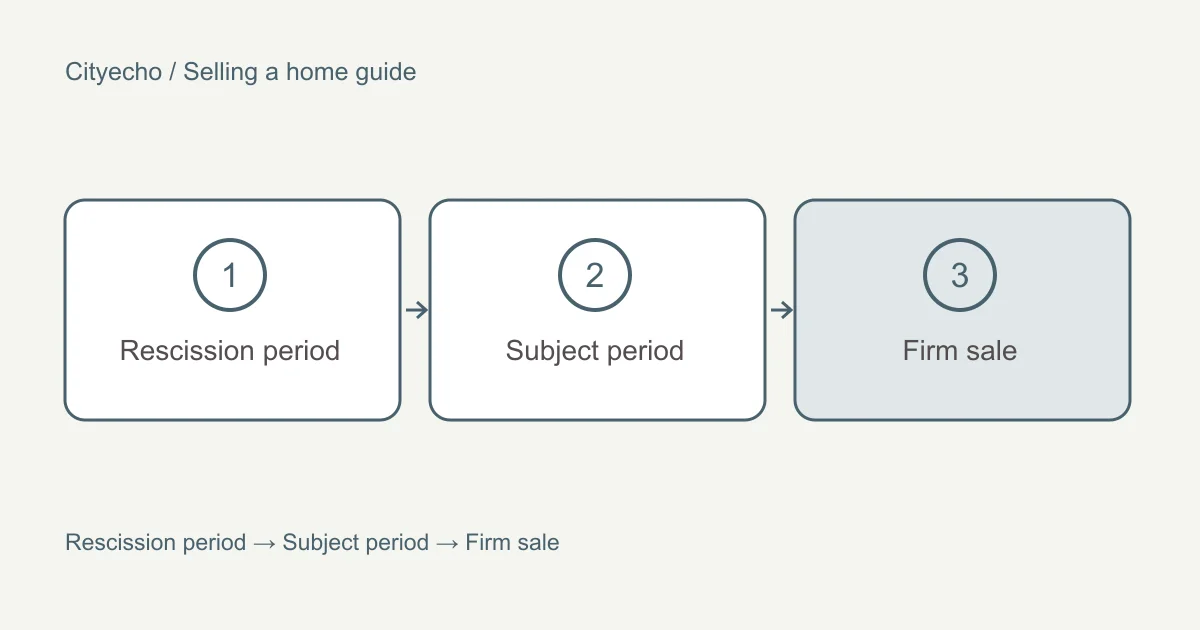
Accepting an offer starts a new stage of the sale. The contract is binding on both sides, but the buyer still has two ways to leave it: the rescission right in the first three business days, and any subject clauses until their removal date. This chapter explains how each works, what the buyer's lender does in that time, and what you can and cannot do while conditions are open.
The chapter is part of the selling a home guide. It follows reviewing offers, where the subjects and dates were agreed, and leads to completion day. The due diligence guide describes the checks a buyer is likely to carry out during this time.
The three business day rescission period
The Home Buyer Rescission Period Regulation gives a buyer of residential real property the right to rescind the contract within three business days. It lists the property types it covers: a detached house, a semi-detached house, a townhouse, an apartment in a duplex or other multi-unit building, a residential strata lot, a manufactured home affixed to land, and some cooperative interests.
The regulation defines a business day as a day other than a Saturday or a holiday. BCFSA's page on the rescission period explains that weekends and holidays are excluded, and that the right applies whether or not a licensee is involved. The regulation exempts property on leased land, a leasehold interest, property sold at auction, and property sold under a court order or court supervision.
Three rules matter most to a seller. Only the buyer can rescind. The right cannot be waived by the buyer or the seller. And the buyer does not have to give a reason.
How rescission works in practice
To rescind, the buyer must notify you in writing before the period ends and pay you 0.25% of the purchase price in the contract. The regulation says the notice must name the property, the buyer, each seller and the date. It is treated as served when it is sent by registered mail to your address in the contract, by fax to your fax number in the contract, or by email with a requested read receipt to your email address in the contract. It can be served on any day.
This makes the contact details in the contract important. Check that your address and email are correct before you sign, and watch that email account for the full period.
The table shows the rescission amount at three sale prices.
| Purchase price | Rescission amount at 0.25% |
|---|---|
| $1,200,000 | $3,000 |
| $1,500,000 | $3,750 |
| $2,000,000 | $5,000 |
If a deposit was paid, the regulation says the rescission amount is paid to you from the deposit, and the rest is returned promptly to the buyer. BCFSA's deposits page confirms that no separate release form is needed in this case. If the buyer's brokerage is not holding the deposit, BCFSA advises the seller to get legal advice on how to recover the money owed.
The subject period
After the rescission period, any subject clauses still apply until their removal date. BCFSA's page on offers from buyers explains that a subject clause sets a condition that must be fulfilled before the sale can go through, while the contract is binding from the moment both sides sign.
The buyer must use every reasonable effort to satisfy the conditions. BCFSA states that subject clauses do not let the buyer avoid their legal responsibilities. When the conditions are fulfilled, the buyer should give you written notice that the subjects are removed. At that point the sale is firm, and both sides must complete on the agreed dates.
If the buyer cannot meet a condition after every reasonable effort, the contract ends and there is no obligation to complete. The deposit is not returned automatically. BCFSA explains that both you and the buyer must sign a release first. If one of you will not sign, the brokerage cannot release the deposit, both of you should get legal advice, and the brokerage may ask to pay the money into court.
What the buyer's lender does
A financing subject gives the buyer time to get a firm mortgage approval for your home. The Financial Consumer Agency of Canada explains that before a lender approves a loan, it will verify that the property meets certain standards, and that these standards vary from lender to lender. It also says the approved mortgage amount depends on the value of the property and the down payment, and that a lender could refuse a mortgage even when the buyer was preapproved.
In practice, this means the lender may want information about your home, and may send someone to see it. Ask your licensee to arrange access in the same way as a showing. If the lender's view of value is lower than the price, the buyer may need more cash, may ask you to change the price, or may be unable to remove the financing subject. Any change to the price or terms needs your written agreement. Ask your licensee to request progress updates from the buyer's licensee as the removal date approaches, so you hear about a financing problem before the last day.
What you can do while conditions are open
You have several choices during the subject period. BCFSA says you remain free to consider other offers until the buyer has removed their conditions. You may have asked, when you accepted, for a clause that lets you require the buyer to remove all subjects within a set time if another acceptable offer arrives. If you have that clause and a new offer comes in, your licensee and lawyer can explain the steps to use it.
You can respond to a request from the buyer. A buyer may ask for more time, for a repair, or for a lower price after an inspection. Each is a proposal to change the contract. You can agree, refuse or propose something else. Any change must be in writing and signed by both sides.
You can keep your records ready. Buyers often ask for documents during this period, such as permits, invoices or reports. Having them in one folder, as the preparing the home chapter suggests, saves time.
What you cannot do
You cannot rescind under the rescission period. That right belongs to the buyer alone. You also cannot waive it for the buyer, even if both of you want to.
You should not sign a second contract without advice. Accepting another offer while the first contract is in force could leave you bound to two buyers. Speak to your lawyer before you sign anything with a second buyer.
You should not hide new information. If you learn of a defect after acceptance, speak to your licensee and your lawyer or notary at once, as the seller disclosure chapter explains.
Keeping track of the deadlines
Write down each deadline as soon as the contract is signed. The first is the end of the rescission period. Ask your licensee and your lawyer or notary to confirm the exact end of that period for your contract, counting business days as the regulation defines them. The next is each subject removal date, with the time of day if the contract states one. After that come the completion, possession and adjustment dates.
Ask your licensee how they will tell you when each deadline passes. You want written confirmation when the rescission period ends without a notice, and a copy of the buyer's written subject removal when it arrives. Keep each confirmation with the contract.
If the sale does not go ahead
A sale can end in the subject period for reasons outside your control. If that happens, first confirm in writing that the contract has ended and how. Then deal with the deposit. If the buyer rescinded, the rescission amount comes to you from the deposit. If a subject was not met, a release must be signed by both sides before the brokerage can pay out the deposit.
Next, look at your listing. Check whether your listing agreement is still in force and when it expires. Review with your licensee what the buyer's inspection or lender raised, if anything. A new fact about the home may change your disclosure, and a lender's concern about value may be a reason to look again at the price, as the pricing chapter explains.
When the sale becomes firm
Once the rescission period has passed and every subject is removed in writing, the sale is firm. Tell your lender that you will be paying out your mortgage, and give your lawyer or notary the contract and your contact details if you have not already. Confirm the completion and possession dates in your calendar, and start planning the move. The journal article on subject free offers explains the case where the buyer made the offer without conditions from the start.