

An offer is a written proposal from a buyer to buy your home on stated terms. When you sign it without changes, it becomes a binding contract. The price is the number most sellers look at first, but the other terms decide how likely the sale is to complete, and when. This chapter explains how an offer is built, what each part means for you, and how to compare two offers whose terms differ.
The chapter is part of the selling a home guide. It follows the showings chapter, and it leads into the chapter on the time after an offer is accepted, which covers the rescission period and subject removal.
How offers reach you
Your licensee must present every offer. Section 30 of the Real Estate Services Rules requires your brokerage to communicate all offers to you in a timely, objective and unbiased manner. Section 46 requires a licensee who receives a signed offer to communicate it promptly unless you instruct otherwise.
BCFSA's page on offers from buyers explains that some sellers accept offers whenever buyers submit them, while others ask buyers to submit offers on a set date and time so all can be considered together. When you are ready, your licensee should go through each offer with you line by line, including every term and clause the buyer added.
Two forms come with each offer. The first is the disclosure of expected remuneration under section 57 of the Rules. It shows, in dollars, what you will pay your brokerage, what your brokerage will pay the buyer's brokerage, and what your brokerage keeps. It is recalculated for each counter offer. The second is the disclosure of the buyer's right of rescission, which can be in the contract or on a separate form.
The parts of an offer
Most offers contain the same parts. The table lists them and the question each one answers for you.
| Part of the offer | What it tells you |
|---|---|
| Buyer's name | Who you are contracting with |
| Price | What the buyer will pay |
| Deposit amount and timing | How much the buyer commits, and when it is paid |
| Subject clauses and removal date | What must happen before the sale is firm, and by when |
| Completion date | When ownership and the price change hands |
| Possession date | When the buyer takes control of the home |
| Adjustment date | The date from which costs such as property taxes are shared out |
| Included and excluded items | Which fixtures and other items stay with the home |
| Assignment terms | Whether the buyer can transfer the contract to someone else |
| Offer deadline | How long you have to respond |
Read the included and excluded items with care. BCFSA's listing page notes that sellers can list fixtures they want to exclude from the sale, such as a fireplace insert or a chandelier. Check that each offer matches what you intended.
Subject clauses
A subject clause, also called a condition precedent, sets a condition that must be fulfilled before the sale can go through. BCFSA explains that the contract is legally binding once both parties sign it, and that subject clauses must be carefully and precisely worded. The buyer must use every reasonable effort to satisfy them. BCFSA adds that a subject clause does not let the buyer avoid their legal responsibilities under the contract.
BCFSA lists common subjects: a satisfactory building inspection, a completed Property Disclosure Statement, financing, the lender's approval to assume your mortgage, the sale of the buyer's present home, and for a strata lot, a review of the strata documents. BCFSA also notes that the buyer is in effect asking you to take the home off the market while they work on the conditions.
For each subject, ask three questions. What exactly must happen? Who decides whether it is satisfied? When is the removal date? A subject that depends on the sale of the buyer's own home has a different level of risk from a subject for an inspection that is already booked.
Deposits
BCFSA's page on deposits explains that the buyer usually provides a deposit with the offer or after it is accepted, and that it is usually held in the trust account of the buyer's brokerage. The brokerage holds it as a stakeholder, which means as a neutral party for the transaction.
If the buyer does not remove a subject, the deposit is not returned automatically. Both you and the buyer have to sign a separate release form, except when the buyer is using the rescission right. If one of you will not sign, legal advice is needed, and the brokerage may ask to pay the funds into court. When a buyer rescinds within the rescission period, the brokerage pays you the rescission amount from the deposit and returns the rest to the buyer, with no release needed. For how deposits are held and applied at completion, read the deposits and adjustments chapter in the costs and taxes guide.
Compare deposits on two points: the amount, and when it is paid. Ask your licensee and your lawyer what each arrangement would mean for you if the buyer did not complete.
Dates
Each offer carries several dates. The subject removal date decides how long the sale stays conditional. The completion date decides when you receive the money. The possession date decides when you must move out. Check that the completion and possession dates fit your own move, and, if you are buying another home, that they fit that purchase too.
A long subject period or a late completion date can be the right answer for some sellers. It gives you time to find your next home. It also keeps your home off the market for longer. The completion day chapter explains what happens on the dates you agree.
Comparing two offers with different terms
Two offers can look close on price and be far apart on risk. Put them side by side and write down, for each one, the price, the deposit and when it is paid, each subject and its removal date, and the completion and possession dates. Then ask one question of each offer: what could stop this sale from completing, and when would I find out?
Consider an example. Offer A has a higher price, a financing subject, an inspection subject, a subject for the sale of the buyer's own home, and a deposit paid after subject removal. Offer B has a lower price, no subjects, a deposit paid on acceptance and the completion date you asked for. Offer B has a smaller number on the first line. Offer A depends on three events outside your control, and you will not know for some time whether they happen. Which offer is better depends on how much weight you give to certainty and timing. Your licensee should explain each difference, and you make the choice.
The journal article on what sellers should know about multiple offers covers the case where several offers arrive together. The article on subject free offers explains what a buyer gives up when they remove all conditions.
Your four choices
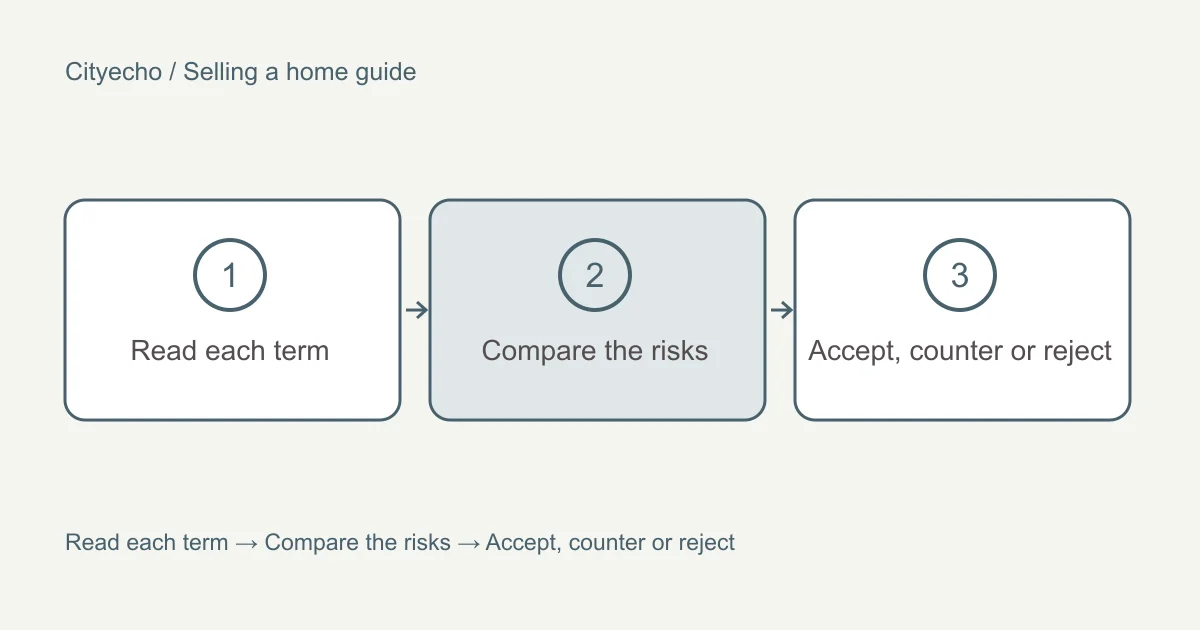
BCFSA describes four responses to an offer. You can accept it without changes, which forms a binding contract subject to the rescission period. You can reject it, since you have no obligation to accept or counter. You can ignore it, in which case it ends when its deadline passes. Or you can make a counter offer.
A counter offer needs care. BCFSA explains that changing anything at all on the buyer's offer rejects it, and that if the buyer does not accept your counter offer, you cannot go back and accept the original. Counter offers can pass back and forth until both sides agree or one side stops.
Assignment terms
BCFSA's answers to common questions explain that licensees must include standard assignment terms in any offer they prepare, unless their client instructs otherwise. The terms say the contract must not be assigned without the seller's written consent, and that the seller is entitled to any profit from an assignment. Check that each offer contains these terms. If a buyer's offer leaves them out, ask your licensee what that means for you.
After you accept
Once you accept, the Home Buyer Rescission Period begins. A buyer of a detached house can rescind within three business days by giving written notice and paying you 0.25% of the price. BCFSA states that this right cannot be waived by the buyer or the seller.
Keep a signed copy of the accepted contract, every counter offer and each remuneration disclosure in one place. Send the contract to your lawyer or notary as soon as it is signed, so they can open a file and tell you what they will need from you before completion.