

A seller knows things about the home that no buyer can see during a viewing. The law in British Columbia requires some of that knowledge to be shared. This chapter explains what you must disclose, how the Property Disclosure Statement works, and what can happen when an answer turns out to be wrong.
The chapter is part of the selling a home guide. Disclosure comes early in the sale. It follows the listing agreement and runs at the same time as preparing the home, because some of the repairs and records you gather will change what you have to say. For a shorter look at the form itself, read the journal article on the Property Disclosure Statement in BC.
The seller's own duty
BCFSA's page on material latent defects explains that a seller has a duty at common law to disclose latent defects to a buyer. A latent defect is one that cannot be found through a reasonable inspection of the property. The duty covers a known latent defect that makes the home dangerous or potentially dangerous to the people living there, unfit to live in, or unfit for the purpose the buyer is buying it for, if the buyer has told you that purpose.
This duty applies whether or not the buyer asks you a question. A buyer who never raises the subject of the basement is still owed disclosure of a leak you know about and they could not find. The word that matters most is known. The duty is about what you know, so the first task is to write down everything you know about the home's condition and history.
Common law duties come from court decisions. They can be hard to apply to a particular home without advice. If you are unsure whether a problem fits the definition, BCFSA's advice is to speak to your licensee or get independent legal advice.
Your licensee's wider duty
Your licensee has a separate and wider duty. Section 59 of the Real Estate Services Rules defines a material latent defect as a material defect that cannot be found through a reasonable inspection. It includes the three kinds of defect in the common law duty and adds three more. The table sets them side by side.
| Type of defect | Seller's common law duty | Licensee's duty under section 59 |
|---|---|---|
| Makes the home dangerous or potentially dangerous | Yes | Yes |
| Makes the home unfit to live in | Yes | Yes |
| Makes the home unfit for a purpose the buyer made known | Yes | Yes |
| Would cost a great deal to fix | Not listed by BCFSA | Yes |
| A local government notice that something must or should be fixed | Not listed by BCFSA | Yes |
| A lack of appropriate municipal building and other permits | Not listed by BCFSA | Yes |
A licensee who acts for the seller must disclose any known material latent defect to all other parties promptly, and before any agreement to buy or sell is made. BCFSA's guidance for licensees says this disclosure must be in writing and separate from any service agreement or contract. The buyer receives it before agreeing to a contract, so they can decide whether the defect affects their decision.
Timing matters here. The duty is to disclose promptly and before any agreement is entered into. If your licensee learns of a defect after the home is listed, for example from a buyer's inspection on an earlier offer that later fell through, the disclosure is due to the next buyer before that buyer signs.
When you and your licensee disagree
Section 59 also deals with a seller who does not want a defect disclosed. If a client tells the licensee to withhold a required disclosure, the licensee must refuse to provide further trading services to that client for that sale. BCFSA's answers to common questions say the same thing in plain terms: if you tell your licensee about a material latent defect and do not disclose it yourself, the licensee must disclose it.
Your licensee should discuss these obligations with you early in the relationship. Raise any doubtful item at your first meeting. A disagreement found after the home is listed can delay the sale while the question is settled.
Examples BCFSA gives
BCFSA lists common examples of material latent defects. The list is a starting point for your own notes.
- High levels of radon.
- A basement that leaks when it rains.
- Structural damage to the property.
- Failure of the building envelope, where water gets in.
- Underground storage tanks on the property.
- Problems with the quality or quantity of drinking water.
- Damage from illegal use, such as a grow operation, that was never remediated.
BCFSA adds that new electrical or gas installations or renovations done without the proper permits and inspections are also examples. Past work without permits is covered in more detail in the preparing the home chapter, because it is often better to find out the permit history before you list. Buried oil tanks are a common question in older neighbourhoods, and the journal article on oil tank searches explains how buyers look for them.
The Property Disclosure Statement
BCFSA states that British Columbia has no prescribed form for disclosing property information. The common way to do it is a Property Disclosure Statement, which is a voluntary form the seller completes about the condition of the home. BCFSA describes completing it accurately and to the best of your knowledge as best practice and in the interests of all parties.
A buyer may ask for it as a condition. BCFSA's page on offers from buyers lists a completed Property Disclosure Statement among the subjects a buyer might include. If you have already disclosed a material latent defect in writing on the statement, BCFSA's consumer guide to disclosures explains that your licensee does not need to give the buyer a second disclosure of the same defect.
There is also a form called the Property No Disclosure Statement. It lets a seller decline to make any statement about the property. BCFSA warns that using it may put you at risk of a legal claim later if latent defects you knew about are found after the sale. It may also make the home harder to sell, because buyers will ask why no disclosure was given. BCFSA tells buyers who receive it to treat it as a sign that further checks are needed and to confirm with their lender that it is enough for financing.
Filling in the form accurately
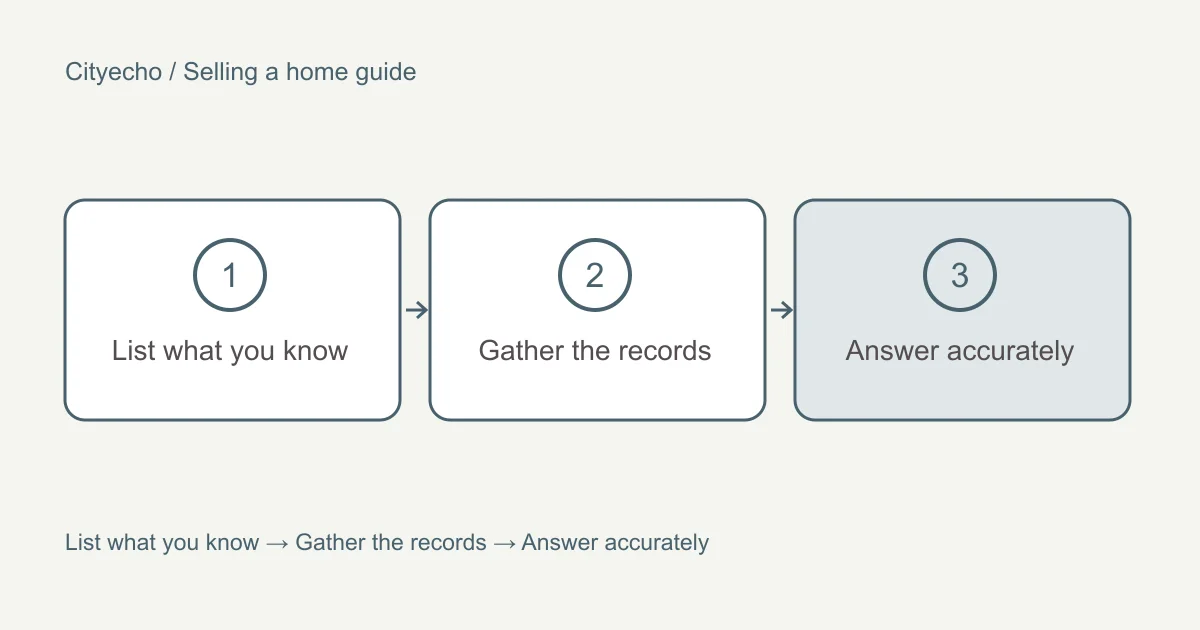
Answer each question from what you know. Where you do not know, say so. A guess written as a fact can become an inaccurate answer. If you bought the home with a disclosure statement from the previous owner, do not copy their answers without checking them against your own experience.
Gather the records behind your answers before you begin. Useful records include permits and final inspections, invoices for repairs and renovations, warranty papers, reports from inspectors or engineers, and any notice from the city. Keep copies in one folder. When a buyer's licensee asks where an answer came from, you can show the document.
If more than one person owns the home, go through the form together. Each owner may know about different repairs, events or notices, and the answers should reflect what all of you know.
Read each question slowly, and check whether it asks about the present condition or about the past. If a question is unclear, ask your licensee what it means, or ask a lawyer. Sign and date the form only when you are satisfied with every answer.
The risk of an inaccurate answer
BCFSA explains that completing the statement accurately helps protect all parties from litigation if a defect is found later and it is proven the seller knew about it. The reverse is also true. An answer that turns out to be wrong, on a matter you knew about, can lead to a legal claim by the buyer after completion.
For a buyer, BCFSA's advice after finding a defect is to seek independent legal advice. If the buyer believes a licensee failed to make a required disclosure, they can contact BCFSA or file a complaint. A seller who is contacted about a defect after the sale should also speak to a lawyer before replying.
If you learn something new before completion, such as a leak that appears after you signed the form, speak to your licensee and your lawyer or notary at once. Ask how the new information should be given to the buyer. The chapter on the time after an offer is accepted covers the period when the buyer is still checking the home, which is when new information is most likely to matter to them.