

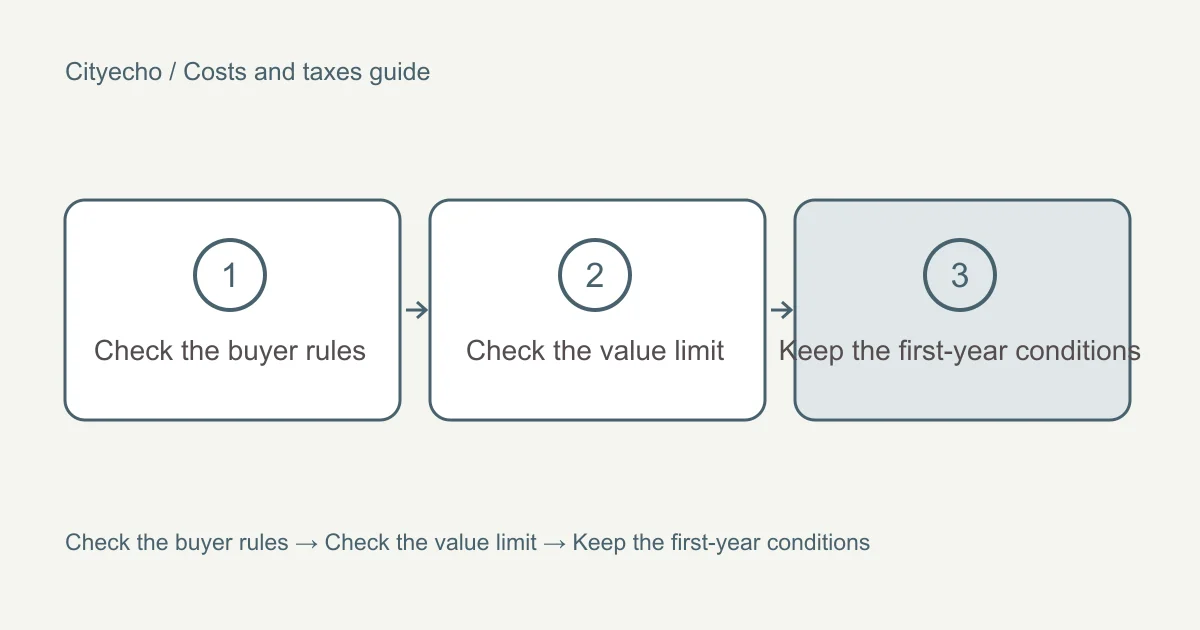
Two provincial programs can reduce or remove property transfer tax on a home you will live in. The first time home buyers' program helps a buyer who has never owned a principal residence. The newly built home exemption helps any qualifying buyer of a new home, first-time or not. Both are claimed on the property transfer tax return, and both carry conditions you must keep meeting after you move in.
This chapter belongs to the costs and taxes guide. It assumes you know how the general tax is calculated, which the property transfer tax chapter explains. All figures below come from the province's pages as they read on 30 September 2026. The province changes thresholds from time to time, so check the current page before you rely on a number.
The two programs side by side
The programs have different buyer rules and different value limits. The table below summarises the figures in effect for transfers registered on or after 1 April 2024, as the province listed them on 30 September 2026.
| Feature | First time home buyers' program | Newly built home exemption |
|---|---|---|
| Who can claim | First-time buyers only | Any qualifying buyer |
| Full exemption up to | $835,000 fair market value | $1,100,000 fair market value |
| Partial exemption range | Above $835,000 and below $860,000 | Above $1,100,000 and below $1,150,000 |
| Size of the saving | Tax on the first $500,000 | The full tax at or below the limit |
| Move in within | 92 days of registration | 92 days of registration |
| Live there until | The first anniversary of registration | The end of the first year |
A buyer of a newly built home who is also a first-time buyer may qualify for both programs. Above a value of $500,000, the newly built home exemption removes more tax, because it covers the whole tax up to its limit while the first-time exemption stops at $8,000. The province's first-time buyer page points first-time buyers of a new home to the newly built home exemption. The newly built home page asks anyone who claimed the first-time program but wants the newly built exemption instead to contact the property transfer tax office.
The first time home buyers' program
The province's first time home buyers' program page sets rules for the buyer and rules for the property. You must meet every rule on the date the property is registered.
The buyer must be a Canadian citizen or permanent resident. You must either have lived in B.C. for at least a year immediately before registration, or have filed at least two income tax returns as a B.C. resident in the last six tax years. You must never have owned a registered interest in a property that was your principal residence, anywhere in the world. You must also never have received this exemption or its refund before.
The property must be used only as your principal residence. It must be 0.5 hectares (1.24 acres) or smaller and contain only residential buildings. Its fair market value must be $835,000 or less for a full exemption, a limit in effect since 1 April 2024. Before that date the limit was $500,000.
How much the first-time exemption is worth
The province's exemption amount page gives the method. If the fair market value is $500,000 or less, the exemption equals the full tax. Above $500,000 and up to $835,000, the exemption is $8,000, which is the tax on the first $500,000. Between $835,000 and $860,000 the exemption is reduced in proportion.
Here is a worked example on a hypothetical $800,000 home. The general tax is $2,000 on the first $200,000 and $12,000 on the next $600,000, for a total of $14,000. The exemption takes away $8,000, so the buyer pays $6,000.
The saving is fixed in dollars, so it matters most at lower prices. Above $860,000 the program gives no exemption at all. Check the price of each home you are considering against the limit before you count on the exemption. Our journal article on stacking first-time buyer programs shows how the provincial exemption sits beside federal savings programs.
The newly built home exemption
The province's newly built home exemption page defines a newly built home by occupancy. A house on vacant land qualifies if nobody has lived in it since it was built. A unit in a new strata building qualifies if nobody has lived in it. The list also covers a manufactured home placed on vacant land, a house moved to a new vacant lot, a house created when an existing building and lot are divided, and a building converted from non-residential use.
The transfer must be registered after 16 February 2016 and must be the first registration of the property with a completed building. The buyer must be a Canadian citizen or permanent resident. The property must be in B.C., used only as your principal residence, and 0.5 hectares or smaller. The full exemption applies up to $1,100,000 of fair market value, a limit in effect since 1 April 2024; before that date the limit was $750,000.
The newly built home exemption amount table shows how the phase-out works. At $1,100,000 the tax is $20,000 and the exemption is $20,000, so nothing is payable. At $1,110,000 the tax is $20,200 and the exemption falls to $16,160, leaving $4,040 to pay. At $1,150,000 the exemption ends.
The exemption is claimed with code 49 on the property transfer tax return. If you bought vacant land, paid the tax, and then built a new home on it, the province describes a refund route. It applies where the land value plus the cost of building is $1,100,000 or less for land registered on or after 1 April 2024.
Conditions you must keep after registration
Both programs set rules for the first year of ownership. You must move into the home within 92 days of the registration date. You must then keep living there as your principal residence until the first anniversary of registration. You claim the exemption at registration, and you keep it only if you meet these conditions during the first year.
The province says you may keep part of the exemption if you move out before the first year ends. For the newly built home exemption, the page states that you repay a portion based on the number of days you moved out early. For the first-time program, the province asks anyone who fails to move in on time, or moves out early, to contact the property transfer tax office.
Two events let you keep the full exemption. If the owner dies, or the property is transferred because of a separation agreement or a court order under the Family Law Act before the first anniversary, the province says the exemption is kept.
If a condition is broken
Plans change after completion. A job may move, a family may grow, or a tenant may be needed to cover costs. Before you move out or rent the whole home in the first year, contact the province's property transfer tax office and your lawyer. Ask what portion of the exemption you would need to repay and when.
The province reviews applications. Its first-time buyer page states that a false declaration about past ownership, or about a past exemption, carries a penalty equal to the amount of the exemption or refund claimed. That penalty is in addition to repaying the exemption. Keep records that show when you moved in and that the home was your principal residence, such as utility accounts and your driver's licence address.
Renting part of the home during the first year raises its own questions. The first-time program requires the home to be used only as your principal residence. The province lists a partial exemption where there is another building on the property besides the principal residence. Ask your lawyer how a suite or a second dwelling affects your claim before registration.
Refunds when the exemption was missed
If you qualified but the exemption was not claimed at registration, you can apply for a refund. For both programs, the refund window opens on the first anniversary of registration and closes 18 months after the registration date. You still need to meet the move-in and occupancy conditions.
A buyer who was not yet a citizen or permanent resident at registration has a separate route. For the first-time program, the province allows a refund application if you gain that status on or before the first anniversary of registration. The newly built home page gives a similar rule for status gained within 12 months of registration.
Where these exemptions fit in your budget
An exemption lowers one closing cost, the property transfer tax. The down payment, the legal fees and the completion-day adjustments stay the same. If the home is newly built, federal sales tax may also apply, with its own rebate for first-time buyers; the sales tax on new homes chapter covers it.
The mortgage rules are separate again. A first-time buyer may have access to a longer amortization on an insured mortgage, which is explained in the mortgage qualifying chapter. Keep each program on its own line in your budget, with its own conditions and deadlines, so that losing one does not surprise you.