

For a buyer with a mortgage, home insurance is part of getting the money. BCFSA notes that a buyer who cannot obtain property insurance may, by extension, be unable to obtain mortgage financing. For an older detached house, the insurer may ask for details about the building that take time to gather, so the work belongs early in the purchase.
This chapter belongs to the costs and taxes guide. It explains why cover must be in place before completion, what insurers look at, and what can make cover harder to obtain. Insurance availability and price are decided by each insurer. Nothing in this chapter predicts whether an insurer will offer cover for a particular home, or at what price.
Why a lender looks for cover before completion
CMHC's worksheet to estimate the total cost of a home purchase lists property insurance among the up-front costs, next to legal fees and the down payment. BCFSA's wildfire advisory, covered below, shows why it matters: a buyer who cannot obtain property insurance with fire cover may, by extension, be unable to obtain mortgage financing.
The reason sits in the mortgage. The house is the lender's security for the loan. The Financial Consumer Agency of Canada's home insurance page explains that a policy on a mortgaged home usually includes a loss payee clause, which makes the lender the beneficiary. After a covered loss, the insurer may pay the lender up to the mortgage balance, or pay you so that you can repair the home.
Ask your lender and your lawyer or notary what proof of cover they need and by what date. Ask your lender exactly what it needs to see, such as the policy number, the named insured, the lender's name as loss payee, and the start date. The mortgage qualifying chapter explains the difference between a preapproval and approval on the home, and insurance is part of that second step.
What home insurance covers
The agency describes home insurance as protection for your home and belongings against theft, loss or damage. A policy may also cover extra living costs if you cannot live in the home for a while. It may include liability cover for injury to visitors and for damage you cause to someone else's property.
The same page lists what a policy usually leaves out. Unexpected events such as earthquakes and floods are usually not covered, and you may need to buy extra coverage for them. Damage an insurer considers predictable and linked to maintenance is also excluded. The agency gives the example of pipes that freeze while an owner is away for more than four days in a row in cold weather.
The agency also explains two ways a claim can be settled. Actual cash value pays what an item cost new, less depreciation. Replacement value pays what it costs to replace the item with one of similar quality. Ask which basis each part of a quote uses.
What an insurer weighs on an older detached house
The agency lists factors an insurer may consider when setting a premium. They include:
- the type of home, such as a single family house or a condo
- the home's materials, age, size, location and replacement value
- the value of the property and contents to be insured
- the distance to a fire hydrant or a fire station
- the crime rate in the neighbourhood
- your claims history
- the type of policy and coverage you choose, and your deductible
An older house brings age and building materials to the front of that list. Ask each insurer which details it needs about the building. Gather what you can from the seller's disclosure and your inspection report about the roof, the electrical system, the plumbing and the heating system, so that you can answer accurately. The agency tells readers to read a policy carefully before signing and to ask the agent or broker about anything they do not understand.
The due diligence guide explains how an inspection fits into your review of a house before you remove conditions. Ask your inspector to note the age and type of the major systems where they can see them.
What can make cover harder to obtain
Several facts can lead an insurer to ask more questions, add conditions, raise the price or decline. The agency's list of pricing factors shows some of them: the building's characteristics, the location, and your claims history. Each insurer applies its own rules, so one insurer's answer does not tell you what another will say.
Use of the home matters too. The agency says that if you rent part of your home, you must tell your insurer. It says a home-based business must also be disclosed, and that using your home for purposes the insurer does not know about may cancel your policy. If you plan a suite or a home office with clients, raise it before the policy is bound.
Wildfire risk is a separate concern. BCFSA's wildfire advisory, number 24-013 dated 15 May 2024, says a sale in an active wildfire zone may be delayed or may collapse if the buyer cannot obtain property insurance with fire coverage, and by extension mortgage financing. It notes that the BC Wildfire Service tracks wildfire season as 1 April to 31 October.
Contract terms that deal with insurance
BCFSA's advisory describes two optional contract terms. The first is a fire or property insurance condition, which gives the buyer time to arrange cover before the contract becomes firm. The second is a wildfire clause. It allows one extension of the completion, adjustment and possession dates, of up to 30 days, if a wildfire prevents the buyer from obtaining fire insurance.
The wildfire clause has limits. It covers wildfire threats only, and it does not include floods. The buyer must show best efforts to obtain fire insurance and must not wait until the last minute. If the buyer gets insurance during the extension, the seller may bring the completion date forward to five business days after the buyer's notice.
The advisory says a prudent licensee will advise a buyer to include an insurance condition, get binding fire insurance as soon as possible, and keep a log of calls and emails to insurance brokers if cover cannot be found. Discuss whether these terms suit your offer with your real estate professional and your lawyer.
Questions to ask each insurer
Use the same list with every insurer so that the answers can be compared. Ask for the answers in writing, with the date.
- Will you offer cover on this address from the completion date, and on what conditions?
- What details do you need about the roof, wiring, plumbing and heating?
- Is the building covered at replacement cost, and what limit applies?
- What are the deductibles for ordinary claims, for water damage and for any optional cover?
- Is earthquake cover available, and is flood cover available, for this address?
- How do you treat a rented suite or a home office with visitors?
- What proof of cover will you send to my lender and my lawyer, and when?
- Can the premium be paid monthly, and is there a fee for doing so?
If an agent or broker quotes on your behalf, ask which insurer the quote comes from. The agency's page says premiums vary from one insurer to another and suggests shopping around and comparing quotes before choosing one.
A timeline that leaves room
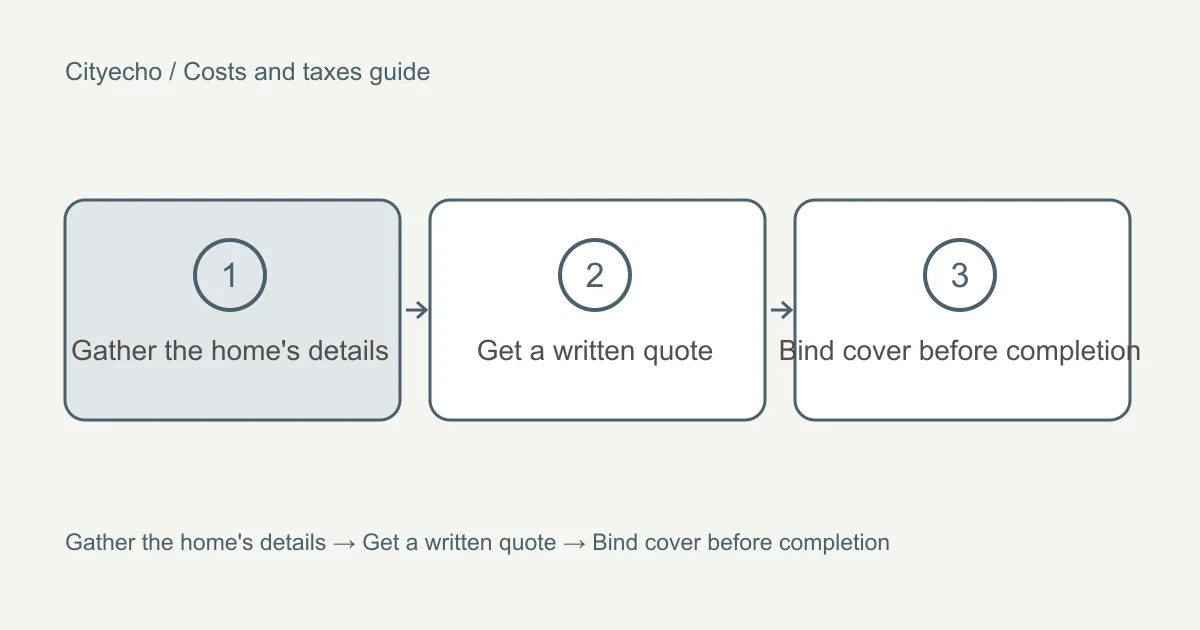
Start before you write an offer. Ask an insurance agent or broker what they need to quote on a detached house, and have that list ready for each home you consider. Once your offer is accepted, send the details the same day and ask for a written quote.
Before you remove your conditions, confirm that an insurer will bind cover from the completion date, and on what terms. If an insurer declines, ask for the reason in writing and try another insurer. Keep your lender and your lawyer informed. If you cannot find cover on terms you can accept, tell them at once, because the completion date in the contract still applies.
After completion, read the full policy that arrives. Check the address, the insured names, the lender as loss payee, the limits and the deductibles. Our journal article on home insurance before completion gives a checklist for that review.
How insurance fits into your costs
Ask the insurer when the first premium is due and whether you can pay monthly or once a year. The insurer sets the amount and the payment options. Put the quoted premium into your budget next to property tax and utilities, because it recurs each year.
CMHC's purchase product requires a home that is suitable and available for full-time, year-round occupancy, and a lender will look at the same property the insurer does. If either one raises a question about the home, the deposits and adjustments chapter explains what is at stake for your deposit if a firm contract cannot be completed. The CMHC purchase product page lists the property requirements for an insured loan.