

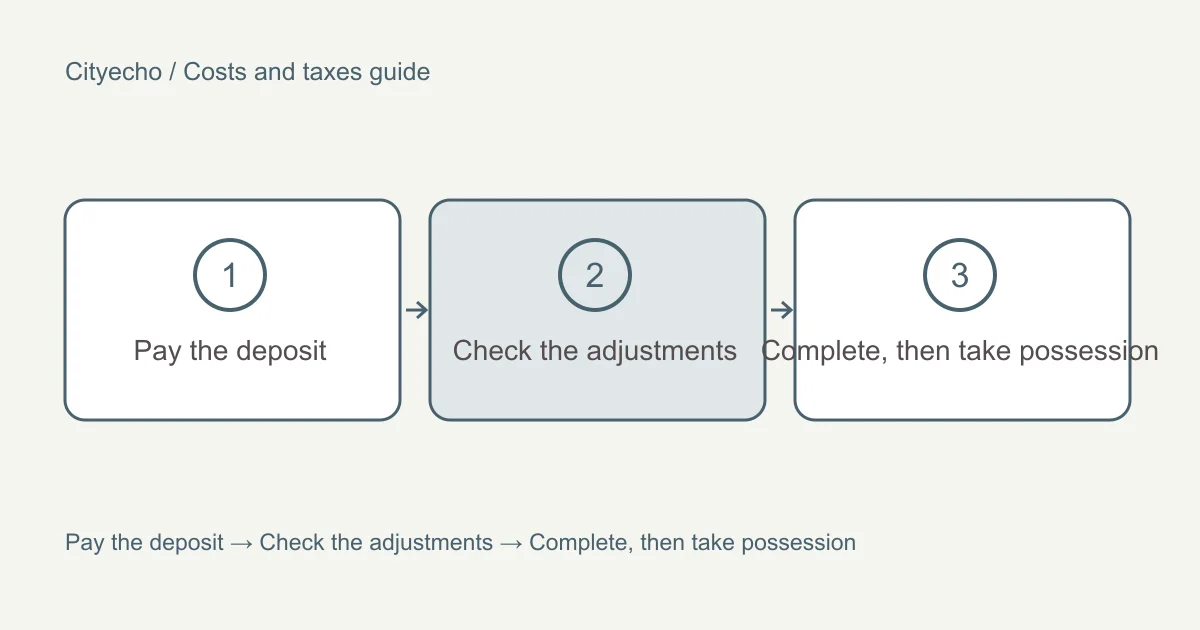
Two amounts of money frame every purchase. The deposit is paid early, when the offer is made or accepted. The balance is paid on completion day, after the lawyer or notary has worked out every credit and charge on the statement of adjustments. This chapter explains how the deposit is held, how the statement is built, and how the three key dates in the contract differ.
It belongs to the costs and taxes guide. The taxes that feed into the statement are explained in the property transfer tax chapter and the annual property tax chapter. The legal fees and registration charges are covered in the legal and registration costs chapter.
How a deposit is held
BCFSA's buyer's page on deposits says you usually pay a deposit with your offer or after it is accepted. The deposit is usually held in your real estate licensee's brokerage trust account. The brokerage holds it as stakeholder: as a neutral party, for neither the buyer nor the seller.
BCFSA's deposits information for licensees adds detail. A licensee who receives a deposit must deliver it promptly to the brokerage. If a deposit is late or is not received as the contract requires, the licensee must tell the managing broker at once, and the managing broker must tell all parties in writing.
BCFSA also notes that a deposit is not needed to make a contract binding. The mutual promises of the buyer and seller are enough. The contract sets the amount of the deposit and the deadline for paying it. If anyone other than a brokerage will hold the deposit, BCFSA advises getting independent legal advice about how it will be held and released.
When a deposit is released
A deposit held as stakeholder is released by agreement of both parties, by rescission, or by a court. BCFSA says that if you do not remove subject clauses in your favour, you do not automatically get your deposit back. Both you and the seller must sign a separate release form, except when you exercise your right of rescission.
If one party will not sign, BCFSA says you will need legal advice, because the brokerage cannot release the deposit without agreement. With no agreement, the brokerage may ask to pay the funds into the B.C. Supreme Court so that a judge can decide where the deposit goes.
Interest on a deposit goes to the Real Estate Foundation of B.C. unless the contract says it is payable to the buyer or the seller. For interest to follow the parties' instructions, BCFSA says the funds must be held in a separate designated trust account.
The home buyer rescission period
BCFSA's page on the home buyer rescission period says the province introduced it on 3 January 2023. It gives a buyer of an eligible residential property up to three business days after acceptance to rescind the offer. Weekends and holidays do not count. The right cannot be waived by the buyer or the seller, and some property types are excluded.
A buyer who rescinds pays the seller a fee of 0.25% of the offer price. On a hypothetical $1,200,000 purchase, that is $3,000. BCFSA's deposits information says the fee is paid to the seller from the deposit and the rest is released to the buyer, with no separate release agreement needed.
Presale deposits
Presale purchases follow different rules. BCFSA's consumer guide to presale purchases says you typically pay an initial deposit when you sign, and you may owe more deposits on a schedule set in the contract. All deposits are held in trust by a lawyer, notary or real estate brokerage. The balance is due when the developer confirms the home is ready.
The same guide says that if the developer does not complete the project, it must return your deposit but does not have to pay additional compensation. If you cannot complete and the developer will not consent to an assignment, you may lose your deposit. Our journal article on presale deposit schedules explains how those payment schedules work.
Three dates in the contract
The contract of purchase and sale sets three dates. BCFSA's page on completing your purchase defines two of them. The completion date is the day legal ownership passes from the seller to you in exchange for the purchase price. The possession date is the day you can move in. BCFSA notes that the two are not necessarily the same day.
The third is the adjustment date. The standard contract of purchase and sale attached to Ministerial Order M362/2014 on BC Laws says the buyer will assume and pay all taxes, rates, local improvement assessments, fuel, utilities and other charges from, and including, the date set for adjustments. That date splits ongoing costs between seller and buyer. Contract forms are revised over time, so read the adjustment clause in your own contract with your lawyer or notary.
| Date | What happens | Source of the definition |
|---|---|---|
| Completion date | Ownership transfers and the price is paid | BCFSA |
| Adjustment date | Ongoing costs become the buyer's from this date | Standard contract on BC Laws |
| Possession date | The buyer can move in | BCFSA |
BCFSA's wildfire clause advisory shows how the three dates move together. The optional clause it describes allows one extension of the completion, adjustment and possession dates if a wildfire stops a buyer getting fire insurance.
What the statement of adjustments shows
BCFSA says your lawyer or notary prepares a statement of adjustments outlining all monies owed by you and the funds you will need to complete. It starts from the purchase price and subtracts the deposit already paid. It then adds or subtracts items that are shared between seller and buyer by the adjustment date.
CMHC's worksheet to estimate the total cost of a home purchase lists a prepaid property taxes and utility bills adjustment among the up-front costs. It covers amounts the seller has already paid for a period after the adjustment date. Ask your lawyer or notary to show, with the statement, the property transfer tax, their fees, the registration charges and the mortgage money the lender will send, so that you can see the exact amount you must provide.
Read the statement line by line before you sign. Check the price, the deposit, the adjustment date, the tax and utility amounts, and the name of anyone the funds are paid to. Our journal article on closing costs for B.C. buyers gives a sample layout.
Questions to settle before you pay the deposit
Settle these points in writing before the deposit leaves your account:
- Who will hold the deposit, and in which trust account?
- What is the amount, and what is the deadline for paying it?
- How will you pay it, and how long will the transfer take to arrive?
- Does the contract say who receives any interest earned on it?
- Which subject clauses protect you, and what is the deadline for each one?
- Does the rescission period apply to this property, and when does it end?
Your real estate professional can answer the first four from the contract and the brokerage's process. Your lawyer can explain the subject clauses and the rescission period. Keep the deposit receipt with your purchase records. It appears again as a credit on the statement of adjustments, and the two amounts should match.
Property tax and utility adjustments in Coquitlam
Local billing dates decide which way an adjustment runs. Coquitlam's property tax page says 2026 taxes were due on 2 July 2026 and covered 1 January to 31 December 2026. If you complete in August after the seller has paid the 2026 bill, the adjustment clause means you repay the seller for the days from the adjustment date to 31 December. If you complete in April, before the bill is paid, ask your lawyer how the seller's share for 1 January to the adjustment date will be credited to you, so that you can pay the full bill by the July due date. BCFSA's list of seller costs includes the seller's share of the year's property tax when it has not yet been paid.
Utilities follow their own calendar. Coquitlam's utility fee page says the 2026 utility bill was due on 31 March 2026 and covered the full calendar year. For a single-family home in 2026, the bill was $1,661 with a small garbage cart, $1,753 with a medium cart and $1,908 with a large cart. A completion after 31 March can include a credit to the seller for the part of that bill after the adjustment date. Port Coquitlam's utility bills were also due on 31 March 2026.
The home owner grant is claimed separately with the province. A buyer can claim it for the year of purchase only if the previous owner did not claim it for that property, so ask your lawyer how the grant is shown on the statement.